
 Jeffrey Wells


BFCA kowtowing
The 2007 Critics Choice Award nominees from the Broadcast Film Critics Association. Due respect but no comment. Wait, here’s one: If the BFCA finds the courage to not give their Best Supporting Actress award to Amy Ryan but to I’m Not There‘s Cate Blanchett instead, they’ll be at least partially redeemed in my eyes.
Not that the BFCA needs to care one iota about my judgments in this matter. I’m just saying that the Amy Ryan thing has become a slight issue (critics groups falling over like synchronized bowling pins, one after another), and the BFCA has a real chance to show that it’s about more than just shameless kowtowing.
Beale on Muslim images in movies
“Possibly the most striking thing about The Kite Runner, opening Friday, is that the film’s lead characters are all Muslims, but not one of them is a terrorist, convenience store owner, cab driver or woman wearing an all-enclosing burqa.” — from a 12.12.07 Newsday article by Lewis Beale.
Sam Riley in a rain forest
A “Lunch with David” interview with Control‘s Sam Riley, posted on 12.10, was live today but went dead this evening. Let’s forget it, shall we?
Bowling pin
There Will Be Blood “becomes an increasingly violent (and comical) struggle in which each man humiliates the other, leading to the murderous final scene, which gushes as far over the top as one of Daniel [Plainview]’s wells. The scene is a mistake, but I think I know why it happened.

“[Paul Thomas] Anderson started out as an independent filmmaker, with Hard Eight (’96) and Boogie Nights (’97). In Blood, he has taken on central American themes and established a style of prodigious grandeur. Yet some part of him must have rebelled against canonization. The last scene is a blast of defiance — or perhaps of despair. But, like almost everything else in the movie, it’s astonishing.” — from David Denby‘s review in teh 12.17 New Yorker.
Amy Ryan to the infinite
After the fifth or sixth Best Supporting Actress critics award for Amy Ryan came in, I began to shake my head. Then I threw up my hands. Scratch a critics awards group and they’ll all feign ignorance or indifference about the choices of the other groups, but c’mon…every last critic in the U.S. of A. group is in love with a vivid but broad caricature of a reprehensible low-life? AmyRyanAmyRyanAmyRyanAmyRyan, etc.
San Francisco vs. Chicago
Congratulations to the San Francisco Film Critics Circle for having the character and conviction to name Andrew Dominik‘s The Assassination of Jesse James by the Coward Robert Ford as their Best Picture of 2007. As opposed to, for example, the divided Chicago Film Critics who put up Zodiac‘s David Fincher as a Best Director contender but lacked the intestinal fortitude to nominate Zodiac — a film that deserves to be honored as much if not more than any other ’07 film — for Best Picture.
Eva Mendes Cleopatra
I’m sorry, but I have trouble responding positively to beautiful actresses like Eva Mendes who insist on wearing mascara and eyeliner. I look at this PETA ad and all I see is the Cleopatra eye makeup and I say to myself, “Why?”

Tony Grebell
Because his brilliant, blunt-mouthed, smart-ass CIA character in Charlie Wilson’s War is highly amusing, Philip Seymour Hoffman is considered a slam-dunk Best Supporting Actor nominee. But Toby Kebbell, a 25 year-old British actor, does the exact same routine in Control — i.e., playing a brilliant, blunt-mouthed, smart-ass band manager named Rob Gretton — and nobody has said jack squat.
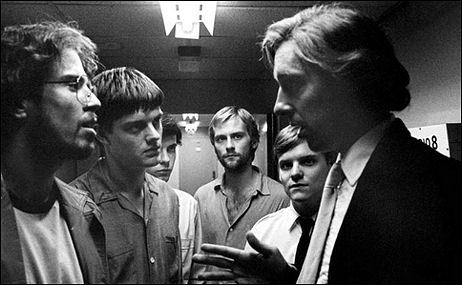
(far left) Toby Kebbell as Rob Gretton in Anton Corbijn’s Control
Gebbell’s version is arguably more entertaining than Hoffman’s, and he delivers a bit more humanity and soul in the process…and Hollywood handicappers haven’t so much as mentioned the guy. So I’m mentioning him. Here’s an mp3 clip of Kebbell doing his here-I-am bit with the Joy Division members.
I should have brought up Gebbell a couple of months ago, not that anyone would have paid the slightest attention. I admit he’s got a dorky-sounding name that’s hard to remember (I had to check his IMDB page three times to get it straight), and it should be spelled like “pebble” instead of “Gebbell.” Perhaps with the Control screeners finally going out…who knows? At least Kebbell will get some work out of it. Maybe.
The WGA award show reality
With nearly everyone admitting that the WGA strike is going to last a good while (i.e., into March or beyond, some say), producers of the Oscar and Golden Globe telecasts need to admit to reality, which is that they’ll be putting on shows that are going to sound, patter-wise, a lot worse than usual because there won’t be any “written” material to work with. Unless, of course, the WGA grants a variance and allows union writers to bang out the usual usual. Which they won’t, of course. (Why make it easier for the producers to promote product?) In which case host Jon Stewart will have to shun any input from his writing team and do all the writing himself…correct? The monologues, the intros, the reaction quips, etc. A tough situation for any performer, but Stewart especially.
The world is what it is
Time‘s Richard Corliss has written a quasi-lament about the stark divide between the films that critics give awards to and the ones that paying moviegoers actually enjoy and will want to see celebrated on next year’s awards shows. There’s a problem, Corliss suggests, in the (likely) low viewing levels for these shows, given the probability that films like No Country for Old Men, Atonement, There Will Be Blood (an “audience punisher,” says Corliss) and Sweeney Todd will be the nominees.


“Moviegoers who are TV viewers don’t want horse races,” Corliss declares. “They want coronations — validations that somebody in Hollywood is ready to honor the movies they love. That won’t happen this year. If the Oscars follow the critics’ prizes, there won’t be a hit film among them — not even the hits that reviewers loved.”
Tough titty. The world that we live in is the world that we live in — deal with it. A relatively small group knows (or at least tries to figure out) the true eternal score and shape of things, and 85% or 90% of the mob outside the gates wants to be entertained with films like Enchanted, I Am Legend, Bee Movie and This Christmas. This is what the mob has always done. What kind of movies did they support big-time in the auteur glory days of the ’70s? Star Wars, The Towering Inferno, Earthquake, Pete ‘n’ Tillie, That’s Entertainment, etc. A tiny fraction of mainstream viewers were paying to see films by Fellini, Bergman and Truffaut in the early ’60s, and yet films by these directors are what everyone thinks of when they list the landmarks of that era.
This is the way of things. Most people have little or no taste. Taste results from a thousand distastes, and yet most consumers can’t be roused to even sample 90% of the films being made today so their judgment is negligible. If the ad revenues for the televised awards shows are going to drop because the gorillas in the malls refuse to watch the films being celebrated, then the ad revenues for the awards show are going to drop…and that’s that. (The Oscar show this year is going to be a mega-disaster anyway with no writers shaping the monologue or the patter.)
The Oscar brand matters a lot — the aura is eternal — but if the viewing audience for the shows is going to be somewhat smaller, then so be it. Reduce the Oscar and Globe show budgets accordingly, downscale the whole magilla, get rid of Gil Cates…live within the real-world limits. It’ll still be a pageant, people will still “ooh” and “aah” at actresses wearing the Vera Wang gowns, everyone will still wear tuxedoes and act like giddy high-schoolers…it’ll just be a somewhat smaller enterprise. Not the end of the world.
Movies were once the reigning popular art form. They are now, for better or worse, an art form that is savored and enjoyed by a relatively small percentage of the populace. The invested, the die-hards, the geeks, the educated, the devoted. This is the final truth of it. The culture has separated. The chasm is deep and wide. Pander to the tastes of the mob and you will lose your soul and go to hell when you die.
What matters is the legacy of the Oscars — the potency of the brand as far as the nomination season is concerned, and the ancillary shelf life of the titles. These things are what count, and why Oscar season continues to excite and thrive and be vital. TV ratings will be what they will be. Whatever to that.
Baked into the business
“Serious reporting used to be baked into the business, but under pressure from the public markets or their private equity owners, newsrooms have been cutting foreign bureaus, Washington reporters and investigative capacity. Under this model, the newsroom is no longer the core purpose of media, it’s just overhead.” — from David Carr‘s 12.10.07 “Media Equation” column in the N.Y. Times.