John Carter Must Die

In the wake of Nikki Finke‘s 2.16 article about “shockingly soft” tracking for Disney’s John Carter (3.9), The Daily Beast‘s Chris Lee has written a hit piece (“John Carter: Disney’s Quarter-Billion-Dollar Movie Fiasco“, 2.21) that focuses on possible repercussions if and when the $250 million Carter does indeed tank.
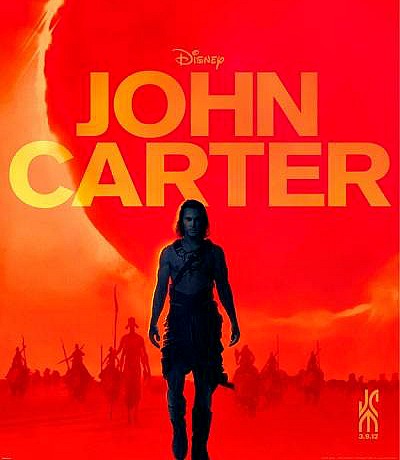
Lee mainly foresees trouble for Disney chairman Rich Ross, even though he states that Carter “is a problem [Ross] inherited from his predecessor” — i.e., former Disney honcho Dick Cook — “and that has provided him a certain level of insulation from the slings of his detractors.”

Lee’s recounts the bizarre thinking on Cook’s part when he approved the hiring of Finding Nemo and Wall-E director Andrew Stanton to helm a monstrously expensive Avatar-like fantasy adventure without stars. “Unless you’re Peter Jackson or Jim Cameron, it’s unheard of,” a rival studio exec tells Lee.

But the biggest forehead-slapper was the decision by Disney marketers to remove “of Mars” from the title. I understand the thinking that one needn’t show loyalty to Edgar Rice Burrough‘s John Carter of Mars, which began as a magazine serial in 1912. But why make a film set on Mars if you’re afraid to use the words “of Mars” in the title? How wimpy can you get?

“Although the character has been known as ‘John Carter of Mars’ and was envisioned as a movie trilogy under that name, Disney marketers dropped the ‘of Mars’ part because of industry-think holding that female movie fans are more likely to be turned off by such overtly sci-fi elements,” Lee writes. “And after the big-budget failure of last year’s Cowboys & Aliens seemingly confirmed that modern audiences are uninterested in Westerns — or, by extension, vintage Americana — Carter’s Civil War connection has been all but excised from the marketing.

“‘You take out ‘of Mars,’ you don’t tell where he came from? That’s what makes it unique!’ a former Disney executive is quoted as saying. ‘They choose to ignore that, and the whole campaign ends up meaning nothing. It’s boiled down to something no one wants to see.”
“After seeing several John Carter trailers, a rival studio executive agreed. ‘You don’t know what it is,’ the source said. ‘The geek generation isn’t responding. It’s too weird for the family audience. Then it has the Disney brand and PG-13? I’m not sure who it’s for.'”

The best that can be hoped for, it seems, is that John Carter will become the Heaven’s Gate of sci-fi actioners. No, not the most ruinously expensive and financially disastrous film of this genre, but the most ruinously expensive or financially disastrous film of this genre that will eventually a become a cult favorite, as Heaven’s Gate has gradually managed to become with the help of guys like F.X. Feeney.

John Carter‘s principal photography went from January to July 2010, so it’s been in post-production for 20 months, which might as well be two years.

And there’s still no spillage from the John Carter junketeers who recently basked in the Arizona sun on Disney’s dime. A John Carter fansite found some tweets that indicated positive reactions. Here’s another tweet-based summary that suggests positive responses to come.
Anatomy Face-Off

I finally watched Criterion’s Anatomy of a Murder Bluray, and I have to admit that while I’m adamantly opposed to slashing off the tops and bottoms of films that looked perfectly fine in their natural 1.33 state, and while I would have preferred a 1.66 aspect ratio (if a cropping had to be done), the 1.85 aspect ration began to grow on me after a spell. I came to accept it. It’s not a mauling of Otto Preminger‘s 1959 courtoom drama — just an unfortunate decision.


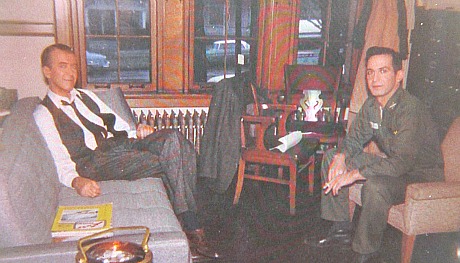
The Criterion Anatomy of a Murder Bluray contains to my knowledge the color photographs taken during the making of the film.

Most of the Anatomy Bluray looks fantastic. Wonderful blacks, enormous range, luscious detail. But every now and then a shot comes along that just looks so-so. Why does Stewart’s hair look a tiny bit soft? Is this starting to feel a little bit grainstormed? Okay, maybe not. But in a certain way, the Anatomy Bluray doesn’t look dramatically “better” than the 2000 ColTristar DVD. I didn’t feel as if it upped my viewing pleasure of the film one iota. It looks better on my 50″ Vizio than the DVD, of course, but that’s to be expected. That’s the format.

I only know that when I first saw that DVD 11 and 1/2 years ago on my 32″ Sony flatscreen, I was knocked out by its beauty. The monochrome tonalites were so rich and vivid that I felt as if I was watching a lab-fresh print in a studio screening room. But when I saw the Criterion Bluray, I went “uh-huh, yup, good work, very nice”…but I wasn’t blown away. I wanted that extra kick, and I didn’t get it. Put your face up to the screen and it’s swarming with natural grain (which is fine) and it looks like real celluloid. So it’s a good job. But honestly? I would been a tiny bit happier with a little digital sweetening, and I’m saying this as a huge fan of Criterion’s Sweet Smell of Success Bluray, which wasn’t sweetened at all. I just know when a Bluray has that extra-special dimensionality and sheen, and Anatomy…well, it’s a solid ground-rule double. Okay, a triple. But it’s no homer.

One thing I did notice is that you can now study James Stewart‘s hair piece (which has too much laquer on it) and figure exactly where the hairpiece ends and the natural hair begins.

Empty Soda Can

Whenever I’m driving slowly (in a parking lot, say) and I see a soda can, I always flatten it. This isn’t horrifically difficult, but it’s not easy either. It takes a deft touch, a certain instinct. But a good driver can do it every time, and always the first time. If you know your car you just know.

I’m mentioning this because (a) I flattened a can earlier this evening, and (b) I was reminded on my way home how some drivers (women especially) will clench up and take forever when faced with the slightest challenge, like driving through a tight spot between two cars or parallel parking or whatever. It’s like following a 15 year-old who’s just learning to drive.

Either you’ve let the Zen of driving into your system or you haven’t. There’s no third way. The ghost of Steve McQueen and the very-much-alive Ryan Gosling know all about this.

Hope

“In the (still unlikely) event that Rick Santorum captures the Republican presidential nomination, his campaign would probably be to social conservatism what Barry Goldwater‘s 1964 campaign was to small-government conservatism: A losing effort that would inspire countless observers to declare the loser’s worldview discredited, rejected, finished.

“In the longer run, a Santorum candidacy might suggest a path that a more electable pro-life populist could follow, much as Reagan ultimately followed Goldwater. But in the short run, it would almost certainly be a debacle – a sweeping defeat for the candidate himself, and a sweeping setback for the causes that he champions.” — N.Y. Times contributor Ross Douthat in a 2.21 “Campaign Stops” column.

Se7en

A movie that nobody of any consequence really loves is going to win seven Oscars on Sunday, in the view of Hollywood Reporter forecaster Scott Feinberg.

How can this be? There’s a solid current of like for this agreeable little film, and that’s about it. No one who knows or cares about Film Catholicism truly respects The Artist as a work of striking originality or spirit or technique or anything. All through the season people haven’t voted for The Artist — they’ve defaulted to it.

I’m trying not to pay too much attention to this or give it too much weight, but when I do I get a little bit sick. It’s 1953 all over again, and we’re about to give the Best Picture Oscar to The Greatest Show on Earth.

Who are the gelatinous AMPAS members who are voting for it? Are they feeling at least a twinge of regret or inner conflict as they mark their ballots? Because — this is the truth — I haven’t spoken to a single person who’s been really knocked flat by The Artist…not one.

That euphoric current that many of us felt when Roman Polanski‘s The Pianist won for Best Director, Best Adapted Screenplay and Best Actor? That electric-jolt feeling that says “wow, amazing…the good guys are winning for a change”? That was one of the biggest Oscar highs I’ve ever felt. Who in the world is going to really be jumping for joy when The Artist starts sweeping the table? Most of us are going to be feeling the opposite — resignation, melancholia, puzzlement. This pastiche is the best we could do? This hodgepodge of imitation?

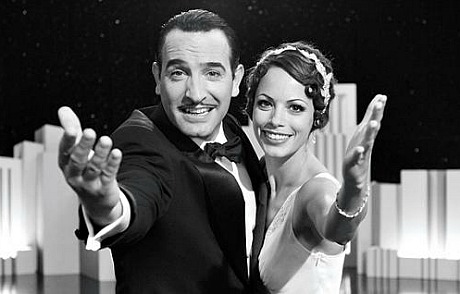
The Artist is a 2011 version of That’s Entertainment! in a silent, black-and-white mode with a strong narrative assist from A Star Is Born and Singin’ in the Rain.

I personally blame the New York Film Critics Circle for getting the ball rolling. They were first out of the gate and gave The Artist their renowned stamp of approval, and that in turn made it easy (or certainly easier) other critics groups, voting bodies and guilds to follow suit. Award voting is about pack mentalities and currents in the river. It’s very easy to get swept along. Nobody wants to be a loner.

From a 2.18 entry in Andrew O’Hehir‘s Salon column:

“So here we are, a week out from the big night in the No-Longer-Kodak Theatre, with Oscar’s big prize all but awarded to a silent black-and-white film made by French people. If we can pull that fact free of the massive ennui we’re all feeling about Oscar season this year, it remains objectively amazing. I mean, don’t get me wrong: The Artist is agreeable lightweight entertainment, and I can see exactly why it appeals to the wounded, nostalgic and crisis-ridden industry insiders of the Academy. Jean Dujardin is an irresistible performer, and I bet he’s been hitting the ‘apprenez l’anglais’ CDs hard in preparation for his likely Hollywood career.

“Still, the likely Oscar triumph of The Artist, like the movie itself, is a novelty hit, a one-off parlor trick that demonstrates the weakened cultural position of the Academy Awards and the lack of confidence endemic to mainstream American filmmaking.

“As a spoof and tribute to the glories of Hollywood’s silent age, The Artist is not especially subtle, but a lot of love and talent and pure high spirits went into making the movie, and that shows up on-screen. It’s not a great film and may not even be an especially good one, but it’s going to win the prize because it resounds with good cheer and confidence and willingness to entertain. Those are precisely the qualities usually associated with American cinema, good or bad, and precisely the qualities lacking in this year’s other nominees.”

Here’s how I put it the day after the NYFCC voted on 11.29.11:

“With The Artist having taken yesterday’s New York Film Critics Circle Best Picture prize, there will be a natural tendency for critics groups around the country to regard this Weinstein Co. release as a safe and likable default choice for Best Picture in their own balloting. Plus any critic voting for an entertaining black-and-white silent film is sending a message to colleagues, editors and especially readers that he/she is willing to embrace the novel or unusual, which indicates a certain integrity.

“Most Joe Schmoe readers are going to say ‘what?’ at first. And the critic will be able to say, ‘Yes, a black-and-white film without dialogue….which you should really see! It’s fun! Trust me!’ And they should. The Artist is a special film and a very nice ride. But the critics need to take two steps back and think things over. Please. I’m begging them.

“The Movie Godz are just as concerned and nervous as I am, trust me, that over the next two or three weeks other critics groups are going to tumble for The Artist like dominoes. Please tell me this won’t happen and that we’ll be seeing some kind of mixed awards salad out there.

“I understand how celebrating a film that mimics how movies looked and felt in the 1920s is a way of saying that you respect classic cinema and Hollywood’s history, blah blah. And by doing so critics will get to lead at least some of their readers into the past, and seem wise and gracious in the bargain, and all the while supporting a film that’s mainly about glisten and glitter and decades-old cliches.

“Have The Artist supporters within the NYFCC given any thought to what it actually meant to choose this film as the best of the year? It presumably meant that they feel it amounts to more than just a sum of delightful silver-screen parts. It means that in their estimation The Artist delivers something in the way of mood or narrative or meaning or style that really got them, Kinks-style. In a truly profound, bone-marrow, deep-soul way, I mean. More than Hugo or The Descendants or Moneyball or whatever…right?

“The NYFCC obviously rejected this notion in choosing The Artist. They said ‘look, whatever…there’s nothing really lifting us up this year so let’s choose something we really like, at least.’ Terrific, guys. It must have taken a lot of character and conviction to hand out your prestigious Best Picture award to the shiniest bauble.”

Two Non-Altercations

I almost had words with a driver of a dark sedan during this morning’s bike ride through Savannah’s historic district. “Almost” is actually overstating it. I could have had words with this guy if I had a little less self-control.

I was stopping to take a picture on a small cobblestoned street, and a friend pulled her bike over to the opposite side. Along comes asshole in his dark sedan, and he doesn’t like that she’s taking up 18 to 24 inches of space in the right lane. He stops and waits for her to walk the bike entirely out his way before he proceeds. Except she doesn’t, meaning he’ll have to veer ever so lightly into the left lane to pass her. There was plenty of room, trust me.

So he starts in with the expressions. He scrunches his face up to express his contempt for her bike-riding skills. Then he does one of those head-wagging, “tsk-tsk” loud-exhale expressions that says “my God, this woman is beyond pathetic…the people I have to put up with…Jesus!,” etc.

The next “almost” happened in a touristy area near Congress Street. I raised my camera to take a picture of a couple of Clydesdale horses. A woman who was about to walk in front of my viewing path went “oh” and stopped and waited. She was being polite, of course, but I’ve said before that waiting for someone to snap a photo is a mark of middle-class cluelessness about photography. A good photographer has to roll with what happens, and sometimes you can get a better shot if somebody or something is half-obscuring what you’re shooting. You never know, and you’re better off not knowing. I never stop and wait for a picture to be taken…ever.

In any case, I said “thanks…it’s okay…it’s cool” to the woman. But I didn’t say it the right way. She took umbrage and asked if I had an attitude problem. I was just trying to get out of there but just to mess with her head I said “uh, yeah, I guess I do.” She stopped in her tracks. “What’s your problem?” People like you, I wanted to say. People who don’t understand that one of the tenets of mediocre photography is refusing to accept the natural unruliness of life and to just go with what happens when you’re shooting and stop trying to control everything. But instead I said “it’s cool, doesn’t matter” and turned away.

Sometime Next Year

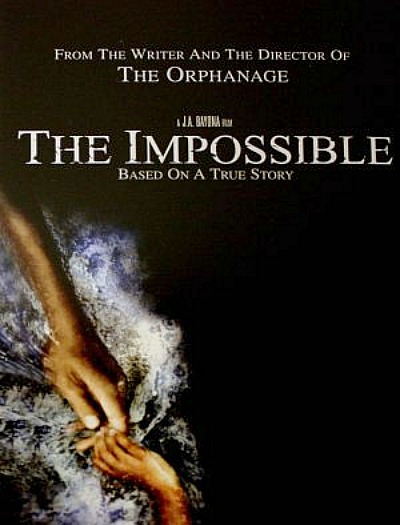
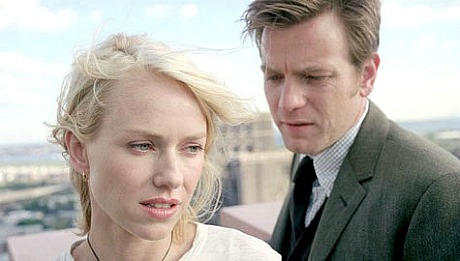
Forgive me for presuming that Juan Antonio Bayona‘s The Impossible, the Asian tsunami drama with Naomi Watts and Ewan McGregor which wrapped last fall, might be ready for release sometime later this year. But no. Summit acquired domestic rights in May 2010, and there hasn’t been a peep out of them since. A rep said he didn’t know when they’ll be releasing it, but all indications point to 2012.

I asked Orphanage producer and Bayona confidante Guillermo del Toro what he knows. No reply as of yet.

The Impossible is a true account of a family swept up in the ’04 tsunami that slammed into the coast of Thailand and neighboring countries. One presumes that fine-tuning the visual effects is at least one reason for the extended post-production effort.

Besides Watts and Macgregor the costars are Tom Holland, Gitte Julsrud and Marta Etura. The same team that worked on Bayona’s The Orphanage (writer, production manager, cinematographer, composer and editor) have reunited for this, so that’s cause for hope. The Orphanage is one of the great adult horror films of this century.

Pic was largely shot in Alicante, Spain and on location in Phuket, Thailand, beginning about 13 or 14 months ago,

Bayona has allegedly described it as an “ambitious, high-quality European film” which will be “competitive on an international market”. Wait…”European film”? I’m betting that Summit honchos flinched and frowned and went “hmmm” when they first read that. We all know Summit.

"Bricks On A Donkey"

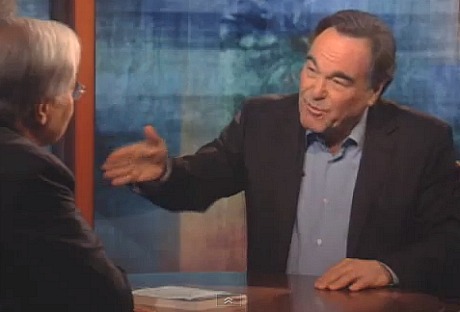
I don’t care if this interview between Bill Moyers and Oliver Stone is 20 months old. It’s the most nourishing and sobering thing that’s seeped into my head all day. It’s basically Stone talking about his time as an infantryman in Vietnam, and how that experience has informed his views of the current debacle in Afghanistan, and convinced him that Obama has made a terrible mistake by trying to go for some kind of win over there, which of course is futile.

Forget segment #1 — start with segment #2 and then watch segment #3, segment #4 and segment #5.

Nothing Recedes Like Success

I’m sure John Wood was extremely grateful when he landed the part of has-been playwright Sidney Bruhl in the stage version of Ira Levin‘s Deathtrap, which opened in February 1978. For the dryly debonair and deliciously decrepit manner Wood lent to the role was so popular with everyone that he became a major character actor in Hollywood films through the ’80s and ’90s. The irony is that he never found a part in any Hollywood film that was as much fun to play (or watch) as Sidney Bruhl. Not one. Not even close.


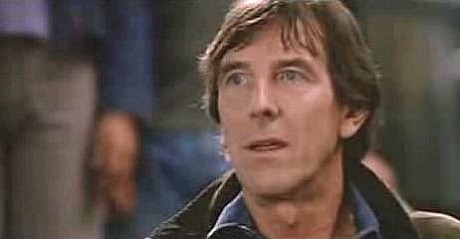
Wood at Dr. Stephen Falken in WarGames.

I know. I caught Deathtrap toward the end of Wood’s run (I think) in the late summer or early fall of ’78. By that time he’d given so many performances he was going a little batty. He was seized with concentration but also looked half-stoned. “I’m jumping off a proverbial cliff with this part and I don’t care because it’s so much fun….yaaahhh!,” he seemed to be saying. I remember noticing that he was half-muttering his costars’ lines — you could almost see his lips move. He was hamming it up for dear life. And when he said “nothing recedes like success” early in the play, he was brilliant. The audience loved him, applauded him. He was so confident, so alive, so cup-runneth-over.

And then the movies let him down. In the ’80s, I mean. A couple of minor flashes of flavor but that’s all. Somebody Killed Her Husband…forget it. Dr. Stephen Falken in WarGames…gimme a break with that running-around-in-the-cave scene at the end. The thin-lipped Deacon of Diction in Richard Donner‘s Ladyhawke…blah. All right, he was not only pretty good but fit the tuxedo in Woody Allen‘s The Purple Rose of Cairo. But then it was back to hell in Jumpin’ Jack Flash and then a mini-part in Mike NicholsHeartburn. And then a supporting role in Lady Jane…okay, not bad.

The the ’90s kicked in and Wood started to get a little bit luckier. Archduke Karry in Orlando. A pretty good part in The Madness of King George. And then parts in Uncovered, Sabrina, Richard III, Jane Eyre and so on. And then he got older and started to slow down in the aughts He died in his sleep on 8.6.11.

Wood had been a Shakesperean stage actor for a little less than 30 years before doing Deathtrap, and I’m presuming he was quite content with his work and life during the ’50s, ’60s and ’70s before Levin’s play came along. I’m sure his accountant was very happy with Wood’s post-Deathtrap income, and I’m sure Wood was pleased as well. If only he could have landed one killer movie role, just one.


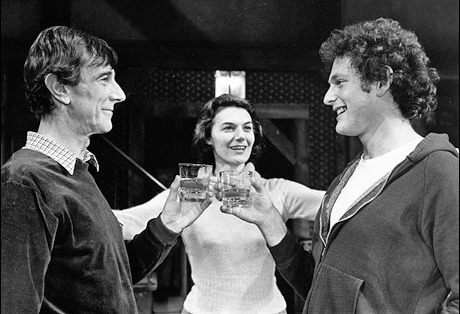
(l. to.r.) Wood, Marian Seldes and Victor Garber during the ’78 stage production of Deathtrap.

True Story

After last night’s Dolby seminar (or sometime around 9:40 pm), I checked into the Mark Hopkins hotel. A youngish desk clerk gave me two pass cards to a room on the sixth floor. I went up there, slipped the plastic card into the door slot, and walked in. The first thing I saw was a short hallway with a right-turn ahead — obviously a fairly big room. But the TV was already on…strange. I took the turn and came upon a middle-aged couple lying on the bed, watching CNN.

They stiffened and sat up and said “Oh, Jesus!,” “My God!”, “What are you doing?” and expressions to that effect. The guy leapt off the bed to defend the territory and his lady. “Whoa, whoa….sorry!” I hurriedly said, holding up my hands. “I was given keys to this room by the desk. It’s a mistake. Obviously I got in with the card so I didn’t break in. Truly sorry.” The guy collected himself and acknowledged that a mistake had clearly been made, and I turned right around and bolted the hell out of there.

The desk clerk was shocked, ashen-faced. “You are Jeffrey Wells, right?” Definitely, I said, and showed him my ID. He apologized and double-checked. Believe it or not, the name of the guy I walked in on is also named Jeffrey Wells. Same name, same hotel…what are the odds? I wasn’t pissed — just amazed and amused. The clerk smiled and said “Thanks for being understanding” as he gave me the cards for the new room, which is on the third floor.

My current room is about half the size of the other Jeffrey Wells’ room. It feels like the garbage-compression room in Star Wars — i.e., the room that Han, Leia and Luke are stuck in as the walls start moving in and making the room smaller and tighter by the second.

If Nancy Meyers had written and directed the scene when I walk in on the other Jeffrey Wells, he and his wife would have been obese tourists from Missouri and having some kind of contortionist sex on the bed. As I turned the corner and stood before them they would have both leapt off the bed with terrified expressions and gone “Aaaaaahhh! Aaaaaahhh!” And I would have stood there and also gone “Aaaaaahhh! Aaaaaahhh!” And then the hotel dicks would be knocking on the door and I’d be cuffed for breaking into a room, etc.

Good Lads

When the kids were toddlers they’d call this or that film is a “talking movie.” People sitting indoors and playing verbal ping-pong, etc. Well, John Michael McDonagh ‘s The Guard is one these, but what talk! What delicious Irish ping-pong! It’s a witty ramble-on thing that’s simultaneously digressive and twinkle-eyed, and one of the best “cops and bad guys batting the ball around” movies in ages. I don’t know if this indie Irish production will be eligible for a Best Original Screenplay Oscar, but it ought to be. It’s all dessert.


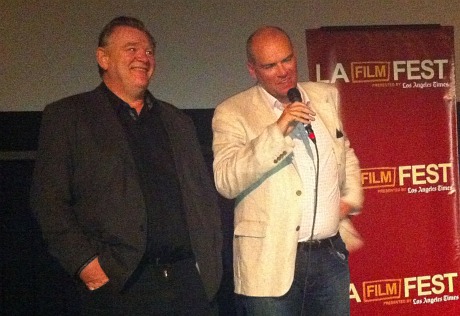
Brendan Gleeson, star of The Guard, and director-writer John Michael McDonagh following an LA Live Regal showing — Friday, 6.24, 11:05 pm.

I did a short phoner with McDonagh a couple of days ago. I’ll post it tomorrow.

I had a little bit of trouble hearing all the dialogue when I first saw The Guard at Sony Studios (Jimmy Stewart, room #24) last week. Irish-speak has a certain gliding, looping, burry sound that can you can lose the ear for if you’re not careful. It’s a little like Shakespeare — once you find it you can hear it, but you can fall off the track if you’re not careful. In any event I heard every syllable during last night’s 10 pm screening at the LA LIVE Regal. I think it was because the sound sounded a bit sharper and cleaner.

Gleeson’s role as Boyle, an irreverent constable who’s mildly, indifferently corrupt in little and medium-sized ways but at the same a good bloke, is probably the best of his career. He’ll definitely be in line for some Best Actor action when 2011 Oscar season kicks in.

Arthur Sucks but Gerwig Glows

The Rotten Tomatoes consensus so far is that Arthur (Warner Bros., 4.8) blows the big one. The only guy who’s given it a semi-pass is MSN’s Glenn Kenny. (Can Kenny be trusted when it comes to romantic comedy? The watchword is “caveat emptor.”) My personal view is that it’s not awful, but it sure is unnecessary.


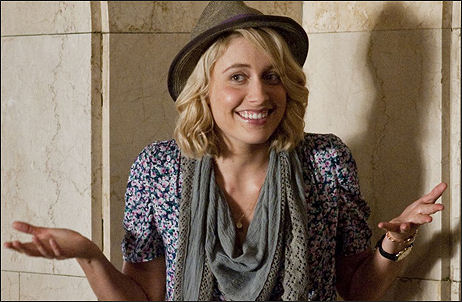
Greta Gerwig in the new, not-so-hot Arthur.

The vibe in the Arclight theatre during last night’s screening felt flat, like a lot of underwhelmed people waiting for a high-school study hall to end. The 1981 original should have been left alone. That was then and this is now. People look at profligate indulgence and giggling, stumbling-around alcoholism differently. For whatever reason Dudley Moore‘s bubbly millionaire slipped through and felt right. But Russell Brand‘s never quite finds the groove.

Brand has done himself no favors, let me tell you. He was looking pretty good and jazzed after the success of Get Him To The Greek, but now he’s bombed and for one reason only: he’s not funny. Plus there’s something generally repulsive (as in “not at all attractive” and “fuck off”) in our post-crash-of-’08 environment in watching a gangly alcoholic infant with a high-pitched “do I sound like Dudley Moore?” voice blowing scads of money and then shrugging it off. I’ll shrug you off, ayehole!

But Greta Gerwig, who plays a version of Liza Minnelli role in the ’81 film, has an inner light in most of her scenes. She’s partly on the movie’s wavelength, partly on Brand’s during their scenes together, and partly on her own. You can sense her basic kindness, openness — a charitable, turn-the-other-cheek disposition. I’ve met and dinner-ed with Gerwig and this is her, pretty much — she’s playing a role in a Warner Bros. film, but also self-portraiture.

And for the first time in her professional life, Gerwig has studio makeup people and hair people and key-lighting people making her look extra-glowing and glamorous with perfect hair, and it works. She’s golden, and this, coupled with her spiritual light, is what makes Gerwig the only element that half-works in this film.

And to think that the Warner Bros. marketers actually kept Gerwig off the one-sheet when the first one came out. These people really do have Death Star attitudes and souls. They seem to only understand corporate-bullshit-franchise movies — they’re lost in the woods when it comes to movies about real people, or trying to convey that a film has elements that might appeal to same.

Jennifer Garner is arch and brittle in the second-lead female role — an ice-queen who wants to marry Arthur for his holdings. She hasn’t done herself any favors either. Helen Mirren is okay — inoffensive — as Arthur’s 60ish female nanny, and Nick Nolte has a moment or two as Garner’s billionaire dad. Although I still don’t understand a scene in which he forces Arthur to test a special electric table-saw that stops instantly when it senses moisture — testing it by placing his tongue on the whirring blade. What the…?