Do Paranoid Films Have To Be Thrillers?

A friend recently said that he found the faint but distinct current of paranoia in Tar to be the film’s most arresting aspect.

I zeroed in on this during my last viewing of Todd Field’s film, and now I agree — once the paranoid stuff begins to manifest, it becomes stronger and stronger until Lydia Tar’s downfall.

My favorite definition of paranoia is one attributed to Willam S. Burroughs — “knowing all the facts.” But what exactly defines paranoia in films?

Most of us would say it’s a vague but persuasive feeling that something undefined but threatening is approaching or waiting around the corner. This feeling gathers strength as the film progresses, but the superior paranoid films hold off at the climax…the prickly vibes linger after the payoff.

I never really thought about paranoid currents in movies until reading about Alan Pakula‘s paranoid trilogy — Klute, The Parallax View and All The President’s Men. I’m actually not so sure about Pakula’s journalism docudrama but the first two are paranoid masterpieces.

In my book the most striking or penetrating paranoid films are, in fact, thrillers — The Conversation, Rosemary’s Baby, The Witch, It Follows, The Innocents, Taxi Driver, Three Days of the Condor, Repulsion, Cutter’s Way.

What films (if any) feel paranoid without conforming the usual scheme of thrillers?

Commendable Fiennes Again Defends Rowling

In a 10.22 N.Y. Times interview, “Ralph Fiennes, Master of Monsters,” the 59 year-old star of David Hare‘s Straight Line Crazy has, to his immense credit, once again defended J.K. Rowling in the face of trans hate:

For the record, Fiennes said roughly the same thing to Telegraph theatre critic Dominic Cavendish on 3.17.21.

“I can’t understand the vitriol directed at [Rowling]. I can understand the heat of an argument, but I find this age of accusation and the need to condemn irrational. I find the level of hatred that people express about views that differ from theirs, and the violence of language towards others, disturbing.”

Here are HE’s choices for Fiennes 11 greatest performances, be they lead or supporting…if your performances ring true, the amount of screen time matters not:’

1. Monsieur Guystave H. in The Grand Budapest Hotel. Fiennes has a classic line about graceful aging and adjusting one’s appetites. Gustave is telling Tony Revolori‘s Zero Moustafa, a Grand Budapest hotel bellboy, that he Biblically “knew” Tilda Swinton’s recently deceased Madame D. Noting that she was “great in the sack,” Fiennes explains that “in your youth it’s all fine filet but as you get older you have to settle for the cheaper cuts.” Or words to that effect.**

2. Amon Goth in Schindler’s List — a performance that spoke for itself from the get-go. I interviewed Fiennes in the fall of ’93 for a regular Sunday column I did for the N.Y. Daily News — the piece called “The Reich Stuff.”

3. Harry Hawkes in Luca Guadagnino‘s A Bigger Splash. For the “Emotional Rescue” scene alone.

4;. Charles Van Doren in Quiz Show.

5. Laurence Laurentz in Hail Caesar!

6. Heathcliff in Emily Brontë’s Wuthering Heights.

7. Dennis “Spider” Cleg in David Cronenberg‘s Spider.

8. Count László de Almássy in The English Patient (though I find his performance a bit labored, a bit of a slog).

9. Coriolanus in Coriolanus.

10. Maurice Bendrix in The End of the Affair.

11. Justin Quayle in The Constant Gardener.

I have to add that I’ve always half-admired Fiennes for that 2007 seven-mile-high episode aboard Quantas Airlines. Only good-looking movie stars get away with this kind of thing, and I had to chuckle with I first read about it. Fiennes had most of his hair back then and his natural good looks were still untouched my middle-aged crease, and Quantas steward Lisa Robertson had loved him in The English Patient so he was in like Flynn.

** That’s generally true if you’re not married, but for the middle six months of 2013 I was utterly blessed by a relationship with an exquisite, marbled, grass-fed filet mignon, to go with the metaphor. God smiled, and I will never forget His generosity. Despite the woundings at the end I caught an amazing break.

“Emancipation” Buzz Feels Untrustworthy

So Will Smith had a recent private screening of Antoine Fuqua‘s Emancipation (Apple, 12.2), but he invited only celebs of color. The same thing happened with that recent D.C. screening, which reportedly was mainly composed of African-American groups. Why am I hearing that the earlybird audiences been racially segregated? It feels like Smith is going for a stacked-deck consensus. The advance word of mouth on Emancipation will not travel unless a certain percentage of tough white critics give it a thumb’s up. Non-invested critics, I mean, who have no particular dog, etc.

Davis Is In Denial

In his 10.20 piece called “Will She Said Hit Too Close to Home for Oscar Voters?,” Variety‘s Clayton Davis is trying to guilt-trip older Hollywood males into applauding this first-rate docudrama about how Jodi Kantor and Megan Twohey took down Harvey Weinstein.

Except She Said doesn’t need Clayton Davis’s help — it stands confidently and efficiently on its own two feet.

If you ask me Davis has invalidated himself by putting quote marks around cancel culture in the third-to-last paragraph.

Quote marks bookending this term is a standard wokester move. It’s meant to suggest skepticism about the validity of the term itself. It’s the same thing as writing “so-called cancel culture.”

So let’s understand this clearly — by attempting to cast doubt or suspicion upon usage of cancel culture, Clayton has made it unambiguously clear that he stands with the bad guys.

“Bardo” Ate Entire Afternoon

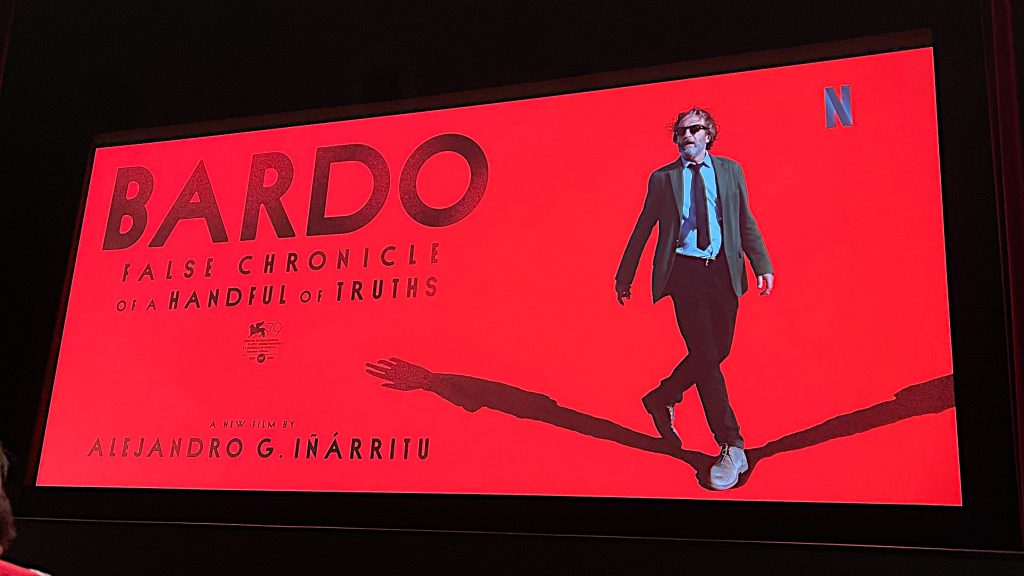
I had to catch an 11:30 am train to Grand Central in order to arrive early for a 2 pm Bardo screening at the Paris theatre. It all happened according to plan.

Alejandro G. Inarritu’s 8 and 1/2-like epic about a filmmaker’s interior journey of guilt, love, identity, marriage, family and creative frustration is now 20-odd minutes shorter than the version that played in Telluride. I was mostly a thumbsupper then and I liked today’s version even better. As you might imagine it’s now tighter, trimmer…a tad more concise.

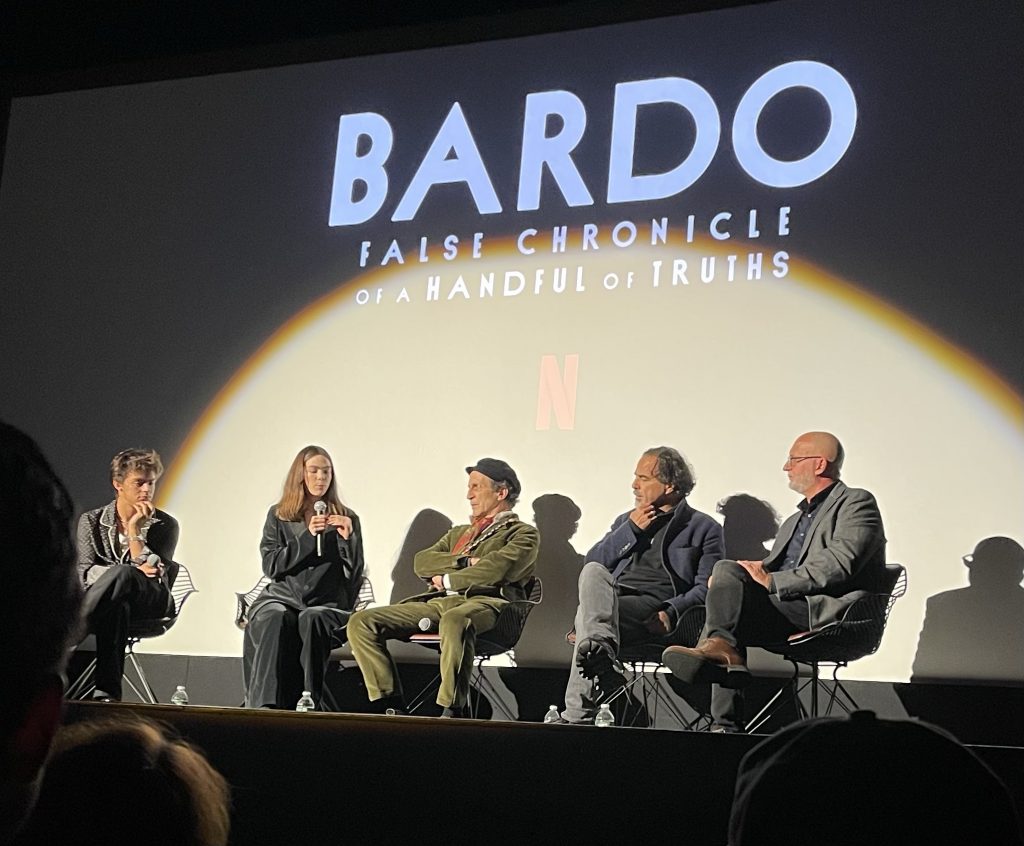
Alejandro and leading cast members Daniel Gimemez Cacho, Ximena Lamadrid and Iker Solano sat for a half-hour q & a following the screening, which began at 2:15 pm and ended at 4:45, not counting closing credits.

I’ll amplify later on my reactions.

It’s now 6:30 pm. I’m sitting in the upstairs dining area at Smiler’s Deli (Madison and 54th) — no wall plugs, no wifi (Smiler’s don’t want no wifi bums) and attempts to use my iPhone as a personal hotspot have failed miserably. I don’t know what I’m doing wrong.

Young, Rich, Well Educated, Flat Abs, “Dull”

Rishi Sunak, Liz Truss’s 42 year-old successor, will soon become the youngest Prime Minister in British history. He and wife Akshata, daughter of Indian billionaire N.R. Narayana Murthy, have a combined fortune of $730 million and perhaps over a billion dollars.

Born on 5.12.80, Sunak would be a Millennial if he had begun life a year later. He’s technically a very young GenXer.

From a certain angle Sunak almost seems like a conservative JFK — young, slim, good-looking, loaded. The non-JFK factor, according to British broadcaster and former politician Nigel Farage, is that Sunak lacks charisma. “He’s very, very dull and detached, and doesn’t connect with ordinary folk,” Farage recently told Sky News.

Autocorrect is giving me all kinds of trouble when I attempt to spell the names of Rishi, Akshata and her father N.R. Narayana…stop pestering me!

Burton’s “Dumbo” Depression

Tim Burton to Deadline: “My history is that I started out [at Disney]. I was hired and fired like several times throughout my career there.

Dumbo is why I think my days with Disney are done. That movie is quite autobiographical on a certain level [because] I realized that I was Dumbo, that I was working in this horrible big circus, and I needed to escape.”

Big, Over-Produced Dumbo Lacks The Original’s Gentle Soul“, posted by yours truly on 3.26.19:

“Tar” Suffocates At Avon

I tried watching Tar again last night — my third viewing. It happened at Stamford’s Avon, which turned out to be a mistake. My next viewing will happen when Tar starts streaming. I’m very much looking forward to reading the subtitled dialogue as there are still passages (particularly when Cate Blanchett‘s Lydia Tar is whispering to her young adopted daughter) that I can’t make heads or tails of.

Tar is exactly the same mindfuck that I saw in Telluride several weeks ago. I still find it complex, ravishing, brilliant (certainly as far as Blanchett’s performance is concerned) and more than a little frustrating at times.

I still don’t get the ticking metronome in the middle of the night or the unseen shrieking girl in the woods scenes. I’m still deeply bothered by the crude table manners of the young Russian cellist. I get that the black dog or wolf in the old tenement buildjng is a metaphor for secrets that Lydia is afraid might come out, but it’s presented as a half-real thing and not a dream sequence so it left me puzzled at first.

I finally realized that the grubby two-bedroom home that Lydia crashes in toward the end is her childhood home, and that the insolent guy at the bottom of the stairs is her under-educated brother, and that her real first name is Linda. (I’ve no explanation for missing this the first time.) I still think it’s absurd that Lydia’s career would be completely destroyed over the Christa thing. And I still think that anyone who would call the last shot racist (a slow tracking shot of cosplaying fans at a kind of Asian ComicCon gathering) is demented.

Alas, the whole experience was diminished due to the Avon’s crummy screening conditions. Yes, it’s an independent theatre and a beloved Stamford mainstay but I’ll never see a film there again. Three bad things — the screen is too small for the auditorium, the screen lighting was way too dim (the minimum SMPTE standard is around 14 or 15 foot lamberts — I’d be surprised if last night’s Avon image was more than eight or nine) and the sound was way too soft.

I complained to the manager (a chubby woman in her 40s or early 50s) and I suspected right away that she didn’t even know what “foot lamberts” means. I returned to my seat, resigned to sit through two hours and 38 minutes of shadows and mud and murky, often indecipherable dialogue.

Basically a shit show and money down the drain.

Incidentally: Owen Gleiberman‘s “Is Tár Rooting For or Against Cate Blanchett’s Superstar Predator Conductor?” is worth reading.

Obstinate Verve

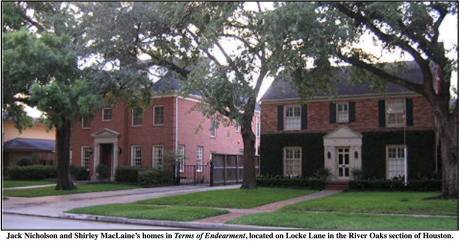
The idea or concept of Jack Nicholson-style insouciance (i.e., that vaguely grinning, self-amused, slightly paunchy, middle-aged swagger hound attitude) didn’t really come into being until his Garrett Breedlove performance in Terms of Endearment, which opened 39 years ago.

Today the Breedlove routine would be shut down so fast that Nicholson’s head would spin. The world that half-chuckled at such antics is dead and gone.

Okay, it’s not dead and gone but people in the heady Hollywood heat of things are too terrified to admit this so it might as well be. Okay, there’s still room for “you need a lot of drinks to kill the bug that is up your ass”…that still works. Just don’t ask IndieWire‘s Anne Thompson, who served as the unit publicist for Terms. Different era.

HE to Beverly Walker: “I’m re-reading your 1985 Jack Nicholson Film Comment interview, and I’m wondering what you’re hearing, if anything, about Jack’s well-being or health or whatever. He’s 85 now, and I know he doesn’t say anything to anyone these days, largely due to diminished capacities.

“But dear God I would love to hear the old Jack weigh in on woke Stalinism and the idea that any actor or filmmaker whose personal behavior has resulted in a blemish or two needs to be expelled or at least discredited. I don’t know what he’d say exactly, but I can guess. To hear it in his own words, his own phraseology…”

Malibu Is Deep Hell

HE: “Malibu is an over-crowded car community with a side order of beachside real estate. It’s arguably the most unpleasant coastal region in the civilized world.”

Overlord: “Then why go there at all. or are you a masochist?”

HE’s Own Insect Antennae: “The same reason all their hikes are through residential Hollywood. He enjoys the proximity to wealth.”

HE: “Because when you finally arrive at the mostly empty and semi-secluded El Matador, La Piedra and Leo Carillo state beaches, the effort feels worth it. For a while.

“But getting there is hell unless (a) you’re on a motorcycle or an HE-approved rumblehog or (b) you manage to avoid peak traffic by traveling between 11 pm and 6 am. Most of the time there isn’t a dime’s worth of difference between PCH and the 405. It’s basically about cars and foggy haze and the near-futility of finding a parking spot (unless you’re visiting the afore-mentioned, Trancas-area beaches) and that constant whahhh of traffic and that atmosphere of speed and aggression and predatory restaurants and the suffocating howl of it all. It just drains your soul.

“I’ve visited so many tranquil, extra-beautiful, far-from-the-madding-crowd beach areas around the world. The Florida keys, Northern California and Oregon, central Vietnam, Maine, New Jersey’s Long Beach island…yes, even New Jersey!…France’s Côte d’Azur, Marina del Campo on the island of Elba, Baja California, Cape Cod, San Blas, the Spanish coast near Almeria, Placencia in Belize and Playa del Carmen and Cozumel in Mexico.

“I’m sorry but alongside these havens the Malibu region is nothing to cherish or speak fondly of.

“It’s one thing if you own a nice canyon home or cliffside spread or if you’re jogging along the track at Pepperdine U., but otherwise ‘later.'” — from “Paradise Cove Overchqrge,” posted on 12.1.19.