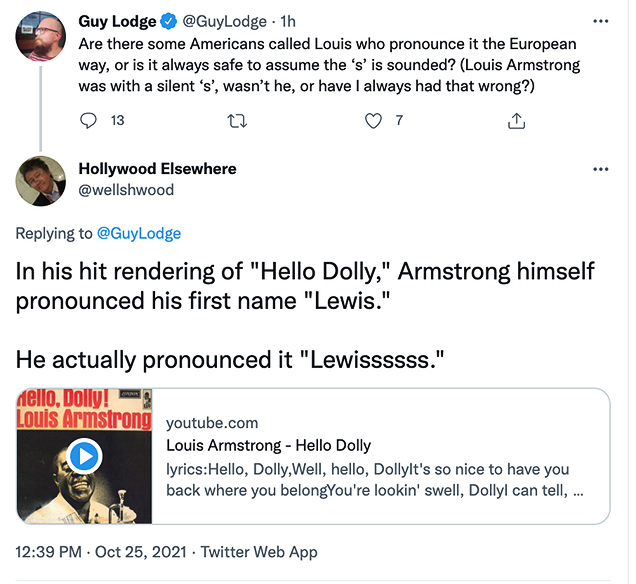
Outside of literary types like Lewis Lapham and Sinclair Lewis, it seems as if more people pronounce it “louie” rather than “louis.” at least when it comes to “Louie Louie,” Claude Rains‘ Louis Renault character in Casablanca, Huey, Dewey and Louie, Louie Anderson and King Louis (i.e., “Louie”) of France. But if there’s one famous Louis who certainly avoided the “ouwee”, it was Louis Armstrong.
Why Armstrong on this agreeably rainy Los Angeles morning? Partly because Satchmo’s rendition of “We Have All The Time in The World” is played over the closing credits of No Time To Die, but mainly because Variety critic Guy Lodge mentioned him this morning.
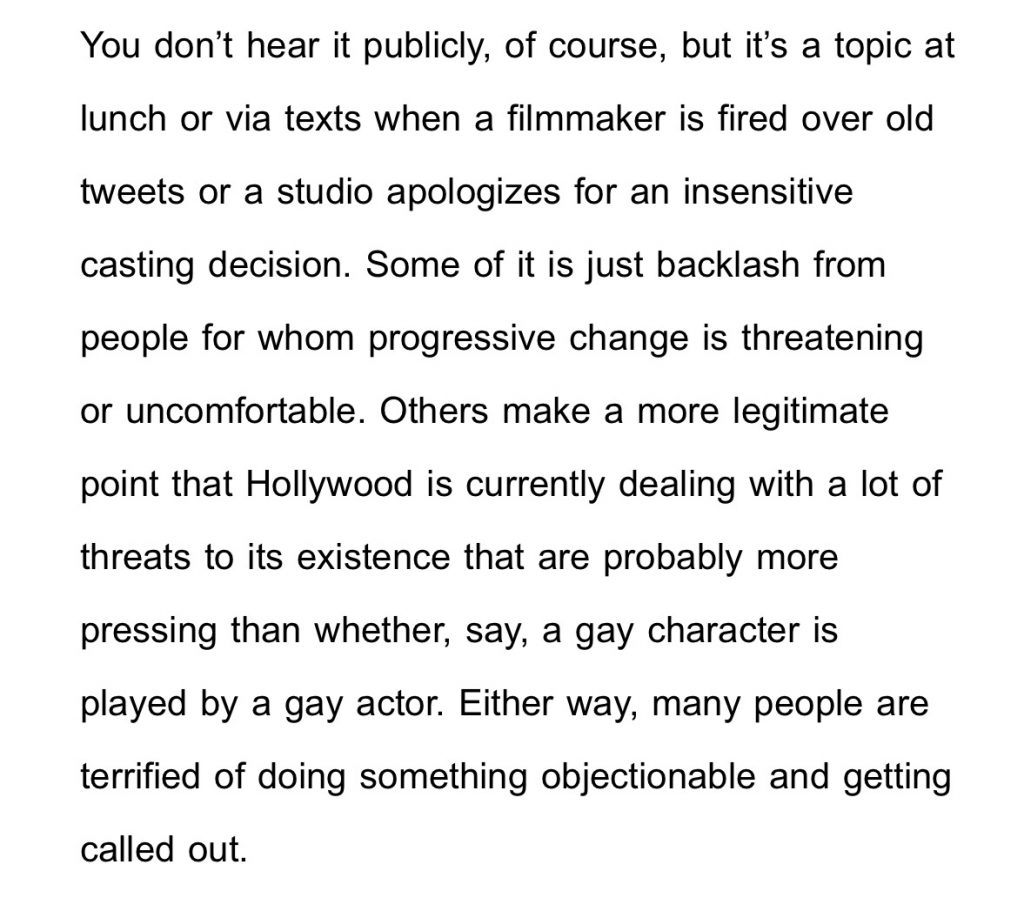
If “many people are terrified of doing something objectionable and getting called out ,” as Matt Bellonireports in his latest “WhatI’mHearing” column, it naturally follows that there exists a climate of Robespierre–liketerror in this town, which I’ve been asserting for two or three years now.
If I had a quarter for every toxic tut-tutter in this town (starting with Variety’s Steven Gaydos) who’s said I’m full of shit about this, I could buy a new Beemer and have a fair amount left over.
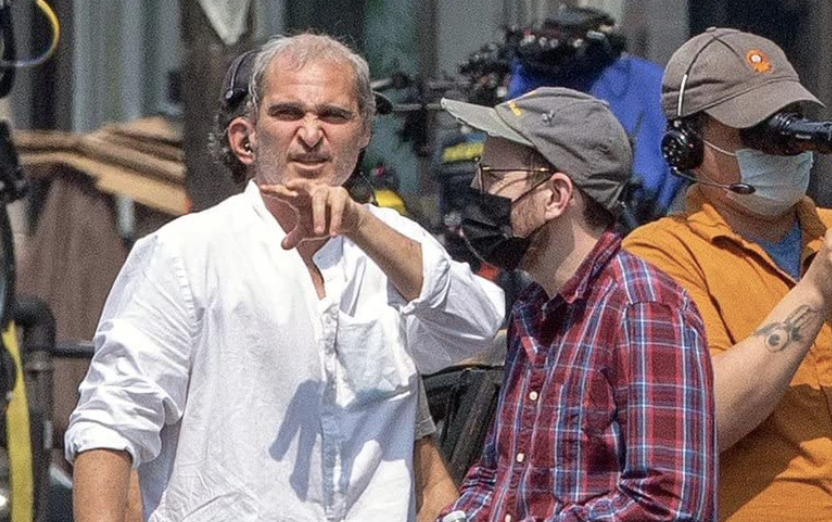
This was snapped sometime in ’01 or ’02…somewhere in there. I’ve been to Prague seven or eight times. My first visit was a honeymoon thing with my ex-wife Maggie in October ’87. (Prague was a total Commie town back then, celebrating the 70th anniversary of the ’17 Russian revolution, scent of soft coal everywhere.) My second visit was in ’92 — managed to shake Vaclav Havel‘s hand at a bookstore. This visit, I think, was my third.
One of HE’s antagonists wrote the following in late September (edited): “I’m not going to share the whole story of how I came to believe I should write this to you. Suffice that I’m undergoing some serious harassment from a former friend and it’s not pleasant. Shoe having been on the other foot, I’ve experienced some clarity.
“Whatever [the motivation, my psychology has] compelled me to act in ways that are unacceptable, both professionally and personally.
“So I’m apologizing, again. And I know you won’t trust it and I do not blame you. I will continue to find a good number of your opinions exasperating, but I’ll try in the future to make a point of not making a point of it. I just wanted to apologize for real and let you know that from hereon in I’ll be making a genuine effort not to make any more trouble for you.”
HE reply [same day]: “Was this written by a humanoid seed pod from Don Siegel’s InvasionoftheBodySnatchers?
“You’ve now sent three emails saying ‘I’ve been a toxic dick and I’m sorry’…right? One seven or eight years ago, and then another (or so I recall) and now this one. It’s a pattern.
“Thisisn’trealunlessyoupostitonTwitter. Maybe it’ll start something. Maybe some of the other battery-acid Robespierre haters will read it and think ‘hmm, maybe I should ease up on my own anti-HE bullshit.’
“Go to Twitter and it’s real. Keep it private and it’s not. Only a fool would presume otherwise.”
HE antagonist back to HE, the same day: “Your proposition interests me. [Perhaps] a proclamation of principles as applied to my treatment of you might be in order. I shall give it serious consideration.”
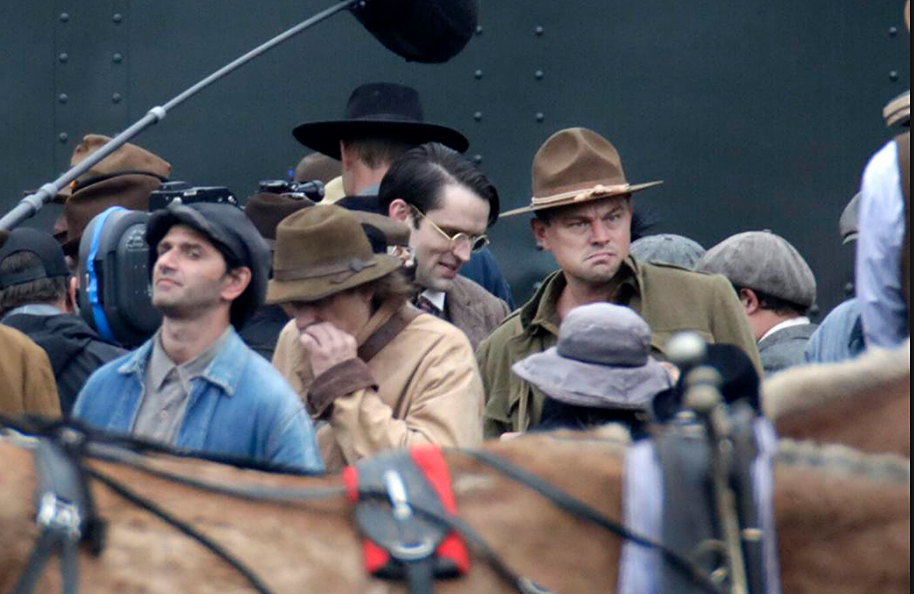
Note: Terence Malick needs between two and three years in post-production to prepare a film for release. The Way of the Wind began filming a couple of years ago, so by my estimation it probably won’t be out for another year.
“Killers of the Flower Moon” (Martin Scorsese) “The Killer” (David Fincher) “The Northman” (Robert Eggers) “Babylon” (Damien Chazelle)
“Armageddon Time” (James Gray)
“Asteroid City” (Wes Anderson) “Disappointment Blvd.” (Ari Aster) “Amsterdam” (David O. Russell)
”Poor Things” (Yorgios Lanthimos) “The Fablemans” (Steven Spielberg) “White Noise” (Noah Baumbach)
”Owl” (Kelly Reichardt)
“The Zone of Interest” (Jonathan Glazer)
“Crimes of the Future” (David Cronenberg) “Bardo” (Alejandro Gonzalez Inarritu)
“The Whale” (Darren Aronofsky)
“Decision to Leave” (Park Chan-Wook)
“Fire” (Claire Denis)
“Tar” (Todd Field) ”Kimi” (Steven Soderbergh)
”Bones and All” (Luca Guadagnino)
“Next Goal Wins” (Taika Waititi)
“The Batman” (Matt Reeves)
”Kitbag” (Ridley Scott — Joaquin Phoenix as Napoleon Bonaparte)
“Don’t Worry Darling” (Olivia Wilde)
“BulletTrain” (David Leitch)
“Nope” (Jordan Peele)
”Men” (Alex Garland) ”Pinocchio” (Guillermo del Toro)
“Elvis” (Baz Luhrmann)
“The Son” (Florian Zeller)
“The Stars at Noon” (Claire Denis) “Blonde” (Andrew Dominik)
“The Bubble” (Judd Apatow)
“Women Talking” (Sarah Polley)
“3000 Years of Longing” (George Miller) “Triangle of Sadness” (Ruben Ostlund)
“The Eternal Daughter” (Joanna Hogg)
“Tori et Lokita” (Jean-Pierre & Luc Dardenne)
“Apollo 10 1/2: A Space Age Adventure” (Richard Linklater)
”Rebel Ridge” (Jeremy Saulnier)
“Deep Water” (Adrian Lyne)
“The Way of the Wind” (Terrence Malick)
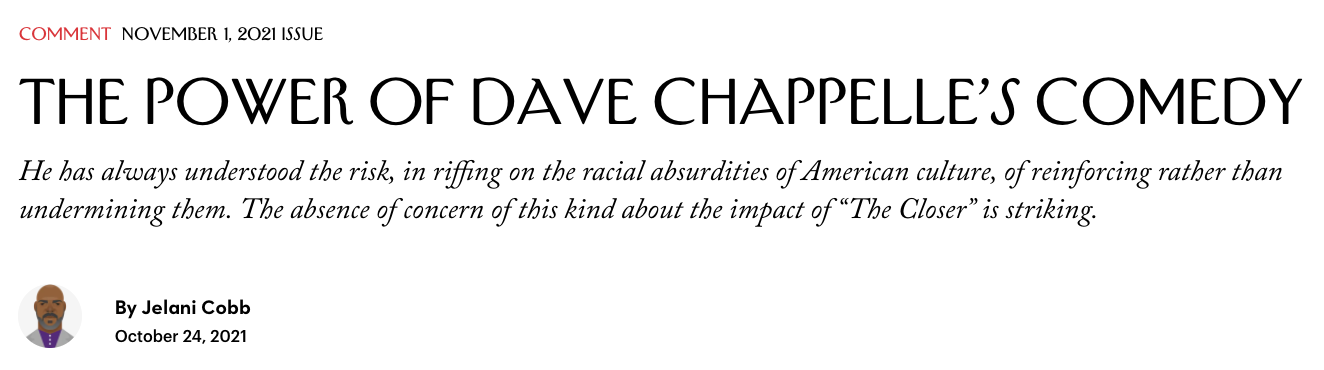
Every now and then an essay will seem insufficient on some level. It’s saying something intelligent but what? That Dave Chappelle is rich? That’s it? All I know is that this New Yorker piece about the discordant reaction to Dave Chappelle‘s The Closer, written by Jelani Cobb and dated 10.24.21, is lacking on some level. The phrasing needs to be blunter, cruder, more declarative.
Excerpt: “The Closer marks a new iteration of the ongoing debate about cancel culture, but not necessarily for the reasons that Chappelle intended.
“In 2005, it meant something for a Black man to reject an enormous pile of money in the name of integrity. The past two weeks reiterated a contrasting point: that Black men, too, can be invested in the prerogatives that wealth purchases. Earlier this year, Netflix removed old episodes of Chappelle’s Show from the platform at the comedian’s request, forgoing the revenue it would have reaped, after he called the contract that allowed Comedy Central to profit from the show more than a decade and a half after its release exploitative. Sarandos has dismissed requests from trans employees that The Closer be removed.
“The most reactionary and dangerous parts of our current politics and culture are driven by powerful people who claim to be the victims of groups that are far more vulnerable than they are. The irony is that these dynamics are increasingly present in matters of racism.
“Days after The Closer aired, Chappelle performed at a sold-out event at the Hollywood Bowl, before an audience that included Nas, Lizzo, Stevie Wonder, Brad Pitt and Tiffany Haddish. He remains powerful and influential, despite the protests from a comparatively small community of activists and their supporters. The turbulence around The Closer will, in all likelihood, amount to just another speed bump in Chappelle’s path. In gliding through this situation, he has emphasized a fact about power that was never particularly noteworthy. Because the one thing that has not been cancelled is the check.”
“There’s no doubt Diana, Princess of Wales went through some tough times as she navigated her initiation into royal life and later her crumbling marital relationship.
“But is this really how we should remember a woman who, after all, campaigned for causes close to her heart, brought joy to the people she met and established herself as a style icon like no other? Doesn’t she deserve to be portrayed as far more than someone who was too scared to go down to dinner with the in-laws?” — from a 10.24 Telegraph piece by Bethan Holt, titled “Diana’s inner circle on Spencer: ‘She’d be horrified at the way she’s portrayed now'”
Kristen Stewart‘s Diana isn’t just skittish about having dinner with the in-laws. She’s behaves like a kind of royalmadwoman, disturbed and beset by visions of Anne Boleyn and whatnot…almost on the level of Julie Harris‘s “Eleanor” in the last third of The Haunting…a kind of sketchycuckoobird in a surreal mindscape movie…a kind of nightmarish Stepford Wives (or wife) in the country.
Filed on 9.4.21: I’ve said before that Pablo Larrain‘s Spencer (Neon/Topic, 11.5) is agony to sit through. It’s a simplistic, impressionistichead–tripfilm…a “poor free-spirited, pheasant-sympathizing, pearl necklace-loathing Diana vs. the cold, bloodless gargoyle royals” bullshit borefest.
It has a half-decent singalong ending (“All I Need Is A Miracle”) but otherwise pretty much stays in the same place start to finish.
Call it Diary of a Mad, Super-Privileged Princess on the Verge of a Nervous Breakdown. Not, alas, directed by Pedro Almodovar but Pablo Larrain.
Stewart will be Best Actress-nominated, I’m presuming. The movie is appalling but she’s very good at what she’s been asked to do — let’s leave it at that. Her Diana speaking voice is breathy and whispery and hardtounderstand, but that’s okay. We enjoy being kept in the dark about certain things.
Spencer follows the wokester narrative that white elitism is evil and rancid and needs to be resisted at all costs. Because Diana needs to breathe, love, live, talk to pheasants and save her sons from those toxic royal traditions and soul-smothering attitudes.
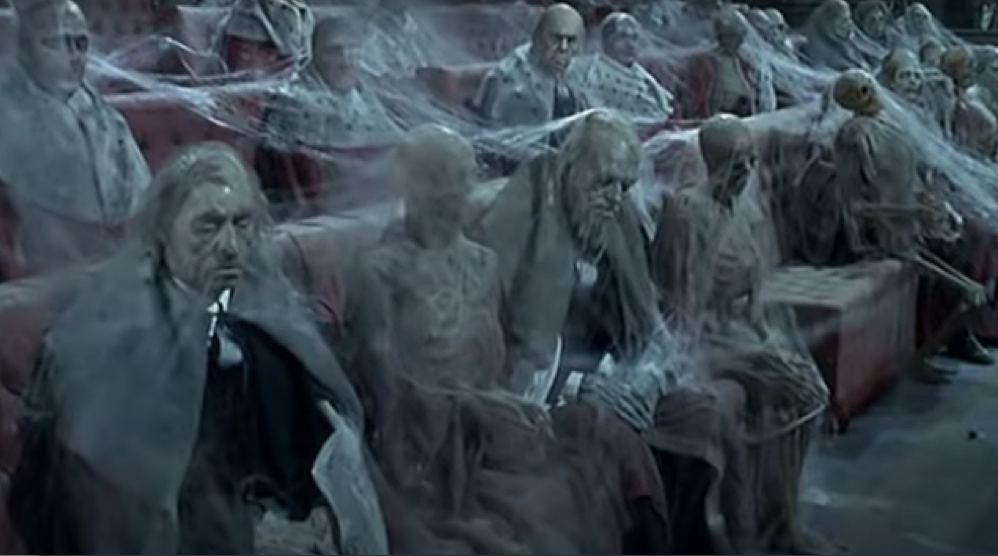
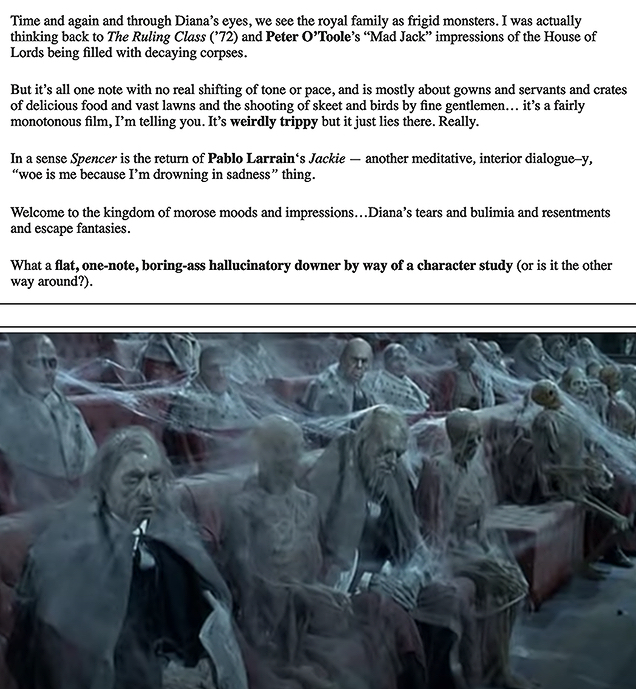
Time and again and through Diana’s eyes, we see the royal family as icy monsters. I was actually thinking back to The Ruling Class (’72) and Peter O’Toole’s “Mad Jack” impressions of the House of Lords being filled with decaying corpses.
Jordan Ruimy: “Diana is portrayed as a total lunatic. She feels stuck and victimized, but is part of the most white-privileged of circumstances. You have no sympathy for her whatsoever. You just wish she could go see a therapist or get proper medication.”
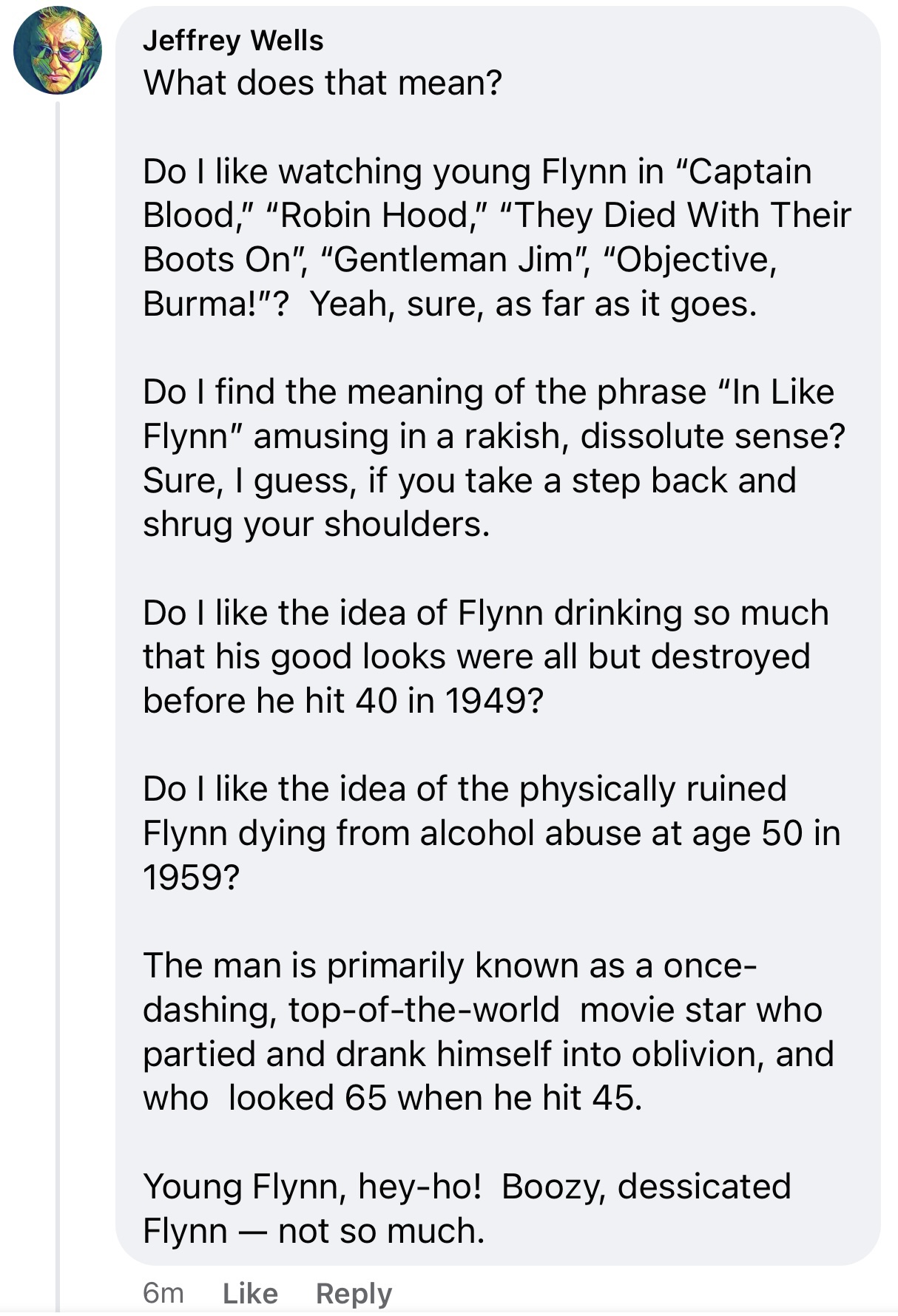
When asked if they “like” Errol Flynn, every last thread commenter except myself answered in the affirmative — “Yes!…love the man!…rakishly charming and handsome!…great buckler of swash!” and so on.
Consider this portion of a speech he gave during the 18th annual meeting of the Valdai International Discussion Club in Sochi. The excerpt was posted by Rebel News and forwarded by Jordan Ruimy:
Putin: “We look in amazement at the processes underway in the countries which have been traditionally looked at as the standard-bearers of progress. Of course, the social and cultural shocks that are taking place in the United States and Western Europe are none of our business. We are keeping out of this.”
“Some people in the West believe that an aggressive elimination of entire pages from their own history, ‘reverse discrimination’ against the majority in the interests of a minority, and the demand to give up the traditional notions of mother, father, family and even gender…they believe that all of these are [milestones] on the path towards social renewal.
“Listen, I would like to point out once again that they have a right to do this, [but] we are keeping out of this. But we would like to ask them to keep out of our business as well. We have a different viewpoint, at least the overwhelming majority of Russian society — it would be more correct to put it this way — has a different opinion on this matter. We believe that we must rely on our own spiritual values, our historical tradition and the culture of our multiethnic nation.”
“The advocates of so-called ‘social progress’ believe they are introducing humanity to some kind of a new and better consciousness. Godspeed, hoist the flags as we say, go right ahead.”
“The only thing that I want to say now is that their prescriptions are not new at all,” Putin continued as he highlighted the similarities between woke progressives to the Soviet revolutionaries who took over Russia.”=
“It may come as a surprise to some people, but Russia has been there already. After the 1917 revolution, the Bolsheviks, relying on the dogmas of Marx and Engels, also said that they would change existing ways and customs and not just political and economic ones, but the very notion of human morality and the foundations of a healthy society. The destruction of age-old values, religion and relations between people, up to and including the total rejection of family (we had that, too), encouragement to inform on loved ones — all this was proclaimed progress and, by the way, was widely supported around the world back then and was quite fashionable, same as today.
“By the way, the Bolsheviks were absolutelyintolerantofopinionsotherthantheirs.”
“This, I believe, should call to mind some of what we are witnessing now,” he said. “Looking at what is happening in a number of Western countries, we are amazed to see the domestic practices, which we, fortunately, have left, I hope, in the distant past.”
“The fight for equality and against discrimination has turned into aggressivedogmatism bordering on absurdity, when the works of the great authors of the past — such as Shakespeare — are no longer taught at schools or universities, because their ideas are believed to be backward,” he said.
“The classics are declared backward and ignorant of the importance of gender or race. In Hollywood, memos are distributed about proper storytelling and how many characters of what colour or gender should be in a movie. This is even worse than the agitprop department of the Central Committee of the Communist Party of the Soviet Union.”