Critical Race Theory By Way Of Hulu

The controversial “1619 Project,” an ambitious reframing and re-branding of U.S. history by way of the N.Y. Times, wokesterism and Critical Race Theory…a massive thesis, published on 8.14.19, that became known in some quarters as (a) historically questionable in some aspects, (b) “ideology masquerading as neutral scholarship” and (c) “a thesis in search of evidence, not the other way around,” will be presented as a documentary series via Hulu.

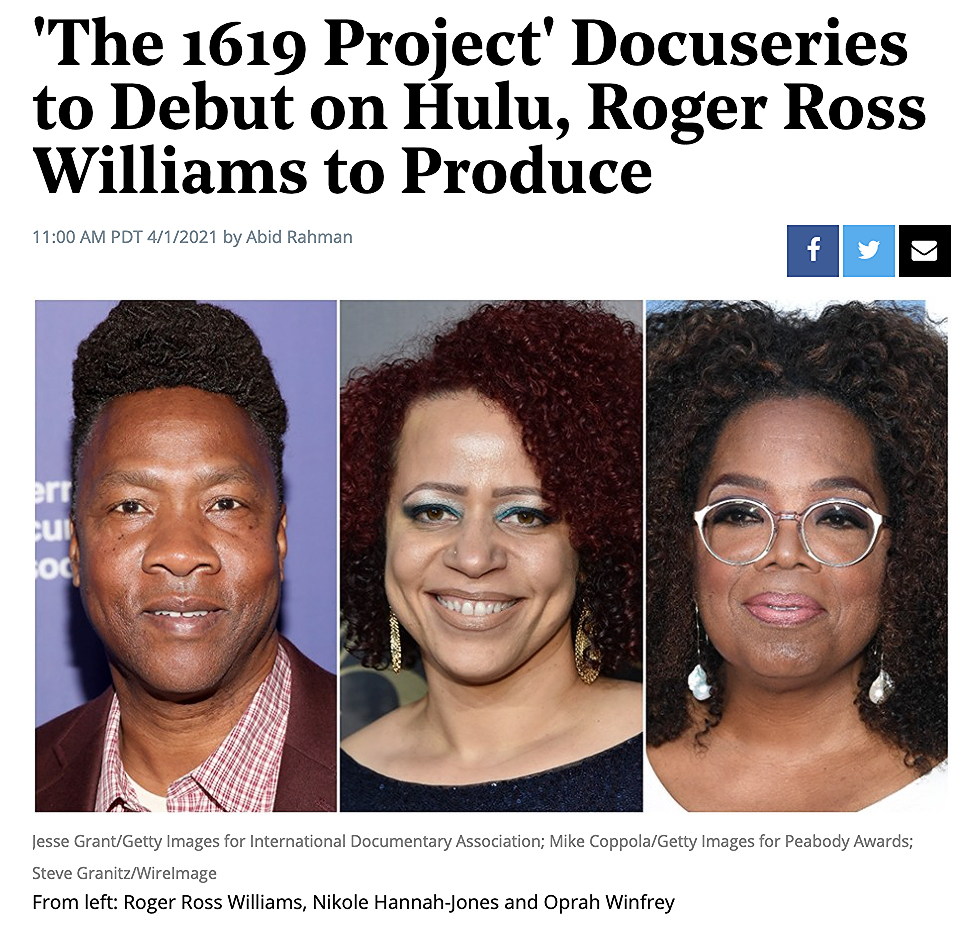
Roger Ross Williams will produce and oversee the series, and will also direct the first episode. Shoshana Guy will serve as showrunner and executive producer. Kathleen Lingo, editorial director for film and TV at The New York Times, will also executive produce as will Caitlin Roper. The series will be made in collaboration between Lionsgate Television, The New York Times, and Oprah Winfrey’s Harpo Films.
HE on 7.30.20: “Don’t tell me that slavery and racism is and always has been this country’s central definer. The 1619 Project’s revisionist zealotry rubs me the wrong way in more ways than I’d care to elaborate upon.

“Slavery has always been an ignominious chapter in the first 245 years of US history (1619 to 1865) and racism has stained aspects of the culture ever since, but to assert that slavery and racism (which other cultures have shamefully allowed over the centuries) are THE central and fundamental definers of the immense American experience strikes me as a bridge too far.

“One stone in the shoe is the 1619 Project’s contention that the American revolution against England was significantly driven by colonist commitment to maintaining slavery.

“Many factors drove the expansion and gradual strengthening and shaping of this country, and particularly the spirit and character of it — immigration, the industrial revolution and the cruel exploitations and excesses of the wealthy elites, the delusion of religion, anti-Native American racism and genocide, breadbasket farming, Abraham Lincoln, Frederick C. Douglas, the vast networks of railroads, selfishness & self-interest, factories, construction, the two world wars of the 20th Century, scientific innovation, native musical forms including jazz, blues (obviously African-American art forms) and rock, American literature, theatre and Hollywood movies, sweat shops, 20th Century urban architecture, Frank Lloyd Wright, major-league baseball, Babe Ruth & Lou Gehrig, family-based communities and the Protestant work ethic, fashion, gardening, native cuisine and the influences of European, Mexican, Asian and African cultures, hot dogs, the shipping industry, hard work and innovation, the garment industry, John Steinbeck, George Gershwin, Paul Robeson, Louis Armstrong, JFK, MLK, Stanley Kubrick, Chet Baker, John Coltrane, Marilyn Monroe, Amelia Earhart, Malcom X, Taylor Swift, Charlie Parker, Elizabeth Warren, Katharine Hepburn, Aretha Franklin, Jean Arthur, Eleanor Roosevelt, Carol Lombard, Shirley Chisholm, Marlon Brando, Woody Allen, barber shops & manual lawnmowers, the auto industry, prohibition & gangsters, the Great Depression and the anti-Communism and anti-Socialism that eventually sprang from that, status-quo-challenging comedians like Richard Pryor, Lenny Bruce and Steve Allen (“schmock schmock!”), popular music (Chuck Berry, Little Richard, Elvis Presley, Frank Sinatra and the Beatles), TV, great American universities, great historians, great journalism (including the National Lampoon and Spy magazine), beat poetry, hippies, the anti-Vietnam War movement, pot and psychedelia, cocaine, quaaludes and Studio 54, 20th & 21st Century tech innovations, gay culture, comic books, stage musicals, Steve Jobs, etc.”


Read more

Soap and Potatoes

Around 8 pm Wednesday evening I bought a bag of small red potatoes. The idea was to chop three or four into eighths and boil them, and then add sautéed onions, a squeeze of lemon, garlic, sour cream, salt and a little butter. I did the chopping and boiling but forgot about the rest due to the distraction of a film Tatiana and I were watching — Karel Reisz and James Toback’s The Gambler (‘74j.

12 or 13 minutes later I remembered about the potatoes. I ran into the kitchen, grabbed a wooden spoon and began stirring the boiling water. Lo and behold, I found a mushy, gleaming bar of hand soap boiling in the same pot…the fuck? I scooped it out and put it into the soap dish, and then poured the potatoes into a strainer and dumped them into a serving bowl.

They tasted like potatoes covered in soap sauce. Brilliant!

This really happened around 9:30 pm. Tatiana was doubled over. “Jeff…only you could do this,” she said between spasms. “You’re crazy!” Maybe but this was an accident. Okay, I’m eccentric but nobody boils soap and potatoes.

Twitter Eruption Put To Bed?

Yesterday Variety‘s Matt Donnelly and Elizabeth Wagmeister riffed about the coming “Armie Hammer iceberg” that will allegedly make things difficult for Disney’s Death on the Nile when it opens on 2.11.22 — Valentine’s Day.

It is presumed that the ugly social-media saga that has dogged Hammer, who plays a significant role in the new Hercule Poirot mystery, will somehow diminish the film’s commercial prospects. Kenneth Branagh has directed the film as well as played Poirot.

This reminded me of another potential p.r. difficulty awaiting Disney marketing when Steven Spielberg‘s West Side Story opens on 12.10.21, or roughly 70 days before the Death on the Nile debut.

I’m speaking, of course, of that bizarre Ansel Elgort Twitter furor that erupted on or about 6.18.20 over allegations of an inappropriate relationship between Elgort, the star of West Side Story, and a young woman named “Gabby” back in December 2014, when she was 17 and Elgort was 20.

The Twitter charges included sexual assault as well as, nonsensically, pedophilia. For two or three days #MeToo and safe-space Twitter wanted Elgort dead and dismembered. Even though the liason apparently happened in New York State, where the age of consent is 17.

To go by available assertions, nothing that happened between them even flirted with the legal definitions of assault or pedophilia.

On 6.19.20 I mentioned that the same kind of relationship happened between 20-year-old Paul McCartney and 17-year-old Celia Mortimer, in the fall of 1962. McCartney later wrote a song about his relationship with Mortimer called “I Saw Her Standing There“, which was released on 3.22.63.

England’s age of consent was 16 at the time so McCartney was legally in the clear.

HE excerpt: “But if, God forbid, 2020 cancel culture had somehow descended upon early ’60s England like a flash flood, McCartney might have sustained serious career damage if Mortimer had decided to accuse him after-the-fact of ‘sexual assault’, which can sometimes be translated as ‘it was my first time and a bit painful, and the sex wasn’t followed by tender emotional caresses and perhaps the beginning of a serious relationship, and so I felt used.'”

Nine months have elapsed between the June 2020 Ansel-Gabby blowup and today. I’m presuming that clearer heads have prevailed and that even the Twitter fanatics who went crazy last June understand that nothing especially horrible (certainly not in a legal sense) happened. So maybe it’s all over and nothing will kick up again.

Rian Johnson Is Flush

The decision by Netflix to cough up $400 million to make two streaming sequels to Knives Out means…well, it’s kind of a major blow to theatrical exhibition as well as Lionsgate. But Rian Johnson is now (and very suddenly) an “in the chips” filmmaker.

Johnson has written the two Knives Out sequels and will now direct them with Daniel Craig reprising his role as the Hercule Poirot-like Benoit Blanc.

The big HE question is whether or not Ana de Armas‘ “Marta”, the central character in Johnson‘s original Knives Out, will return in the sequels. If so, Johnson will have to decide if she’ll continue to wear those annoying Saks Fifth Off hipster pants (cuffs three or inches above the shoe line) that only upmarket, cutting-edge Millennial women and style-enslaved actresses wear.

If Johnson is smart he’ll steer clear of this questionable wardrobe choice and start fresh. If, that is, de Armas will be returning in the first place.

Eight years ago Johnson and I shared a nice Indian dinner in Paris. We met at the now-shuttered Angeethi (36 rue de la Roquette) as Johnson had just been to a Wagner opera at the Bastille Opera. Johnson was the first Hollywood hotshot to urge me to try Uber, which I had never ridden at that point. He also told me about Tunnel Bear, a VPN service that was created in 2011.

Minneapolis Masks

I began wearing Covid masks on a daily basis in mid-March 2020. Masks had become mandatory all over the country (certainly among employees of markets and convenience stores) between then and late March. The George Floyd tragedy happened on 5.25.20. So why, I’m wondering, was no one wearing a mask inside that Minneapolis store on the day that Floyd passed a counterfeit $20 bill and was soon after murdered by Derek Chauvin?

Obviously a side issue, but weird nonetheless.

“All Athletes and Poets…”

The more I hated the hyper jackhammer insanity of Uncut Gems (’19), which wasn’t so much “directed” as mainlined by the crazy hypodermic Safdies, the more I fell in love with the memory of Karel Reisz and James Toback‘s The Gambler (’74) — a film that considers the gambling-junkie pathology in tragic-poetic terms.

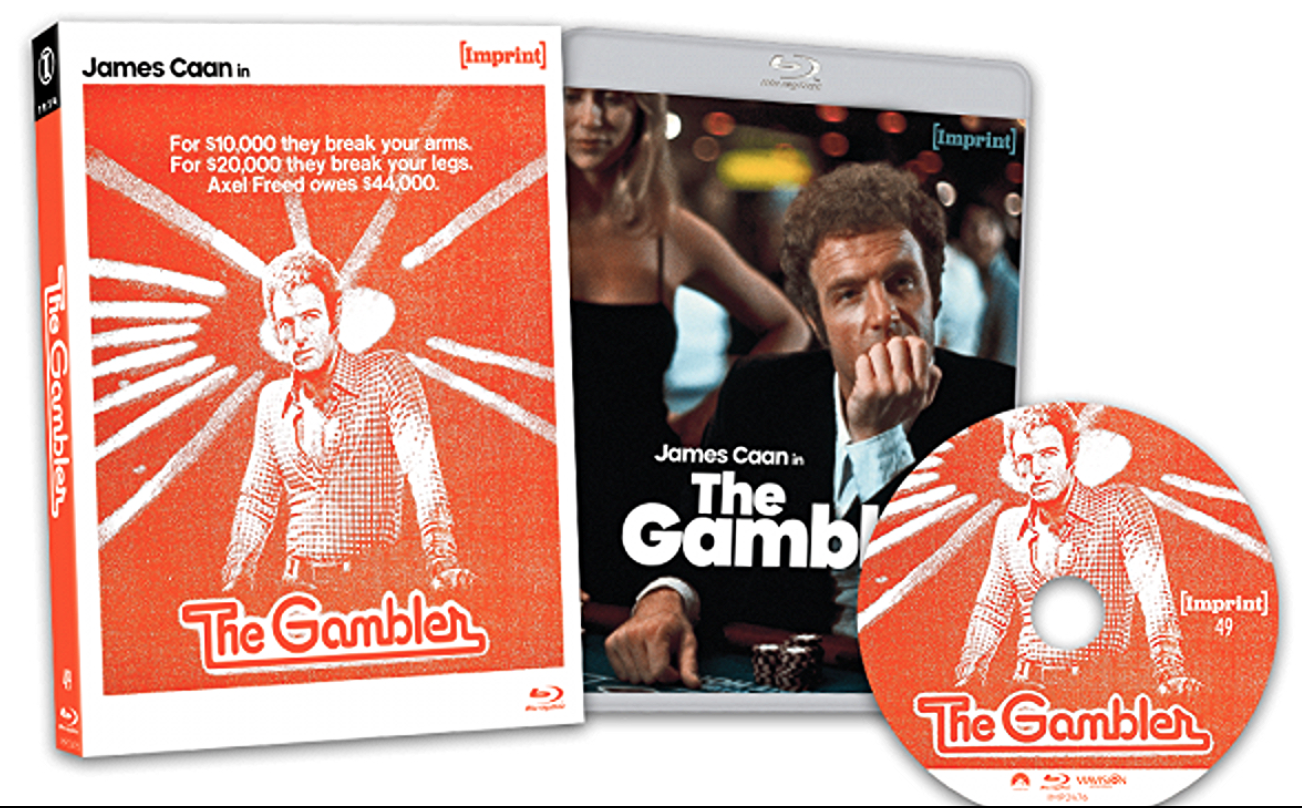
I can rent a high-def streaming copy any day of the week, but I’d love to own a first-rate Bluray as a keepsake. An Imprint Bluray is out on 5.26.21, at a cost of $34.95, Isn’t that a bit much? And isn’t the orange packaging a stopper? It sure is on this end.

Remember This?

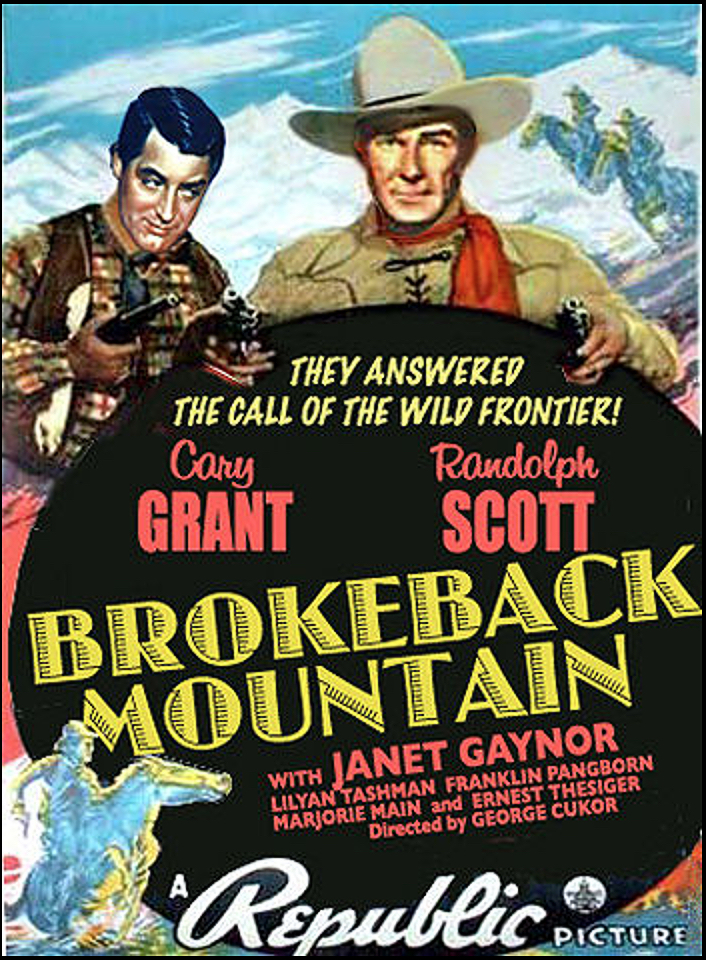
Cary Grant could’ve never played a truck-driving Montana sheepherder type. Not with that Bristol accent and all. He could only play variations of his “Cary Grant” persona. But when and if technology were to allow for a George Cukor-flavored Brokeback Mountain with Grant and Randolph Scott in the Jake Gyllenhaal and Heath Ledger roles…okay, it’s a silly idea. But imagine the possibilities when and if classic films could be remade and recast at will.

I’ve been day-dreaming about digital recreations along these lines for 30 years now. I wrote a piece about them for Empire back in ’92.

Old White Guys Boosting “Promising Young Woman”?

Seasoned Filmmaker to HE: “I’ve come to strongly believe that Promising Young Woman is hitting the 60-plus White Male Academy voters (which still constitute the majority) in a sweet spot, and that for this reason Emerald Fennell‘s film is bound to be the upset Best Picture winner that Parasite was last year. Trust me — Promising Young Woman is the film that ALL my voter colleagues in LA and overseas are raving about.”‘

HE to Seasoned Filmmaker: “Really? Huh. And what do your friends think of Nomadland?”

Seasoned Filmmaker to HE: “Non-urgent admiration for Nomadland.”

HE to Seasoned Filmmaker: “I feel the same way about Nomadland but at least it doesn’t have a glaring error like Promising Young Woman — it has more overall integrity and a unity of purpose.

“But can you tell me why older white guys are so taken with Promising Young Woman?

“It’s a dry, arch & acrid indictment film of not most but ALL young males on the prowl. It doesn’t say most of them are indecent predators (a harsh but arguably valid point of view) but ALL of them are, as even Bo Burnham’s nice guy pediatrician boyfriend is revealed at the end to be a friend and apologist of a rapist.

“On a certain level I admire Fennell’s boldness of vision (however extreme) because this is how strong social-vision directors have tended to operate from Salvador Dali and Luis Bunuel onward. But pulling the rug out on audiences during the last 15 minutes by suddenly identifying Burnham as just another bad guy is a mark of mediocre writing — a capitulation to an industry-wide rule that a last-minute twist is required of all scripts.”

Seasoned Filmmaker to HE: “So many Older White Male Academy members have a skeleton in their closet. Younger Academy men do as well. Moonlight and Parasite allowed the Academy to atone for #OscarsSoWhite. Right now Academy members want more than anything to not be caught on the wrong side of Cancel Culture. Promising Young Woman is this year’s Parasite.”

HE to Seasoned Filmmaker: “Okay, got it — Promising Young Woman has a possible edge on the Best Picture Oscar because of the Woke Terror factor. It’s the culturally safe choice — a kind of ‘get out of jail’ card to be used in case of an emergency.”

Seasoned Filmmaker to HE: “It’s all in the mind…but yes.”

Forebodings of “Nobody Cares” Oscars

Ask anyone in any shopping mall in this country what the main problem with the Oscars is, and you’ll get the same answer: Oscar voters are virtue-signalling elitists who live in their own separate, politically-correct corner of the culture, and so they often nominate movies or performances that don’t mean that much to those who live in non-industry regions.

Sure, Average Joes will tune in when a really good film that they’ve paid to see is nominated for Best Picture, but how often does that happen?

I’ve said over the years that you can’t make the Oscars too populist — that would mean the death of a true quality metric because people out there…I wouldn’t say they have no taste but they’re certainly lacking in that regard. Certainly by the standards of the great Francois Truffaut — “Taste is a result of a thousand distastes.”

But you also can’t make the Oscars too woke or average Americans will tune out. Because wokesters and cancel-culturalists are despised by something like two-thirds of the American public.

Said it before, saying it again: If I was emperor I would put wokesters in pillories and encourage passersby to pelt them with vegetables.

It falls right into line, therefore, that a new poll from Guts + Data (and passed along by Variety‘s William Earl) says that most of the public hasn’t heard of (probably because they don’t want to hear about) the current Best Picture nominees.

Among 1500 persons polled, none of the Best Picture nominees were recognized by more than 50%. Only 18% know or care about Mank, despite the easy Netflix access. Only 23% are aware of Sound of Metal. Only 24% have heard of The Father and Minari — less than as quarter of the population! A bit more than a third have heard of Promising Young Woman (34%) and Nomadland (35%).

The Best Picture nominees with the highest awareness are The Trial of the Chicago 7 (39%) and Judas and the Black Messiah (46%).

In other words, in case you haven’t heard, the current Oscar contenders and forthcoming Oscar telecast will go down in history as the dud Oscars, the nobody-gives-a-shit Oscars, the asterisk Oscars, the pandemic Oscars.

A few months ago Bill Maher explained why the Oscar brand means as little as it does these days out in Joe & Jane Popcorn-land — wokesterism, virtue signalling, snowflake concerns, Twitter plague, etc.

Here he is again:

Cautionary Tale

I was in line for a screening of something or other at the the Los Angeles County Museum theatre, way back in the good old rickety days when Ron Haver was running the film series. And some people were praising Robert Altman‘s The Long Goodbye (’73), a revisionist Phillip Marlowe flick with Elliott Gould, and I was joining in and saying “yeah, I love it…it understands the ’70s and the way things are now.”

And suddenly there was some snarly old guy putting the Altman film down for being an unfocused mess and saying it denigrated the classic hard-boiled chops of Raymond Chandler‘s Marlowe books, and saying that Howard HawksThe Big Sleep (’46) was ten times better in this regard…a tougher, snazzier detective film with saucy writing and the right kind of noirish overlay.

I remember saying to myself “jeez, don’t ever become that guy when you get older…resentful of new attitudes and new ways of telling stories…don’t ever become the cranky guy who always says ‘the older films were better and the newer films suck.’ Always try to understand and appreciate the newer stuff. Or at the very least, don’t close yourself off to whatever’s new and developing. Keep an open mind.”

Here’s the problem: ’40s detective films had a certain proficiency and ’70s revisionist films (satires or whatever) had a certain attitude or flavor, but the films of right now don’t seem to have a great deal of flavor or conviction or anything…they don’t seem to stand up to the ’40s and the ’70s, quality- or intrigue-wise. I don’t know what’s going on now, but it doesn’t feel like much. Maybe things will change when theatres open up again, and maybe they won’t. Maybe we can’t go home again and it’s all streaming from here on.

Now I’m wondering if I’ve become that snarly LACMA guy.

But you know something? The Big Sleep was a better Phillip Marlowe film than Altman’s The Long Goodbye, even if Altman’s film was a richer, more ambitious film across the board.

Altman obviously wasn’t into the classic Marlowe brand…the romance and machismo and crusty attitudes. He was mainly using an old Chandler book to explore the way things were in mid ’70s Los Angeles, and making sardonic fun of the culture and how things seemed to be percolating at the time…Gould buying cat food at 3 am, cruising around town in a 1948 Lincoln Continental, Marty Augustine living in Trousedale Estates and “juicing guys so I can juice the guys I gotta juice,” hippie yoga chicks dipping candles, etc.

I’m basically saying that both films have aged fairly well, and that the old cranky guy wasn’t totally full of shit.

Michael Winner Avoidance Syndrome

In a recent Facebook thread author and former Variety critic Joseph McBride confessed to feeling ashamed about being an extra in Michael Winner‘s Death Wish II (’82).

McBride: “I was an extra in Death Wish II. I have a copy [of the film] but have never been able to watch it.”

McBride offers a little background: “Christa Fuller and I were walking across a street as Charles Bronson ran to catch a bus. Christa asked me to walk between her and the camera. I asked why, and she said, ‘Because I don’t want my friends at Cahiers du Cinéma to see that I am in a Michael Winner film.'”

Hilarious!

McBride: “We were on that location only because we wandered down Olympic Blvd. during a break from Sam shooting White Dog. Christa wanted to see her friend Tony Wade, who was on Winner’s crew. Winner was screaming at his cameraman (his third, after firing two earlier), and the crew [people] were openly laughing at the director, sometime I had never seen before and have never seen since then. As an extra I was paid five dollars, the least money I received for appearing in a film. Even Roger Corman paid his extras $15 a day.”

HE to readership: What films or TV shows are you currently ashamed of having worked on, if any?