Forebodings of “Nobody Cares” Oscars

Ask anyone in any shopping mall in this country what the main problem with the Oscars is, and you’ll get the same answer: Oscar voters are virtue-signalling elitists who live in their own separate, politically-correct corner of the culture, and so they often nominate movies or performances that don’t mean that much to those who live in non-industry regions.

Sure, Average Joes will tune in when a really good film that they’ve paid to see is nominated for Best Picture, but how often does that happen?

I’ve said over the years that you can’t make the Oscars too populist — that would mean the death of a true quality metric because people out there…I wouldn’t say they have no taste but they’re certainly lacking in that regard. Certainly by the standards of the great Francois Truffaut — “Taste is a result of a thousand distastes.”

But you also can’t make the Oscars too woke or average Americans will tune out. Because wokesters and cancel-culturalists are despised by something like two-thirds of the American public.

Said it before, saying it again: If I was emperor I would put wokesters in pillories and encourage passersby to pelt them with vegetables.

It falls right into line, therefore, that a new poll from Guts + Data (and passed along by Variety‘s William Earl) says that most of the public hasn’t heard of (probably because they don’t want to hear about) the current Best Picture nominees.

Among 1500 persons polled, none of the Best Picture nominees were recognized by more than 50%. Only 18% know or care about Mank, despite the easy Netflix access. Only 23% are aware of Sound of Metal. Only 24% have heard of The Father and Minari — less than as quarter of the population! A bit more than a third have heard of Promising Young Woman (34%) and Nomadland (35%).

The Best Picture nominees with the highest awareness are The Trial of the Chicago 7 (39%) and Judas and the Black Messiah (46%).

In other words, in case you haven’t heard, the current Oscar contenders and forthcoming Oscar telecast will go down in history as the dud Oscars, the nobody-gives-a-shit Oscars, the asterisk Oscars, the pandemic Oscars.

A few months ago Bill Maher explained why the Oscar brand means as little as it does these days out in Joe & Jane Popcorn-land — wokesterism, virtue signalling, snowflake concerns, Twitter plague, etc.

Here he is again:
Cautionary Tale

I was in line for a screening of something or other at the the Los Angeles County Museum theatre, way back in the good old rickety days when Ron Haver was running the film series. And some people were praising Robert Altman‘s The Long Goodbye (’73), a revisionist Phillip Marlowe flick with Elliott Gould, and I was joining in and saying “yeah, I love it…it understands the ’70s and the way things are now.”

And suddenly there was some snarly old guy putting the Altman film down for being an unfocused mess and saying it denigrated the classic hard-boiled chops of Raymond Chandler‘s Marlowe books, and saying that Howard HawksThe Big Sleep (’46) was ten times better in this regard…a tougher, snazzier detective film with saucy writing and the right kind of noirish overlay.

I remember saying to myself “jeez, don’t ever become that guy when you get older…resentful of new attitudes and new ways of telling stories…don’t ever become the cranky guy who always says ‘the older films were better and the newer films suck.’ Always try to understand and appreciate the newer stuff. Or at the very least, don’t close yourself off to whatever’s new and developing. Keep an open mind.”

Here’s the problem: ’40s detective films had a certain proficiency and ’70s revisionist films (satires or whatever) had a certain attitude or flavor, but the films of right now don’t seem to have a great deal of flavor or conviction or anything…they don’t seem to stand up to the ’40s and the ’70s, quality- or intrigue-wise. I don’t know what’s going on now, but it doesn’t feel like much. Maybe things will change when theatres open up again, and maybe they won’t. Maybe we can’t go home again and it’s all streaming from here on.

Now I’m wondering if I’ve become that snarly LACMA guy.

But you know something? The Big Sleep was a better Phillip Marlowe film than Altman’s The Long Goodbye, even if Altman’s film was a richer, more ambitious film across the board.

Altman obviously wasn’t into the classic Marlowe brand…the romance and machismo and crusty attitudes. He was mainly using an old Chandler book to explore the way things were in mid ’70s Los Angeles, and making sardonic fun of the culture and how things seemed to be percolating at the time…Gould buying cat food at 3 am, cruising around town in a 1948 Lincoln Continental, Marty Augustine living in Trousedale Estates and “juicing guys so I can juice the guys I gotta juice,” hippie yoga chicks dipping candles, etc.

I’m basically saying that both films have aged fairly well, and that the old cranky guy wasn’t totally full of shit.

Michael Winner Avoidance Syndrome

In a recent Facebook thread author and former Variety critic Joseph McBride confessed to feeling ashamed about being an extra in Michael Winner‘s Death Wish II (’82).

McBride: “I was an extra in Death Wish II. I have a copy [of the film] but have never been able to watch it.”

McBride offers a little background: “Christa Fuller and I were walking across a street as Charles Bronson ran to catch a bus. Christa asked me to walk between her and the camera. I asked why, and she said, ‘Because I don’t want my friends at Cahiers du Cinéma to see that I am in a Michael Winner film.'”

Hilarious!

McBride: “We were on that location only because we wandered down Olympic Blvd. during a break from Sam shooting White Dog. Christa wanted to see her friend Tony Wade, who was on Winner’s crew. Winner was screaming at his cameraman (his third, after firing two earlier), and the crew [people] were openly laughing at the director, sometime I had never seen before and have never seen since then. As an extra I was paid five dollars, the least money I received for appearing in a film. Even Roger Corman paid his extras $15 a day.”

HE to readership: What films or TV shows are you currently ashamed of having worked on, if any?

On The Death of Gordon Liddy

In Lawrence of Arabia, Peter O’Toole‘s T.E. Lawrence extinguishes a lit match by squeezing it between his fingers. When William Potter tries the same thing he cries out and says “it damn well hurts!” and demands to know what the trick is. Lawrence’s reply: “The trick, William Potter, is not minding that it hurts.”

Audiences have always been impressed by Lawrence’s enigmatic reply. Burning your skin with a match is obviously a weird thing to do, but people admire anyone who has an indifference to pain.

In All The President’s Men, which opened 14 years after Lawrence, Hal Holbrook‘s “Deep Throat” told Robert Redford‘s Bob Woodward a story about Watergate burglar Gordon Liddy (it starts in the below video around 1:31):

“I was at a party once, and Liddy put his hand over a candle, and he kept it there. He kept it there until his flesh was burned. Somebody said ‘what’s the trick?’ and Liddy said ‘the trick is not minding.'”

Exact same bit, different impressions. Holbrook was telling Redford (and the ATPM audience) that Liddy was an eccentric weirdo and possibly a dangerous character. It’s all in the context.

Read more

Inky, Overbearing 4K “Commandments”

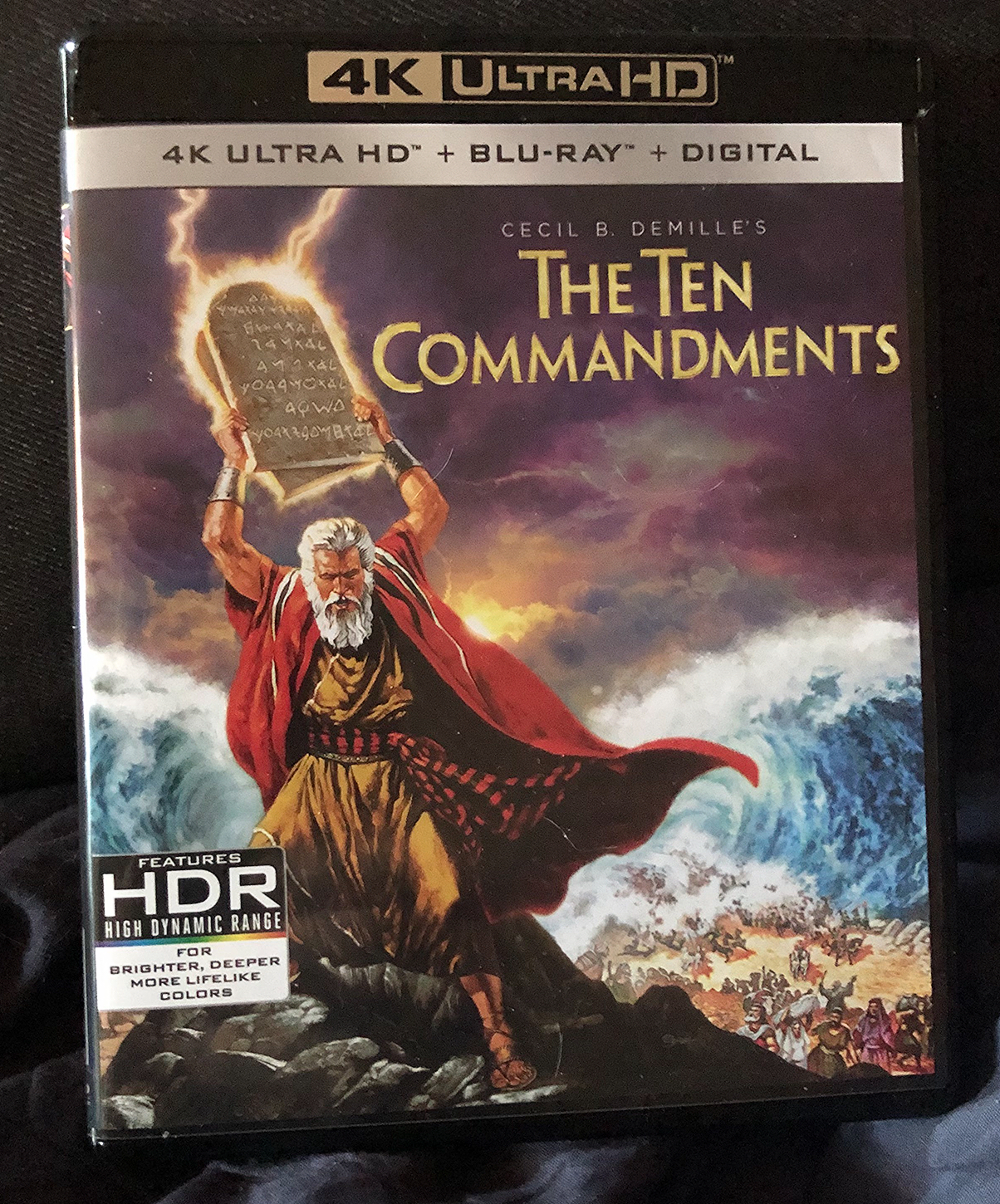
Paramount Home Video’s 4K Bluray of The Ten Commandments arrived today. The package also includes a 1080p version based on a ten-year-old harvest, and I have to be honest: I prefer the 1080p version to the 4K.

I’m sorry but the 4K Commandments tries too damn hard…too intense, too inky, too contrasty, too fierce. I think it’s fair to call it slightly obnoxious.

The 1080p version, by contrast, is absolutely perfect. It glows, bathes and sharpens; it saturates and radiates VistaVision perfection, and it made me go “wow, wow, wow, double-wow, triple-wow, quadruple-wow, quintuple wow.”

I’m not sure if the new 1080p Bluray version is better than the ten-year-old version that I reviewed on 3.24.11, but I do know (or think that I know) that this new 1080p version seems more bountiful than it did before.

Maybe I’m fooling myself, or maybe it looks better now because I’m watching it on a better TV…a 4K HDR 65-inch 4K Sony that I bought four or five years ago…what do I know?

All I know is that my eyes were much happier as they watched the 1080p than when they endured the overbearing 4K version. I don’t care if this review makes me sound like Buddy Ebsen‘s Jed Clampett or some old-schooler who doesn’t really get the glories of 4K. I know what I like and I like what I like, and if the 4K flim-flammers don’t like what I’m saying here, too bad.

Remember when LexG used to say that he was accustomed to watching VHS tapes or 480p DVDs of movies and that he didn’t want to know from Blurays, and that tapes and DVDs of movies were “good enough”?

Well, that’s me right now — I’m LexG saying that the Ten Commandments 1080p Bluray is a radiant eye-popper and that it’s more than good enough and that the 4K…well, it may be fine for others but it’s just not for me.

It was almost exactly ten years ago (3.24.11) when I wrote that Paramount Home Video’s Ten Commandments Bluray “is fairly close to magnificent. It’s a visual bath of the first order.

“The costumes, the golden armor, the beards, the wood grain, the jewelry, the matted hair on the donkeys and oxen…all the remarkable little details that are part of any well-photographed, large-format, big-event film just keep on coming. The glossy, freshly-painted chariots are a trip in themselves.

“I’m not exaggerating — this is one of the most excitingly detailed Blurays I’ve ever seen.

Read more

Toothless, Chinese-Curated “Study Tour”

Consider a two-day-old 60 Minutes report, moderated by Lesley Stahl, about the origins of Covid-19 and the refusal of the World Health Organization to attempt a serious, real-deal investigation of what happened.

It focuses on a WHO excursion to Wuhan earlier this year. Technology futurist and geopolitics expert Jamie Metzl, who suspects that the coronvavirus may have came from a lab leak, is the good guy in the report. EcoHealth Alliance president Peter Daszak is the bad guy.

60 Minutes transcript excerpt: “The question: how did SARS-CoV-2, the virus that causes COVID-19, originate? Among the leading theories examined: was it accidentally leaked from a lab in Wuhan or did it come from infected animals in a wet market there?

“The WHO inquiry was far from comprehensive, because, as it has done since the beginning of the outbreak, the Chinese government withheld information.

Jamie Metzl: “I wouldn’t really call what’s happened now an investigation. It’s essentially a highly-chaperoned, highly-curated study tour.”

Lesley Stahl: “Study tour!”

Metzl: “Study tour. Everybody around the world is imagining this is some kind of full investigation. It’s not. This group of experts only saw what the Chinese government wanted them to see.”

Metzl — former NSC official in the Clinton administration and member of a WHO advisory committee on genetic engineering — is one of more than two dozen experts, including virologists, who signed an open letter earlier this month calling for a new international inquiry with a return to China.

The letter says the WHO team did not have the independence or access “to carry out a full and unrestricted investigation” specifically into a possible accidental leak from a laboratory at the Wuhan Institute of Virology in the city where the first outbreak occurred.

Metzl: “We would have to ask the question, ‘Well, why in Wuhan?’ To quote Humphrey Bogart, ‘Of all the gin joints in all the towns in all the world, why Wuhan?’ What Wuhan does have is China’s level-four virology institute, with probably the world’s largest collection of bat viruses, including bat coronaviruses.

Stahl: “I had seen that the World Health Organization team only spent three hours at the lab.”

Metzl: ‘While they were there they didn’t demand access to the records and samples and key personnel.

That’s because of the ground rules China set with the WHO, which has never had the authority to make demands or enforce international protocols.

Read more

40 Years On…

Forty years ago today John Hinckley tried to kill President Ronald Reagan outside the Washington Hilton. The 25 year-old Hinckley fired six shots. One hit press secretary James Brady in the head and left him with permanent brain damage. (Brady died on 8.4.14.) A bullet hit police officer Thomas Delahanty; another hit Secret Service agent Tim McCarthy in the chest. And another bullet ricocheted off a car door and hit Reagan in the ribs. He survived.

According to Moving Picture Blog‘s Joe Leydon, at the time an interim arts editor with the Dallas Morning News, “early reports indicated Reagan was a goner.” The paper’s film critic Philip Wuntch “was out in Los Angeles for the Oscars,” Leydon recalls, “and he filed an absolutely brilliant overview of Reagan’s movie career on about one hour’s notice.

A day earlier (or on 3.29.81) Leydon interviewed Lee Marvin, who was visiting the USA Film Fest in Dallas. Leydon: “I joked with him that he had shot the President — Ronald Reagan — in [Don Siegel‘s] The Killers (1964), Reagan’s last movie. ‘Yeah,’ Marvin responded with a wolfish grin, ‘but he wasn’t President yet when I shot him.'”

Meanwhile up in Manhattan I was working for a modest McGraw Hill company called Product Information Network (PIN). I was glad for the employment (I was working on a large report about landfill compactors) but for the most part I was miserable. I remember being alarmed by the news about Reagan, but not quite emotionally distraught on a JFK-in-Dallas level, Reagan being a Republican and all.

The 65-year-old Hinckley, by the way, has been a relatively free man since September 2016. On 7.27.16, a federal judge ruled that Hinckley could be released from St. Elizabeths mental hospital as he was no longer considered a threat to himself or others. Hinckley was released from institutional psychiatric care on 9.10.16, with “many” conditions. He was required to live full-time at his mother’s home in Williamsburg, Virginia.

Read more

Blackened Peanut Shells

John Bailey, camera operator on Days of Heaven (starting at 13:15):

“Normally the locusts would have been done in visual effects. But I think Nestor [Almendros] came up…maybe it was Nestor and Terry [Malick] but I know Nestor was instrumental in deciding that we could [shoot swarms of locusts] in actual production.

“I remember that we had the Panaflex with a reverse-run magazine. It was backloaded on the take-up side [and] we ran the camera backwards. So what happened was there was a plane that came by, full of peanut shells that were painted black. [And they were tossed out of the plane] so they were all coming down, but since the camera was running backwards it looked like [the peanut shells] were rising up into the air. And we had the actors also reverse their motion. I remember that we rehearsed it. Very carefully.”

Ship Has Sailed

Industry impressions of Nomadland (mostly approving with some dissenters) have settled in. They are what they are. IMAX screenings aren’t going to move the needle. You know what I’d love to see in a first-rate, real-deal IMAX theatre? Tenet. With subtitles, of course.

Reality Must Be Faced

The daily jazz-spewings and soul-searchings of Hollywood Elsewhere have been totally free-of-charge for 16 and 2/3 years, starting in August ’04. I really wish I could keep going like this, but ad revenue has been dwindling over the last three years, largely due to Khmer Rouge wokelisting. I regrettably have no choice but to convert HE into a paywall site. It breaks my heart but the situation is the situation.

I became a significant journo player in the early ’90s when I began with Entertainment Weekly and the L.A. Times “Calendar” section. I became a weekly LA Times Syndicate columnist starting in the fall of ’94, and then a biweekly online columnist (Mr. Showbiz, Reel.com) in October of ’98. HE independently launched in August ’04, and the daily bloggy-blog format kicked in in the spring of ’06.

HE was a moderately successful operation between ’06 and ’09, and then a flush site between ’10 and ’17.

Alas, Wokester Robespierre-ism (i.e., pushed by the sensibilities of Millennial and Zoomer-aged agency buyers) has resulted in moderately diminished ad revenues over the last three years.


Just to be clear, HE will NOT become a Patreon site but a similar self-created paywall site of my own specific design and contouring

I’ve been working on trying to transfer HE into a total paywall site (or a mostly paywall one) for the last three months or so. In December-January my son Dylan, who’s always been super-brilliant at this stuff, created a test system with Patreon. Except I’ve decided that I don’t want HE to be a Patreon site. I want to have my own paywall revenue going straight into my PayPal account.

And yet I want to create the same kind of deal that the Patreon thing would have been. Readers would be able to read the first four or five lines of each story before it fades into grayness and then nothing….unless they’re a subscriber. Or something like that.

In ’18 and ’19 I tried a separate paywall site called HE Plus — the idea was that one or two stories would be paywalled on HE Plus. But doing this made me feel overwhelmed, like my head was a cantaloupe being split in two. I tried and tried but it was driving me crazy. I couldn’t continue it. I was ready to shoot myself.

I’m figuring that for the new thing I would charge a $5 monthly cheapie rate OR $10 monthly for an enhanced HE experience — (a) regular daily column plus (b) access to bimonthly serialized HE novel installments plus (c) a bi-weekly podcast plus (d) access to ’90s and early aughts columns archived and re-formatted and re-examined. Or a $70 annual flat rate for the highest access of everything.

This is similar to what Graydon Carter‘s Air Mail and the Daily Wire charges.

I’m currently speaking to a couple of people to help install this new system. It’s not that tricky. WordPress has a paywall function. I’m sure it will all pan out. I want to be up and rolling by May 1st or May 15th…sometime around then.

HE to loyal readers who’ve been with me since ’98: I’m very sorry that economic conditions have forced me to do this. I wish I could just keep going for free. Alas, I can’t. Ad revenue will continue (Oscar + Emmys) but as long as wokesters are making the ad-buying calls it won’t be enough.

Feldman Chronicle, Part 2

Seven days ago I raved about the Kino Lorber Bluray of Marty Feldman‘s The Last Remake of Beau Geste (’77), which is considerably enhanced by Alan Spencer‘s delicious, I-was-there-because-I-was-Marty’s-friend commentary track.

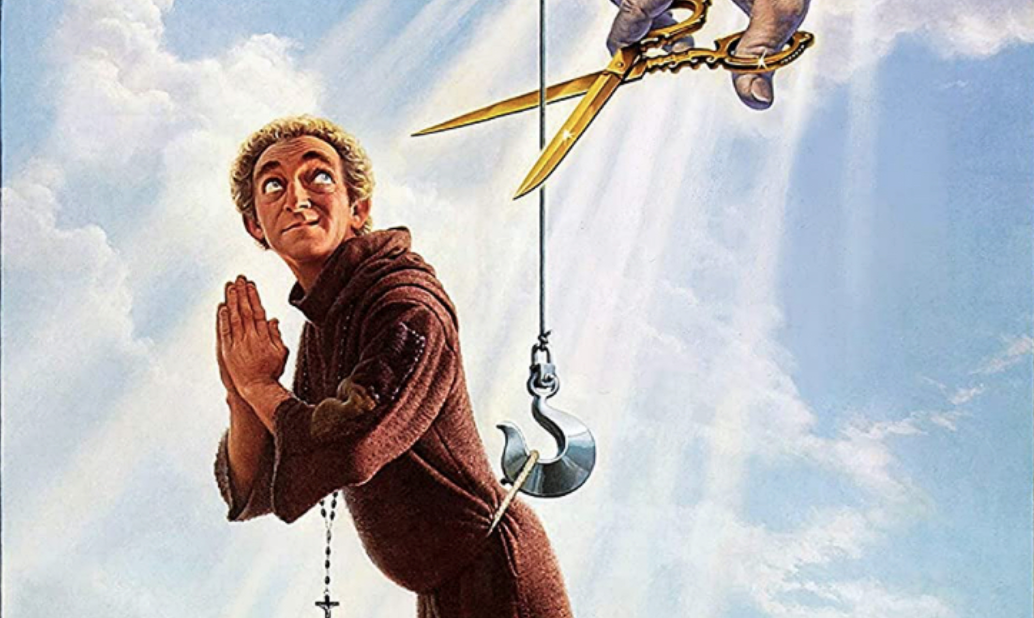
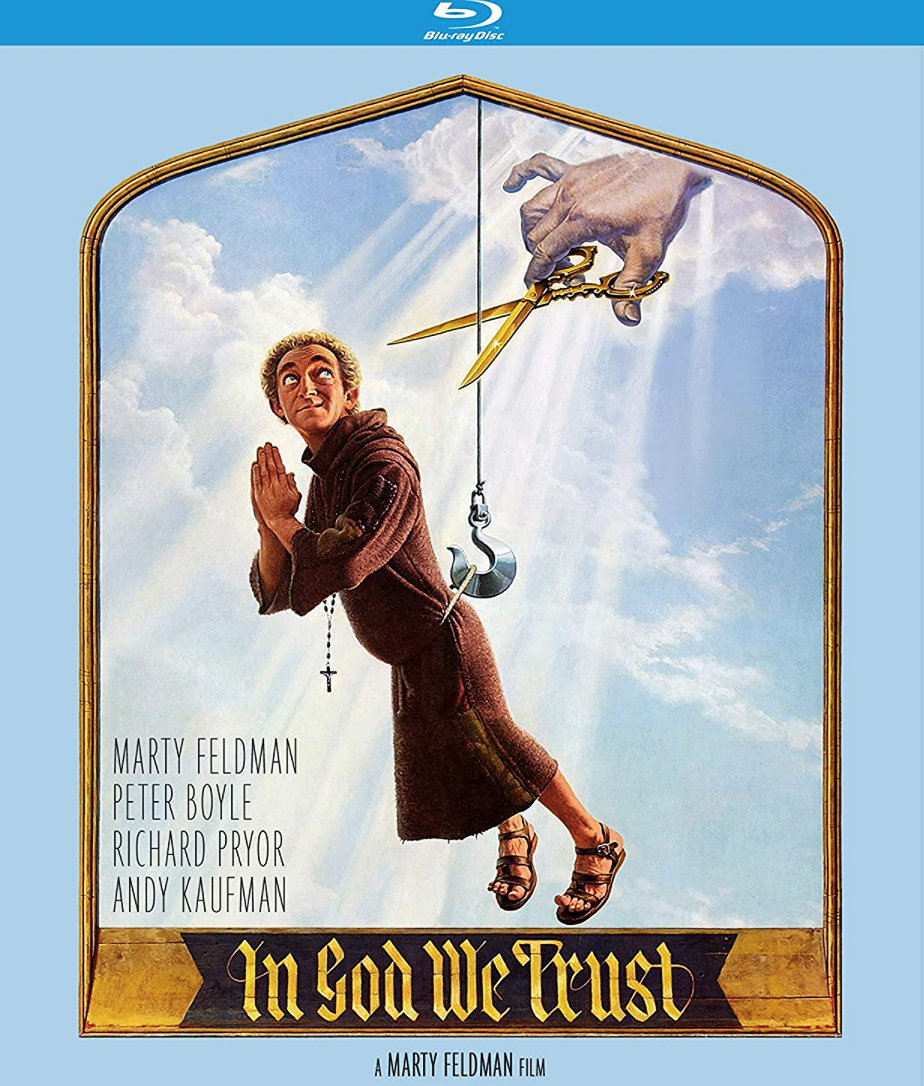
A day or two later I watched a KL companion disc — a Bluray of Feldman’s In God We Tru$t, a 1980 anti-religion, anti-corporate satire that proved to be Feldman’s undoing.

The film contained a brief riff that insulted Universal/MCA by comparing it morally to the Ku Klux Klan. Feldman was told to remove the bit but he refused, contractually fortified as he was with final cut. In so doing he effectively terminated his five-film deal with Universal.

Plus In God We Tru$t wasn’t very funny. Not a total wash (it’s an inventive effort and carefully assembled) but that mescaline-in-the-blood feeling was in low supply.

Spencer’s commentary is just as first-hand candid and knowledgable as his Beau Geste shpiel, but the God We Tru$t saga is basically a downer. I’m sorry but it’s hard to feel intrigued, much less turned on, by a story about a comic genius who simultaneously killed himself (Feldman smoked five to six packs of cigarettes per day) and deep-sixed his career at roughly the same time. It’s an emotional tale from Spencer’s perspective, but tinged with a wasteful residue.

Feldman died of a heart attack in a Mexico City hotel in 1982, while filming Yellowbeard.

Son of Aching Calf Muscles

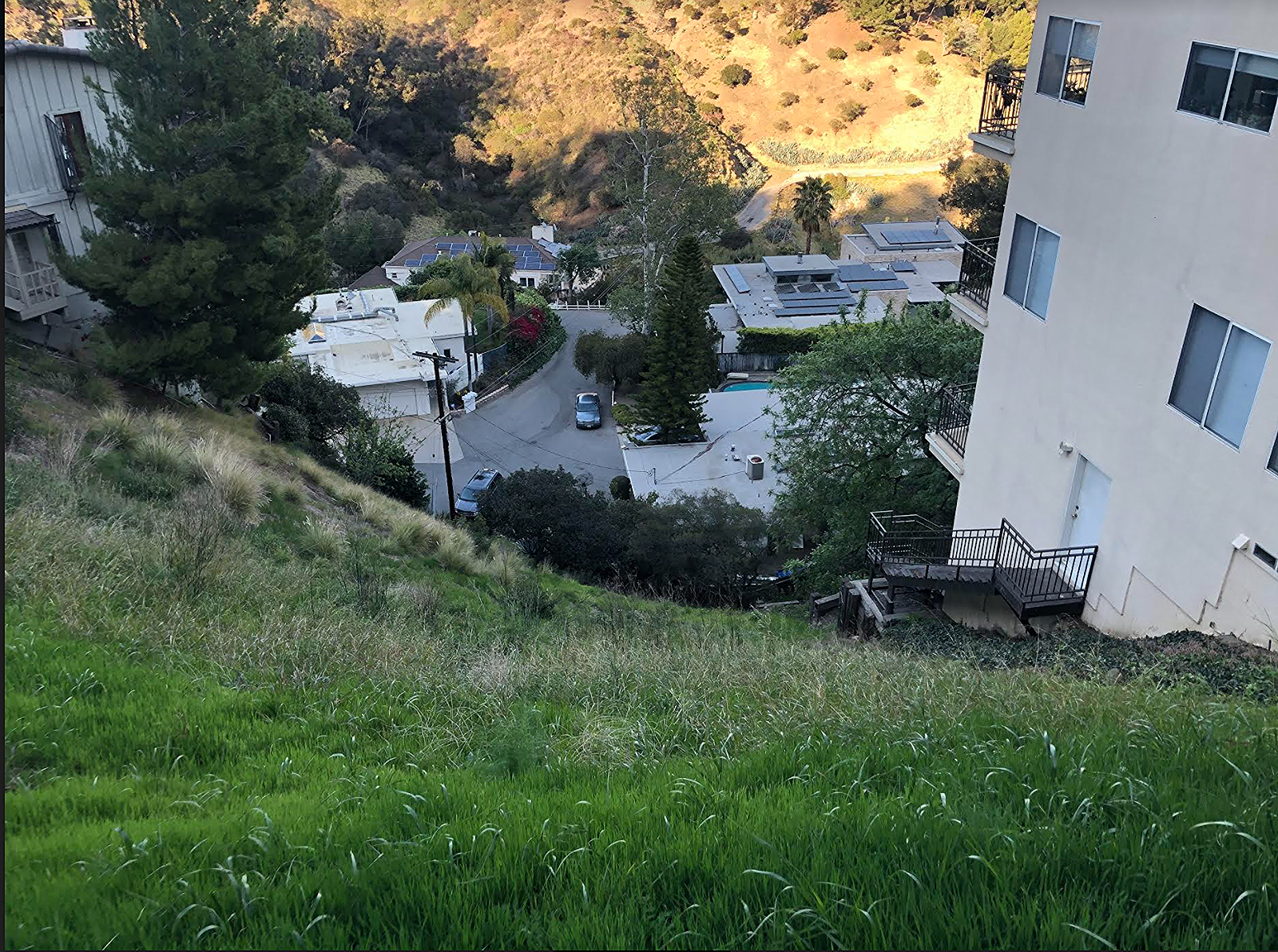
Our favorite Sunday hiking path…Whittier Drive and Lexington, north to Bridle Lane and then left on Angelo Drive and up, up, up and winding like a snake, right on Davies Drive, up and down and winding down to Cielo Drive and down to Benedict Canyon south, right on Roxbury and back to Lexington. Roughly a two-hour journey including breathers.

Read more