Armie Never Ate Flesh

…and weasels never ripped it.

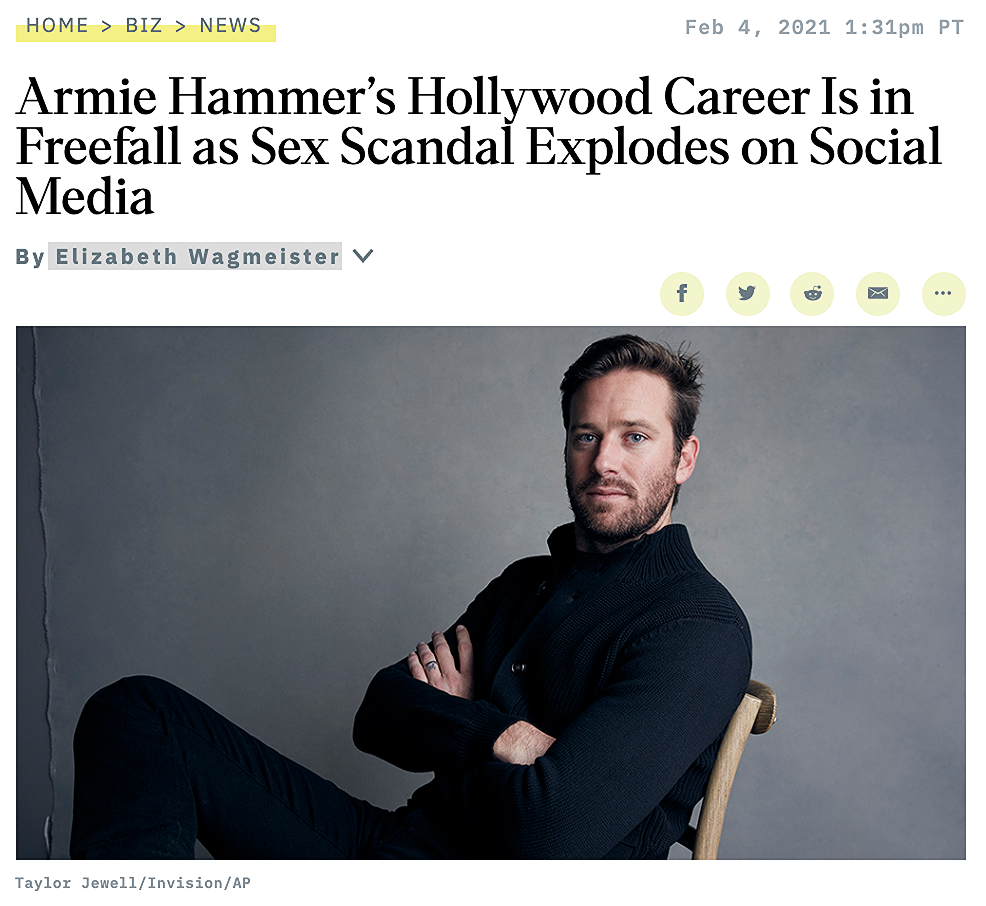
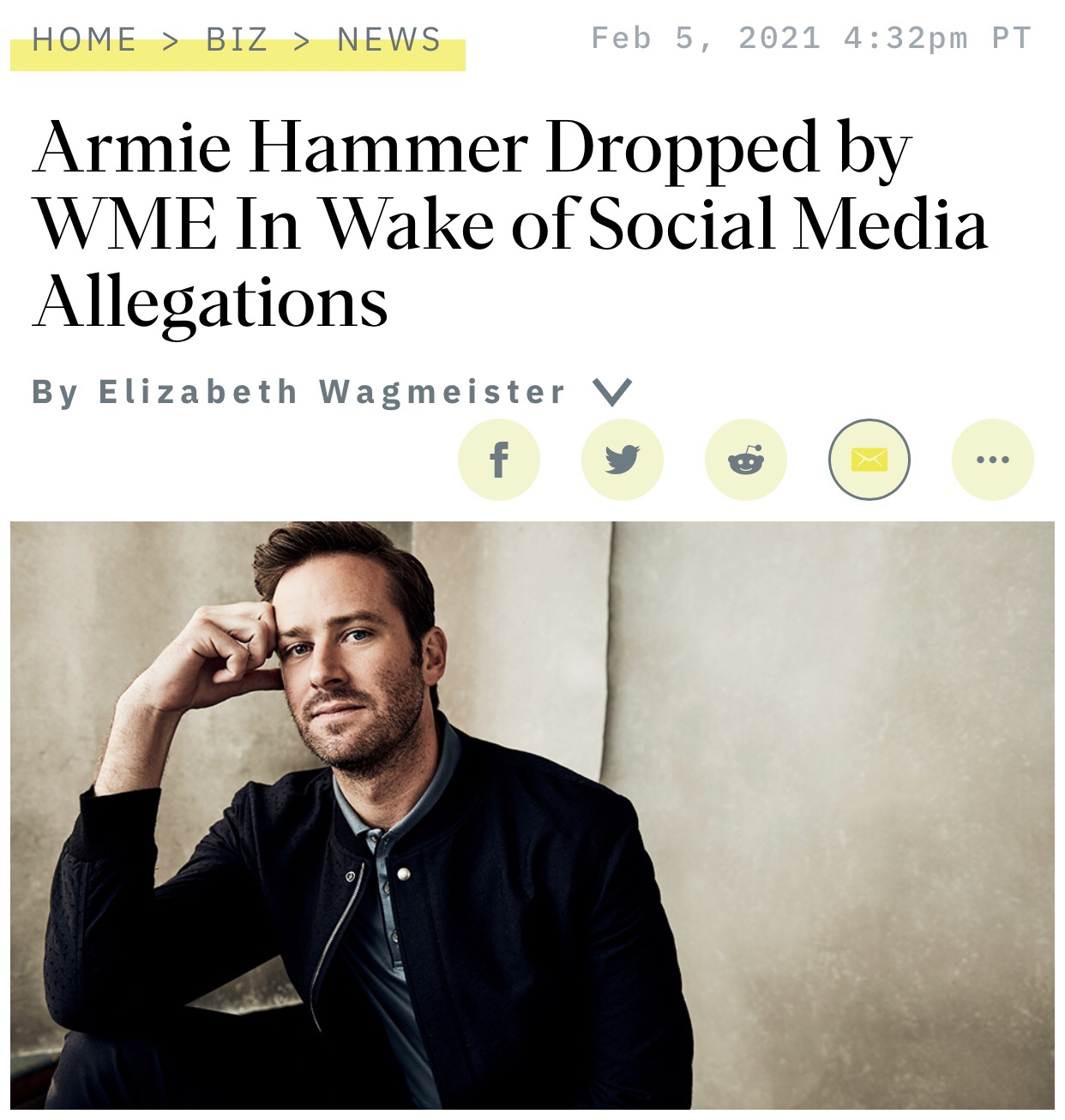
Anonymous source who’s “close to [Armie] Hammer“, speaking to Variety‘s Elizabeth Wagmeister: “[Armie has] never eaten human flesh, he has never drank blood, he has never cut off a toe, he has never locked anybody in a cage, or whatever else is in these crazy messages.

“These messages definitely shouldn’t be taken literally — even if he did text them. Anyone can say what they want and solicit craziness on Instagram or TikTok or Clubhouse. People think that kinky sex is weird and taboo, and maybe it is to most people, but clearly there are adults who engage in it and enjoy it.”

This is what I’ve been saying all along about the cannibal thing. Hammer describing himself in a text message as a “cannibal” didn’t literally allude to the eating of flesh, for heaven’s sake, but to the idea of cunnilingus cannibalism — voraciously tongue-bathing a certain area of a woman’s anatomy with exceptional vigor.

Trump to SAG/AFTRA: “Eat It”

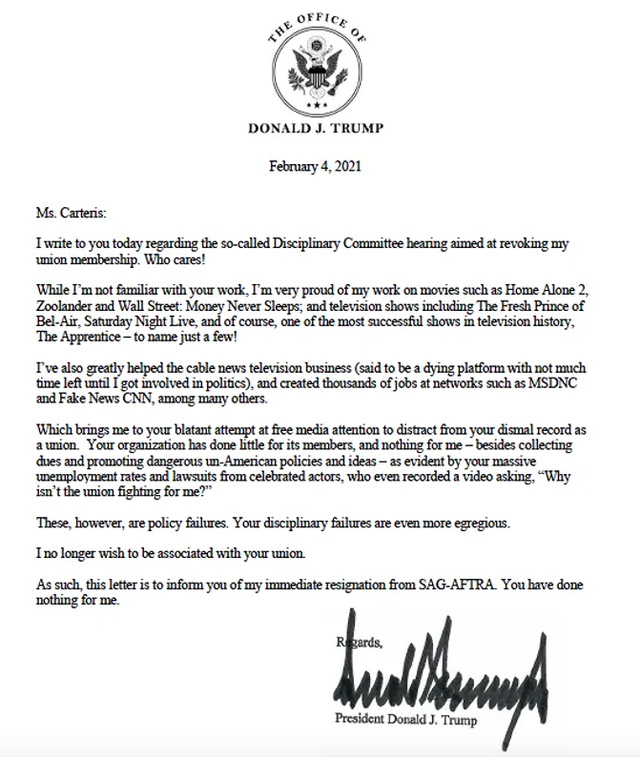
Ex-President Donald Trump resigned today from the Screen Actors Guild after learning that the union’s Disciplinary Committee was planning to give him the boot.

Excerpt: “I write to you today regarding the so-called Disciplinary Committee hearing aimed at revoking my union membership. Who cares! Because I quit! In fact, why don’t you guys fly down to Palm Beach, come upstairs, put on blindfolds, drop to your knees and take turns doing the unspeakable?”

Trump didn’t actually write that last sentence, and the second-to-last sentence reads “this is to inform you of my immediate resignation from SAG/AFTRA.” Same difference.

Read more

SAG Nom Assessments

The SAG Ensemble Award (Outstanding Performance by a Cast in a Motion Picture) is somewhat akin to a Best Picture Oscar nomination, at least as far as SAG/AFTRA membership is concerned. So congrats to Spike Lee‘s Da 5 Bloods, Regina King‘s One Night in Miami and George C. King‘s Ma Rainey’s Black Bottom — a trio of historical films about the black experience — for snagging SAG Best Ensemble noms. And congrats to Netflix for producing all three.

Another attaboy back-pat for Lee Isaac Chung‘s Minari, a 1980s drama about a South Karean family attempting to settle in Arkansas. Hearty congrats are also offered to Aaron Sorkin‘s The Trial of the Chicago 7, which is set a half-century ago in Chicago and which principally deals with a ragtag group of fair-skinned ’60s radicals and their attorneys.

So the five best films of the year, in the view of SAG/AFTRA, are all history flicks — one set in the late 1920s, one in the mid ’60s, two in the late ’60s and one in the mid ’80s. On top of which Steve McQueen‘s Mangrove, HE’s choice for the best feature film of the year, is also set in the late ’60s — a trifecta.

It would have been interesting if at least one nominated film had some connection with the 21st Century, but that wasn’t on the table this year. A chief priority was the politics of representation, and I think it’s fair to say that this concern has been well represented today.

The most disturbing SAG/AFTRA announcement, IMHO, was the failure of members to nominate Sound of Metal‘s Paul Raci in the Best Supporting Actor category, and at the same time giving a nomination to Jared Leto for his psycho-hippie weirdo performance in The Little Things.

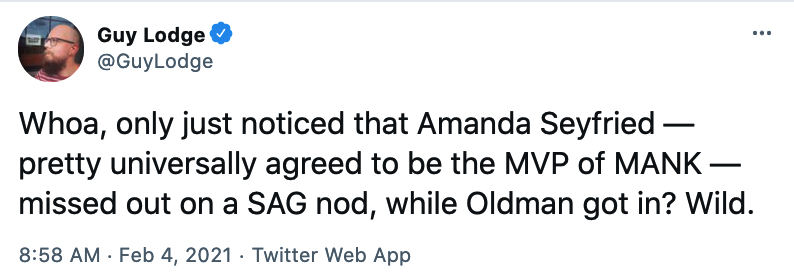
The second most unsettling thing was Mank‘s Amanda Seyfried, whose performance as Marion Davies was praised by everyone, being blown off while Mank topliner Gary Oldman was nominated for Best Actor, which in itself is fine.

In addition to handing Da 5 Bloods a Best Ensemble nom, the SAGsters also handed a Best Supporting Actor nom to the late Chadwick Boseman as well as a Best Stunt Ensemble nom to Lee’s film. Bloods costar Delroy Lindo, who was stiffed yesterday by the HFPA, was blown off again today.

The SAG awards will air on the evening of Sunday, April 4, at 6 pm Pacific (TNT/TBS).

Here’s a partial SAG rundown; HE picks are in boldface:

Outstanding Performance by a Cast in a Motion Picture / “Da 5 Bloods” (Netflix); “Ma Rainey’s Black Bottom” (Netflix); “Minari” (A24); “One Night in Miami” (Amazon Studios); “The Trial of the Chicago 7” (Netflix)

Outstanding Performance by a Female Actor in a Leading Role / Amy Adams (“Hillbilly Elegy”); Viola Davis (“Ma Rainey’s Black Bottom”); Vanessa Kirby (“Pieces of a Woman”);Frances McDormand (“Nomadland”) / Carey Mulligan (“Promising Young Woman”).

Outstanding Performance by a Male Actor in a Leading Role / Riz Ahmed (“Sound of Metal”); Chadwick Boseman (“Ma Rainey’s Black Bottom”); Anthony Hopkins (“The Father”); Gary Oldman (“Mank”); Steven Yeun (“Minari”)

Outstanding Performance by a Female Actor in a Supporting Role / Maria Bakalova (“Borat Subsequent Moviefilm”); Glenn Close (“Hillbilly Elegy”); Olivia Colman (“The Father”); Youn Yuh-Jung (“Minari”); Helena Zengel (“News of the World”).

Outstanding Performance by a Male Actor in a Supporting Role / Chadwick Boseman (“Da 5 Bloods”); Sacha Baron Cohen (“The Trial of the Chicago 7”); Daniel Kaluuya (“Judas and the Black Messiah”); Jared Leto (“The Little Things”); Leslie Odom, Jr. (“One Night in Miami”)

Scott Feinberg thought: “For performers overlooked by both groups — folks like Sophia Loren, Zendaya, The Way Back‘s Ben Affleck, News of the World‘s Tom Hanks, Malcolm & Marie‘s John David Washington, Ammonite‘s Kate Winslet” — yes! — “and Saoirse Ronan, Never Rarely Sometimes AlwaysSidney Flanigan and Talia Ryder, Sound of Metal‘s Paul Raci and Olivia Cooke, Nomadland‘s David Strathairn and Meryl Streep of both Let Them All Talk and The Prom — is it time to pack it in, or to double-down?”

HE to Feinberg: Raci should push on by all means — ignoring him is a grievous oversight by the HFPA and SAG/AFTRA….what’s wrong with you guys?

Friendo: “They’re going to blame all the Lindo snubs on racism .”
Getting This

Yes, I’m still a sentimental physical-media fool. The ardor has cooled over the last five years, but I’m still inclined to plunk down $20 on almost any decently remastered 4K Bluray of a respected, large-scale ’50s film. The key issue is whether or not it was shot in the VistaVision process. Which The Ten Commandments (’56) definitely was. How much better can it look? Will it deliver a significant bump over the 2011 Bluray version? My head tells me “maybe” but my gut says “naahh, probably not that much…okay, maybe a bit.”

Alfred Hitchcock‘s North by Northwest and To Catch A Thief were shot in VistaVision — what’s the hold-up? And what about the legendary Ben-Hur (’59), which was shot in Camera 65**? I’ve been “hearing” about a 4K version of William Wyler‘s multi-Oscar winner for several years now. The 60-year anniversary came and went two years ago.

Read more

Bend The Language

A couple of websites that post rock-song lyrics don’t understand what the female chorus is singing in Sting‘s “We’ll Be Together.” But I do, and I think it’s genius because it makes up its own and runs with it. Like in The Wizard of Oz, for example, when Ray Bolger‘s scarecrow sings “I’d unravel every riddle / for any individdle / in trouble or in pain.” Or the Cowardly lion rhyming “rhinoceros” and “impoceros.”

The second verse of Sting’s 1987 song goes as follows: “To have you with me I would swim the seven seas / I need you as my guide and my light / My love is a flame that burns in your name / we’ll be together / we’ll be together tonight.”

And then, according to genius.com, the chorus chimes in with “we’ll be together…yeah!”

That’s definitely not what they’re singing. They’re repeating Sting’s love mantra (as in “tell it to her, Gordon…shout it from the rooftops”), but abbreviated. They’re not singing “together” and certainly not “we’ll be together” — way too many syllables. They’re singing “togaahhhh” — as in “together” but with the last four letters abandoned and the middle “e” changed into an “aahh.”

When Sting and the chorus singers were rehearsing, he said “you’ll be repeating my central pledge but three syllables kills it, so just sing ‘togaahhh‘ and give it everything you’ve got.”

Read more

“CODA” Confidential

Hollywood Elsewhere saw Sian Heder ‘s much-adored, Sundance award-showered CODA this morning. It’s moderately appealing and nicely made for the most part. Understand, however, that it’s an “audience movie” — aimed at folks who like feel-good stories with heart, humor, romance and charm.

It’s about a shy Gloucester high-school girl named Ruby (Emilia Jones) with a decent if less than phenomenal singing voice. She’d rather attend Boston’s Berklee College of Music than work for her deaf family’s fishing business, we’re told. The film is about the hurdles and complications that she has to deal with in order to realize this dream.

CODA is one of those “real people struggling with life’s changes and challenges” flicks, but given the fishing-off-the-Massachusetts-coast aspect it’s fair to say it’s no Manchester By The Sea — trust me. It’s a wee bit simplistic and schticky and formulaic -— okay, more than a bit — and contains a fair amount of “acting.”


Emilia Jones in Sian Heder’s CODA.

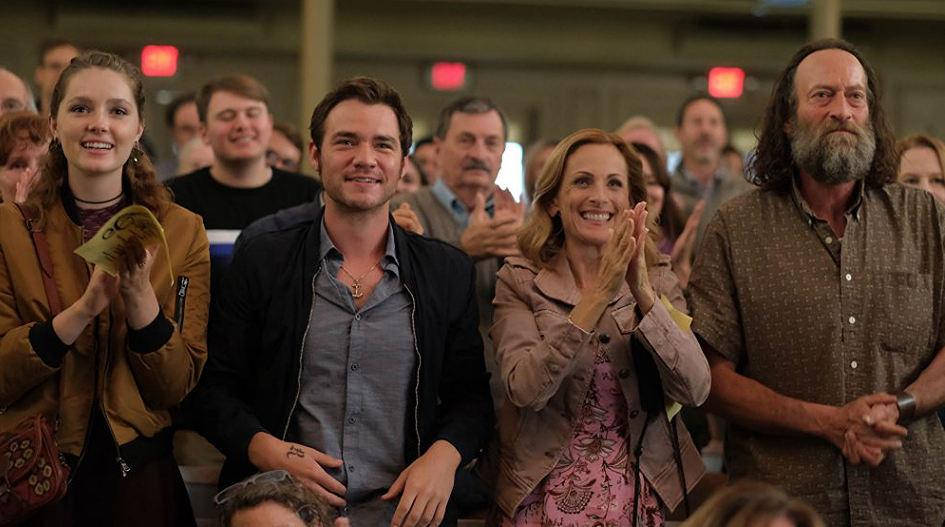
For my money Jones overplays the quiet, withdrawn, still-waters-run-deep stuff, but it’s an honest performance as far as it goes — she has an appealing, unpretentious rapport with the camera. Eugenio Derbez‘s performance as an eccentric, Mexican-born music teacher is probably the film’s best single element. Bearded, baggy-eyed Troy Kotsur and 54 year-old Marlee Matlin are engaging as Ruby’s live-wire parents.

Matlin and Kotsur are the source, actually, of some clunky sexual humor (frisky parents noisily going at it during the late afternoon, randy Kotsur urging chaste Ruby to make her boyfriend wear “a helmet” during coitus, that line of country). Except the jokes don’t really land, or at least they didn’t with me.

In a phrase, CODA is not a Guy Lodge film.

But CODA is an okay film. It works here and there. It didn’t give me a headache. I can understand why some are enthusiastic about it. It deserves a mild pass. Heder is a better-than-decent director.

Friendo: “It’s a by-the-numbers family romcom with an added progressive-minded openness for the deaf.”

(Posted from iPhone while waiting in line at the Tijuana border, heading back into the States.)

Netflix Leads in GG Noms; “Da 5 Bloods” Blanked

7:01 am Update: I have to stream a film within a narrow three-hour window starting right now, so I’ll have to complete and clean up my HFPA story late rthis morning.

Earlier: Netflix is proudly brandishing the top two most-nominated Golden Globe features — David Fincher‘s Mank and Aaron Sorkin‘s The Trial of the Chicago 7. Fincher’s Hollywood-based period drama has corralled six GG nominations — the most of any film. Sorkin’s political courtroom drama is the second most nominated film with five noms.

Spike Lee‘s Da 5 Bloods, a popular film among zeitgeist-influenced critics and the top vote-getter in a Best of 2020 critics poll from World of Reel‘s Jordan Ruimy last July, has been stiffed by the Hollywood Foreign Press Association. I’d heard that the HFPA membership wasn’t big on Lee’s film, but I didn’t think they’d blow it off entirely.

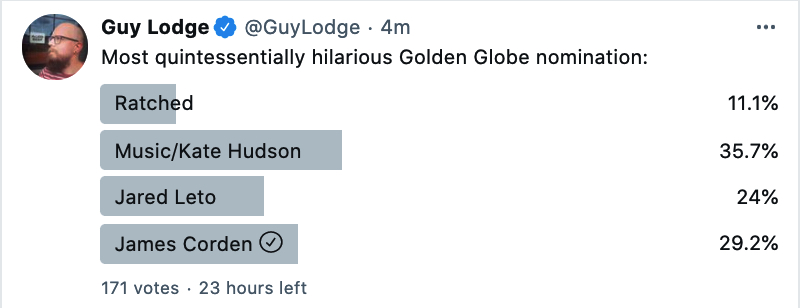
Help me out here…James Corden‘s flamboyant performance in The Prom is competing for a Golden Globe against Sacha Baron Cohen‘s standard-schtick performance in Borat Subsequent Moviefilm and Andy Samberg‘s overpraised Palm Springs performance…what is this?

Cohen was also nominated for a Best Supporting Actor Golden Globe for his Chicago 7 turn as Abbie Hoffman…fine. Judas and the Black Messiah‘s Daniel Kaluuya was also nominated in that category for playing Fred Hampton, despite LaKeith Stanfield‘s performance as William O’Neal being far more worthy.

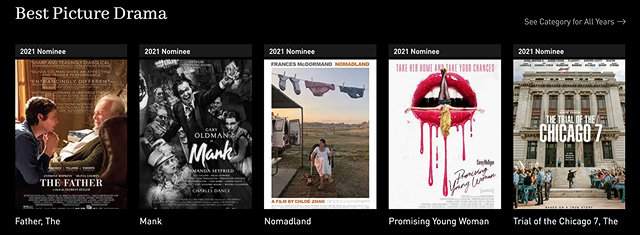
Best Motion Picture – Drama / “The Father” (Sony Pictures Classics), “Mank” (Netflix). “Nomadland” (Searchlight Pictures). “Promising Young Woman” (Focus Features), “The Trial of the Chicago 7” (Netflix)

Best Actor in a Motion Picture – Drama / Riz Ahmed, “The Sound of Metal” / Chadwick Boseman, “Ma Rainey’s Black Bottom” / Anthony Hopkins, “The Father” / Gary Oldman, “Mank” / Tahar Rahim, “The Mauritanian”

Best Actress in a Motion Picture – Drama / Viola Davis (“Ma Rainey’s Black Bottom”); Andra Day (“The United States vs. Billie Holiday”); Vanessa Kirby (“Pieces of a Woman”); Frances McDormand (“Nomadland”); Carey Mulligan (“Promising Young Woman”)

Read more

Fan Mail

In 1996 at age 23, Joanna Rakoff was hired at the storied New York literary agency Harold Ober Associates, which looked after the interests of the notoriously reclusive J. D. Salinger. Rakoff’s responsibilities included responding to the large volume of fan mail that Salinger was sent, Rakoff would respond with a generic response (i.e., “Salinger doesn’t read fan mail”). She eventually began composing thoughtful replies instead.

Her second novel, “My Salinger Year” (`14), is about Rakoff’s Ober/Salinger experiences. Philippe Falardeau‘s film adaptation, which premiered 11 months ago at the Berlin Film Festival, stars Margaret Qualley as Rakoff and Sigourney Weaver as her boss, Margaret (based on Salinger’s actual agent, Phyllis Westberg).

Warning: My Salinger Year currently has a tepid 68% Rotten Tomatoes rating.

“The gleaming presence of up-and-comer Margaret Qualley bolsters an otherwise mildly entertaining reheating of The Devil Wears Prada story template, only here built around the enduring mystique of J.D. Salinger.” — Jim Schembri.

Sundance “Coda” Sweep

Among the just-announced Sundance ’21 awards: (a) US Dramatic Audience Award: Coda (d: Sian Heder); (b) Special Jury Award for Best Ensemble: Coda; (c) Directing Award: Sian Heder, Coda; (d) Grand Jury Prize: Coda (d: Sian Heder)

Variety‘s Steven Gaydos: “Congrats to Variety Director to Watch Sian Heder!”

Hollywood Elsewhere: “All hail Sian Heder!”

Emotional Snapdragon

I was friendly with Julia Phillips starting around ’94 or thereabouts. Friendly in a certain sense, I mean. I loved her caustic wit and candor and big blue eyes, but I didn’t much care for Julia discharging me from time to time, depending on whatever shortcoming I’d been accused of (or was admittedly guilty of).

I’ve never written this or even admitted it privately but the first stage of our relationship was about Julia having a certain romantic interest and my not being as receptive as she would’ve preferred. Okay, not receptive at all. That resulted in all kinds of bile and battery acid. I tried to be cool and mellow and easy about it, but rejection is rejection.

We gradually became friendly on a mutually respectful palsy-walsy basis. I gave her a lot of notes about her 1995 novel, Driving Under The Affluence, which was more or less a sequel to You’ll Never Eat Lunch In This Town Again (’91). We were reasonably good friends for a couple of years (she was living in a cool Benedict Canyon bungalow at the time), and then we were friendly off and on until…oh, roughly a year before she passed in ’02.

I remember her telling me over the phone one day that she’d been diagnosed with terminal cancer, and my not knowing what to say or feel…I tried weeping but it didn’t come. I was stunned. I’d never known anyone who’d been handed a death sentence.

Julia passed on January 1, 2002. I attended her memorial on the roof of the Empire West condos (1100 Alta Loma Road) and found out that she’d occasionally “fired” other friends from time to time, so I felt a little better in retrospect.

Julia’s hair was dark and smooth and tomboy-ish when The Sting won the Best Picture Oscar in the spring of ’74. Her hair was silvery and glistening and closely cropped when I knew her.