Musical Score As Strong Supporting Character

I’ve written a few times about the four different kinds of film scores — (a) old-school orchestral, strongly instructive (telling you what’s going on at almost every turn), (b) emotional but lullingly so, guiding and alerting and magically punctuating from time to time (like Franz Waxman‘s score for Sunset Boulevard), (c) watching the movie along with you, echoing your feelings and translating them into mood music (like Mychael Danna‘s score for Moneyball), and (d) so completely and harmoniously blended into the fabric of the film that you’ll have a hard time remembering a bridge or a bar after the film ends.

We all understand that the era of classic film scores — composed by Miklos Rosza, Bernard Herrman, Waxman, Max Steiner, Maurice Jarre, Alex North, Dimitri Tiomkin, Bronislau Kaper, Ennio Morricone, Leonard Rosenman, Nino Rota, Elmer Bernstein, Alfred Newman, Hugo Friedhofer and Jerry Goldsmith — is over and done with. Their work (i.e., the artful supplying of unmissable emotional undercurrents for mainstream, big-studio films that peaked between the mid 1930s and late ’70s) belongs to movie-score cultists now. It’s sad to contemplate how one day these awesome creations will be absent from playlists entirely.

But I’ve always enjoyed these movie symphonies the most because their composers — most of them classically trained and European-born — didn’t just write “scores” but created non-verbal, highly charged musical characters. They didn’t watch the film in the seat beside you or guide you along as most scores tend to do — they acted as a combination of a Greek musical chorus and a highly willful and assertive supporting character.

These “characters” had as much to say about the story and underlying themes as the director, producers, writers or actors. And sometimes more so. They didn’t musically fortify or underline the action — they were the action.

If the composers of these scores were allowed to share their true feelings they would confide the following before the film begins: “Not to take anything away from what the director, writers and actors are conveying but I, the composer, have my own passionate convictions about what this film is about, and you might want to give my input as much weight and consideration as anyone else’s. In fact, fuck those guys…half the time they don’t know what they’re doing but I always know…I’m always in command, always waist-deep and carried away by the current.”

Eight and a half years ago I wrote the following about Rosza in a piece called “Hungarian Genius“: “Rosza sometimes let his costume-epic scores become slightly over-heated, but when orgiastic, big-screen, reach-for-the-heavens emotion was called for, no one did it better. He may have been first and foremost a craftsman, but Rosza really had soul.

“Listen to the overture and main title music of King of Kings, and all kinds of haunting associations and recollections about the life of Yeshua and his New Testament teachings (or at the least, grandiose Hollywood movies about same) start swirling around in your head. And then watch Nicholas Ray’s stiff, strangely constipated film (which Rosza described in his autobiography as ‘nonsensical Biblical ghoulash’) and it’s obvious that Rosza came closer to capturing the spiritual essence of Christ’s story better than anyone else on the team (Ray, screenwriter Phillip Yordan, producer Samuel Bronston).”


Read more

Mr. Milky Strikes Again

One of the complaints about Robert Wise‘s West Side Story (’61) was that here and there the Upper West Side slums of Manhattan looked too lush and pretty. Wise cleaned up the milieu, painting the tenement alleys bright red and de-rusting the fire escapes, and Daniel Fapp‘s cinematography, following Wise’s lead, made it seem as if much of the film was happening on a Hollywood back lot.

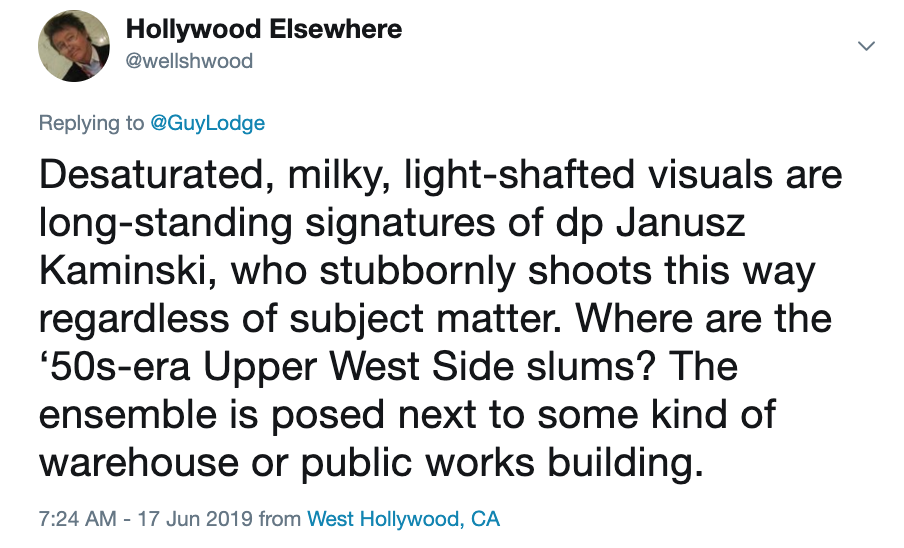
Director Steven Spielberg and dp Janusz Kaminski are clearly looking to lean the other way on their new version of West Side Story (Disney/Fox, 12.18.20). Or, if you will, Kaminski is delivering the same desaturated, vaguely milky colors that have become his trademark in a majority of the films he’s shot for Spielberg over the last quarter-century.

Kaminski did the same thing to the Washington Post newsroom in The Post — he grayed and grimmed it up, certainly compared to the newsroom captured by dp Gordon Willis in All The President’s Men.

Misheard HE lyric: “With a click, with a shock, phono jingo dorro knock…”

Father’s Day

Ever respectful and always affectionate, Jett called to wish me Happy Father’s Day today. This was snapped sometime around late ’91 or early ’92. Jett was four; Dylan had just turned three. We’re looking at a video feed of ourselves.

Read more

Woke Script, Younger Women

After that somewhat disappointing Booksmart tally ($19.7 million after 24 days compared to $121 million domestic for Superbad) and Late Night‘s slow showing ($5.5 million after two weekends), the question is when will a woke + younger women movie break through and become the next The Devil Wears Prada ($124 million domestic)?

Maybe $25 million-plus grosses just aren’t in the cards for this kind of fare. Is it permissible to say that woke-minded scripts seem to be appealing to a fairly narrow slice of the viewing public? And that this slice tends to get narrower when you…forget it.

Diary of a Teenage Girl ($1,477,000), The Miseducation of Cameron Post ($904,703), Eighth Grade ($13,539,709), Thorougbreds ($3,072,605), The Edge of Seventeen ($14,431,633), etc.

The somewhat wokey Long Shot managed $30.2 million but that was aimed at the low-rent Seth Rogen faithful; Charlize Theron was an added ingredient.

“If You’re Going To Cough…”

Donald Trump to chief of staff Mick Mulvaney: “My God, man…can you control yourself or what? I’m doing an interview with George Stephanopoulos and you cough? I’m talking about my taxes and you fucking cough? Are you a child? Coughing is a sign of nervousness and uncertainty — ask any Broadway producer. Next time you’re seized by an urge to cough while I’m doing an important interview, please leave the room. Only men are allowed in this room. If you’re going to behave like a 12 year-old with the sniffles, you have to leave.”

Justice In The Jungle

The controversial highlight of the just-concluded Sydney Film Festival was the adverse reaction to Jennifer Kent‘s The Nightingale (IFC Films, 8.2) during a 6.9 screening at the Ritz Cinema.

Except I saw The Nightingale three or four days ago and didn’t think it was quite as horrific as Sydney festivalgoers did. Rough stuff, yes, but delivered with a kind of stylistic restraint.

Set in 1825 Tasmania, the film is a rough-round-the-edges revenge drama in which Clare (Aisling Franciosi), a young Irish convict, is determined to pursue a cruel British officer (Sam Claflin) and three underlings after they rape her and then murder her husband and baby. Clare hires Billy (Baykali Ganambarr), an Aboriginal tracker, to guide her through the island’s jungle-like wilderness on the trail of the killers. The audience complaints were about two scenes in which Clare is savagely raped, the second time in gang fashion. Her infant child is also killed in the latter scene.

Give all this negative build-up, I was surprised by how much I admired and respected The Nightingale, the awful cruelty and brutality notwithstanding. Kent is a very scrupulous and well-focused director, and she’s simply incapable of delivering over-the-top violence for its own sake. Start to finish The Nightingale feels well-honed and exacting. It depicts terrible things, but it’s not a wallow. It conveys a sense of justice and appropriate balance.

But there’s also a point in The Nightingale in which which everything changes and it all kind of falls apart — the story tension vanishes. It happens somewhere around the 75% or 80% mark when Clare loses her nerve in her quest for revenge. From that point on it doesn’t work. Because the film has delivered what William Goldman used to call a “drop-out” moment -— i.e., when something happens that just makes you collapse inside, that makes you surrender interest and faith in the ride that you’re on. You might stay in your seat and watch the film to the end, but you’ve essentially “left” the theatre. The movie had you and then lost you, and it’s not your fault.

Read more

Exiled in Demmeville

When we think about the current climate of political terror (left-radical finger-pointing, shrieking condemnations on Twitter, threats of Danton-like beheadings and social shunnings), we tend to associate this with the politically correct intensity of the last two or three years, or since Donald Trump became President. But I was reminded this morning that the first stirrings began in the late aughts.

10 1/2 years ago and one month before the ’08 election of Barack Obama, I was severely beaten, gouged, kicked and bloodied by p.c. goon-squad types for mentioning a friend’s against-the-grain opinion about Jonathan Demme‘s Rachel Getting Married.

Demme’s film is not really about the marriage of the alabaster Rachel (Rosemarie DeWitt) and Sidney, a handsome Afrique-ebony guy (Tunde Adebimpe) as much as the travails of Rachel’s older sister Kim (Anne Hathaway), and especially her drug and alcohol problems and general inability to restrain her attention-whore tendencies during the wedding festivities.

The paragraph that landed me in hot water: “A friend has observed that the way Demme portrays the [film’s] African-American and Jamaican characters — Sidney, his Army-serving younger brother, his parents and the various musicians and guests who float in and out — reps a form of benevolent reverse racism. He does this, my friend argued, by making certain that only the white characters — Rachel and Kym and their parents, played by Debra Winger and Bill Irwin — are the screwed-up ones. Antsy, haunted, angry, nervous, gloomy. But the darker-skinned characters are all cool, kindly, radiant, gentle, serene.”

This is actually a dead-on observation, but the goon squad wasn’t having it. Here was my response:

“You guys sound like a typical personification of the morally and ethically superior media p.c. elite. Admonishing from a hanging-judge perspective or vantage point, but also speaking from an ivory tower.

“All I said is that Rachel Getting Married felt annoyingly fake — unnatural, restrictive — for two reasons in this context. One, only the white characters have any hangups or interesting character wrinkles of any kind, and two, the fact that nobody in the entire wedding ensemble over the weekend makes any kind of observational innocuous remark about the Sidney-Rachel dichotomy.

“Every good movie is a product of the mind and sensibilities of the director (or the director-writer) but if the auteurist card is overplayed a movie can end up feeling like the movie is taking place on another planet, or at least in another hemisphere.

“You’re telling me that in real life (and not in the rarified world of Demme Land) that nobody would say anything about Rachel-Sidney? Nothing? With the dialogue that we’ve all been hearing all across the country for the last year or so about the ‘elephant in the room’ in the current presidential election?

“With this country being a little more than 235 years old, and a once-significant (if extremely dated) Stanley Kramer social issues movie about the difficulty of accepting an interracial marriage on the part of the bride’s parents having been released only 40 years ago? You’re saying the country has become so transformed over the last 40 years that nobody invited to the Rachel-Sidney wedding would say anything at all? Nothing?

“During the LA Film Festival I asked a question of the director of Boogie Man, the doc about Lee Atwater. I said that I don’t believe that a strong>Willie Horton-type smear campaign would be as effective today as it was 20 years ago, and I was laughed at by some in the audience — they thought my statement was close to ridiculous.

“They didn’t think, in other words, that this country has moved a single inch from where it was values-wise in 1988. And you’re telling me there are no remnants whatsoever of the 1968 mentality, attitudes and social currents that resulted in Guess Who’s Coming to Dinner? You’re living on your own planet, gentlemen.”

Good One

“The president is an unabashed gargoyle atop the White House, chomping on American values.
.
“The way Trump publicly wallows in his mendaciousness and amorality is unique in presidential history. His motto might as well be: ‘I cannot not tell a lie.’ His ego is too fragile to play patriarch to the country, so he takes the more ruinous role of provocateur.

“He makes it so easy for everyone to focus on the tweets and the maniacal, moronic reality show that you have to struggle to look away and take the measure of what he’s doing. And what he’s doing is altering domestic and foreign policy in terrible ways while running up huge deficits.

“The Trump White House may be a clown show and a criminal enterprise. But it’s also an actual presidency.

“It’s turning out to be a genuinely reactionary administration led by a wannabe authoritarian who refuses to recognize constitutional checks on power. The real danger is not the antics but the policies. If Trump isn’t careful, he’s going to add substance to his administration. And it won’t be the kind we want.” — from Maureen Dowd‘s “A Down and Dirty White House,” posted on 6.15.

“Bye-Bye, Blackbird”

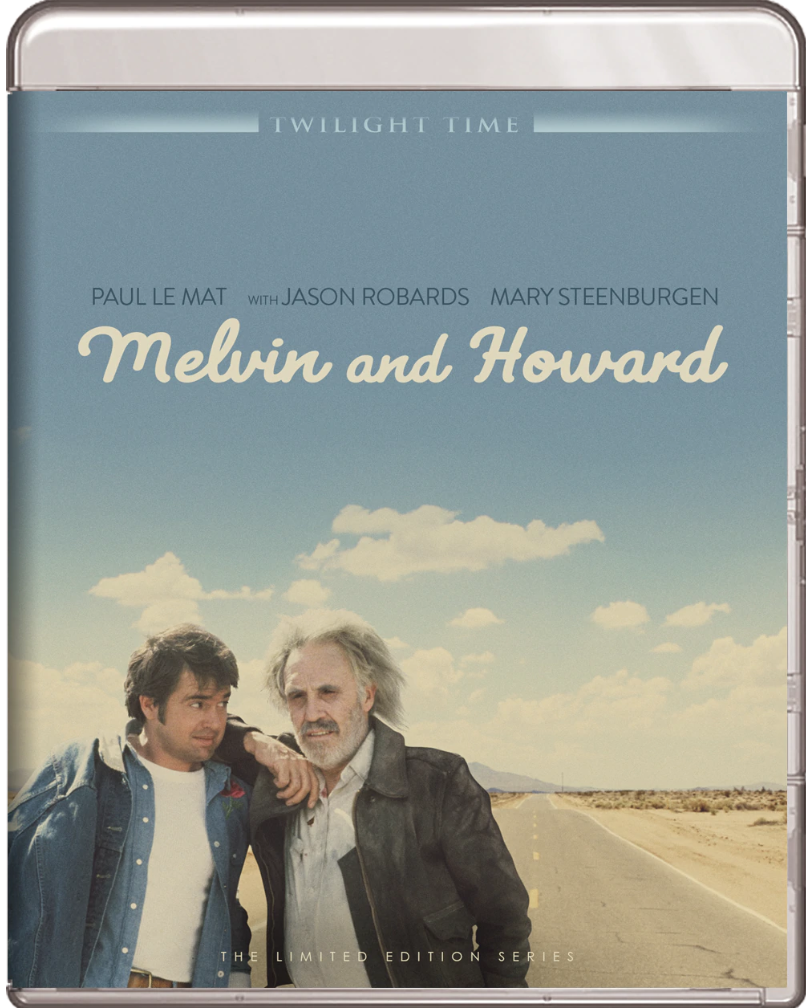
I realize that I’m expected to adore Jonathan Demme‘s Melvin and Howard, but I could never quite manage that. I haven’t seen this amiable, slow-moving American dramedy since the initial release. I recall being more intrigued than head over heels after catching it at the old Magno screening room (now Dolby 88), and being faintly irked by Paul LeMat‘s performance as the kindly, none-too-brilliant Melvin Dummar. (Whom I met at a Manhattan press party, by the way — Dummar, not LeMat.) To be honest the only part I found truly fascinating was the pickup-truck scene between LeMat and Jason Robards‘ Howard Hughes. And of course the refrain ending.

I’d be interested in streaming Melvin and Howard for $3.99 but I can’t see forking over $30 for the Twilight Time Bluray. It falls between the cracks.

Read more

Oppo Flim-Flammers

Roughly three weeks ago I posted a piece called “Thoughts of Fisticuffs.” It was largely…okay, mostly about my anger at people who deliberately blew smoke about the playability of Region 2 (or B) Blurays on U.S.-manufactured Region 1 (or A) Bluray players. The commenters compounded things by insisting that all I had to do to watch Region 2 Blurays on my Oppo BDP 103 was “push a few buttons.” Bullshit!

Phat Abbot” said that “on the modified Oppo, power up the unit by pressing the 2 button on the remote to boot into Region B,” and that I can return to region A by powering up with the 1 button on the remote.” “Joe Gideon” added that “if you have the right model Oppo, it’s even easier than that — you don’t even have to power down. You just open the disc tray, press one of the four buttons to set the region code, and hit play.” More bullshit!


The Oppo Digital BDP-103 BDP-105 Darbee Region Free USB Hardware Upgrade Cable Kit.

I hired a smart tech guy to come over and help with trying to convert the Oppo BDP 103 into a Region 2 (or B) player, and he said the only way it could happen would be to buy an OPPO DIGITAL BDP-103 BDP-105 DARBEE REGION FREE USB HARDWARE UPGRADE CABLE KIT.”

I found a couple of these devices on eBay. I ordered one; it arrived four or five days later. The same smart guy returned and inserted the device into the rear of my Oppo player, and then and only then would it play Region 2.

The way to switch regions is via the Oppo remote. You have to push DIMMER DIMMER DIMMER, and then MUTE, and then 2. And then you have to power the unit off. When you turn it back on, it will play Region 2. (You can switch back to Region 1 or even to Region 3 if you follow the same procedure.) But I couldn’t have made this work without installing the above-named cable kit.

Let every nation know, whether it wishes us well or ill, that Phat Abbot and Joe Gideon didn’t know what they were talking about.

Proof of God’s Amorality

This monster actually said “I got a little gettin’ even to do.”

“The most terrifying fact about the universe is not that it is hostile but that it is indifferent; but if we can come to terms with this indifference and accept the challenges of life within the boundaries of death, our existence as a species can have genuine meaning and fulfillment. However vast the darkness, we must supply our own light.” — Stanley Kubrick, sometime around 1966.