
Daily
I Confess
The Manhattan-based Edith Zimmerman has written a rash and brash but nicely phrased profile of Captain America star Chris Evans in the July GQ (“American Marvel“). It’s actually more of a first-person, the-dog-ate-my-notes, this-is-how-I-kind-of-screwed-things-up confession piece, which is what I like about it. It’s kind of a Hunter S. Thompson approach to a 21st Century celebrity profile from a tradition-defying, Bridesmaids-influenced, hang-it-all journalist who isn’t much for kissing celebrity ass.
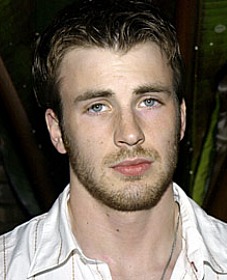
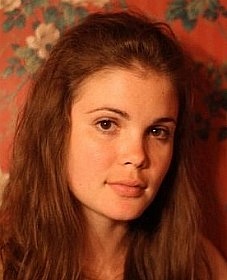
(l.) Chris Evans; (r.) Edith Zimmerman.
Or…no, wait. She is into “celebrity ass”, so to speak, when she’s doing the interview and hanging out and drinking (and God knows what else), but then she goes back to her place and writes the piece and it’s not really about the subject, which is what all ass-kissing profiles are necessarily focused on, right?
In writing the article this way Zimmerman has mainly portrayed herself and her issues (which may or may not involve wine-sipping, but definitely include a comme ci comme ca “what, me worry?” professional demeanor), and has revealed that she’s only slightly interested in Evans. But you learn enough about him, and about her, and you end up wondering if anything might have…uhm, occured between them because a lot of boozing happened and she wound up crashing at his place and then hitching a ride home.
What the article is really saying is that Zimerman thinks Evans is a little bit boring. She finds him hunky and hot and all that, but in the final analysis she can’t rouse herself to seriously inspect and consider every last detail about the guy because he’s just a dude from Boston who grew into a good-looking egotist. On top of which she finds her own longings and vulnerabilities to be at least as intriguing as Evans, if not more so.
Zimerman has the same nervy and irreverent blood, I suspect, that runs through Diablo Cody and Kristen Wiig and other cool ladies of the moment.
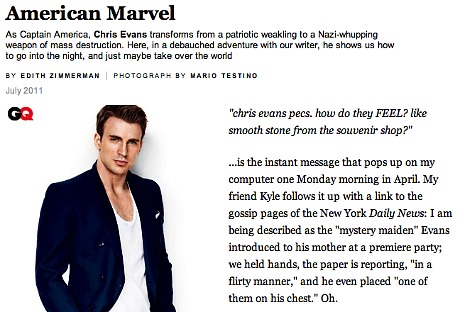
Paramount wil release Captain America: The First Avenger , a Marvel property, on 7.22. Evans will also costar in The Avengers, which will come open in May 2012.
I wrote the following to Zimmerman a couple of hours ago:
“I’m Jeffrey Wells. I write www.hollywood-elsewhere.com on daily/hourly basis. And I’ve just read the Chris Evans GQ piece. I thought, all in all, that the excellent writing balanced out what some might characterize as the drunken, undignified, un-reporter-like behavior.
“Or, put another way, that the drunken, undignified, un-reporter-like behavior acquired a certain confessional splendor — a go-for-broke, fuck-it-all Hunter S. Thompson quality — via the honesty and resultant vulnerability, and the quality of the writing.
“I think what you wrote was well-sculpted and brave, as you had to know you would draw a certain amount of flak for what traditional-minded journos would no doubt describe as an un-professional approach to a celebrity interview, blah blah.”
Case Closed
Some Came Running‘s Glenn Kenny has published a copy of a 12.8.75 letter written by Stanley Kubrick and sent to projectionists that states unequivocally that Barry Lyndon was shot at 1.66 and that it should be projected at this aspect ratio, “and in no event at less than 1.75 to 1.”
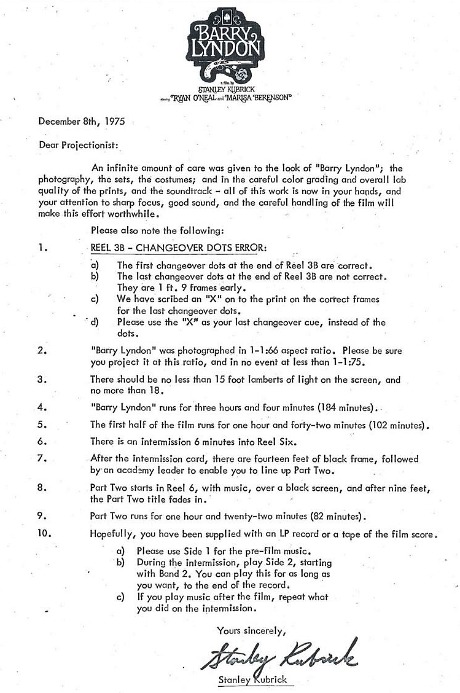
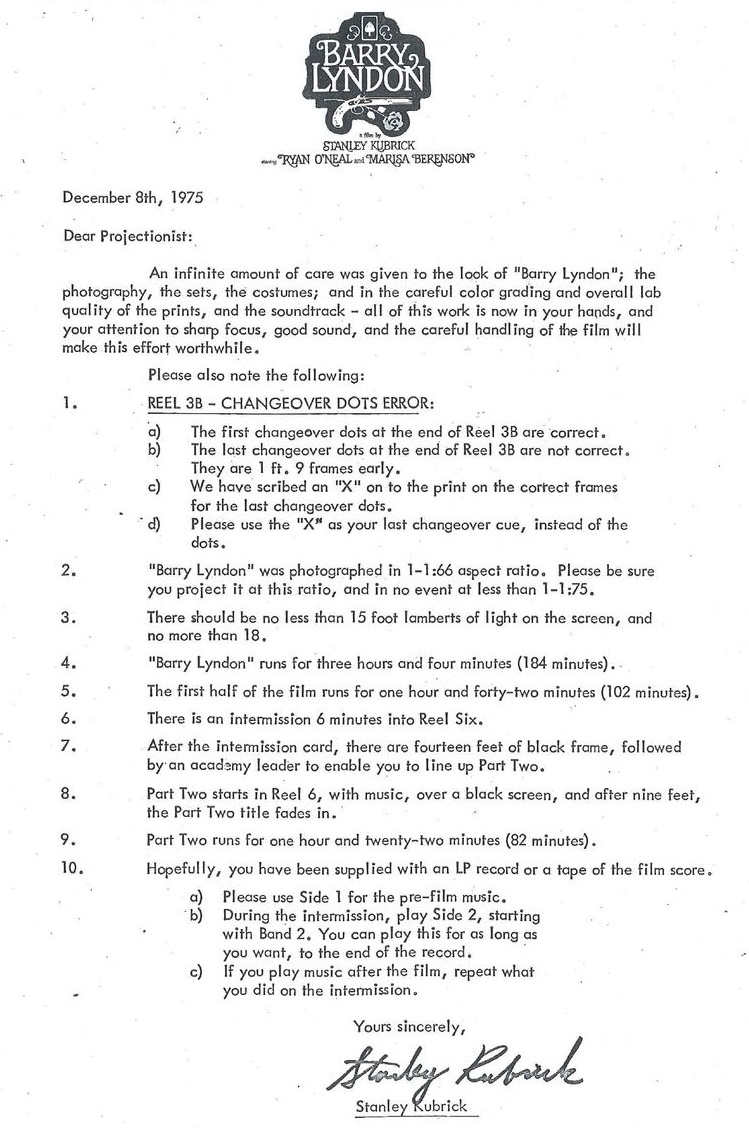
This is the irrefutable, concrete, smoking-gun proof (which was supplied to Kenny by screenwriter and former Time critic Jay Cocks) that I’ve been right all along about this aspect-ratio brouhaha, and that Leon Vitali, former assistant to Kubrick who infamously declared at a New York press conference last month that the intended aspect ratio of Barry Lyndon was 1.77 to 1, and whose commitment to this piece of revisionist history led to Warner Home Video’s Barry Lyndon Bluray being presented at 1.78 to 1, is dead wrong.
Yes, Kubrick states in the letter than he was willing to tolerate Lyndon being shown at a 1.75 to 1 aspect ratio. It is this allowance, apparently, that Vitali and Warner Home Video seized upon to justify their 1.78 to 1 aspect ratio determination. And yet — let’s try to not misunderstand — Kubrick says in clear and unmistakable terms in the letter that Lyndon was shot in 1.66 and should be projected at that aspect ratio — period, end of story and shut up.
Vitali and Warner Home Video were willfully wrong in their insistence upon presenting the Lyndon Bluray at 1.78 to 1, and now is the time for Vitali and Warner Home Video’s Ned Price to stand up, man up, come clean, admit their mistake and pledge to re-issue a Barry Lyndon Bluray at the correct aspect ratio.
If I were Vitali, I would grab a fishing hat and a fake beard and hide out in the desert for a good two or three weeks until this matter blows over or at least settles down. For he has now been proven to have endorsed misinformation that has slightly distorted and diminished the presentation of a classic film.
12:05 pm Update: I’ve just spoken to Vitali at the Standard Film Company, where he works in some co-managing or partnering capacity with director-writer Todd Field. I asked for an email address, and sent him the URL of Kenny’s article, and asked for a reply after he’s had time to digest it.
I wrote the following to Kenny this morning: “EUREKA! What a SCORE!! Congrats to you, and thanks ever-so-much to Jay Cocks.
“I’m nonethless mystied by the response from a Warner Home Video rep, which you quote in your short piece about the letter: “We stand firmly that we are 100% in compliance with Mr. Kubrick’s wishes” and that ‘the letter from Kubrick to projectionists was the reference for our 1.78 aspect ratio call.”
How does Kubrick specifying 1.66 to 1 and allowing that he will tolerate a 1.75 to 1 presentation become a “reference” for Warner Home Video’s 1.78 aspect ratio call? By what kind of strange, Orwellian, logic-bending process did the WHV rep compose this sentence?
Olbey Returns
As Keith Olbemann‘s new Countdown-on-Current debuted last night at 8 pm, I was watching Anne Buford‘s Elevate — a humane, heartfelt and well-crafted doc about young basketball players from Senegal — at the LA Film Festival.
Here’s the last ten minutes of Monday night’s show. Each night’s broadcast will re-air at 9 am, 12 noon and 3 pm the following day. (That’s what it says on my Time Warner guide.) It’s lamentable that it’s not airing in high-def, but I guess I can roll with the 1990s look of it….for now.
Dead Drop
Aired last night, posted by Deadline at 5:51 am this morning:
The Mysterians
Some editor…actually probably at least a couple of editors at the L.A. Times thought the older beardo on the left with the Dodgers baseball cap was Steven Spielberg. My initial thought was that he looks like Art Linson. I’m presuming that when Matt Donnelly, author of the “Ministry of Gossip” story about Spielberg-Bay-LaBeouf-Fox, first saw the layout he said to himself, “Oh, Jesus God no…no!”
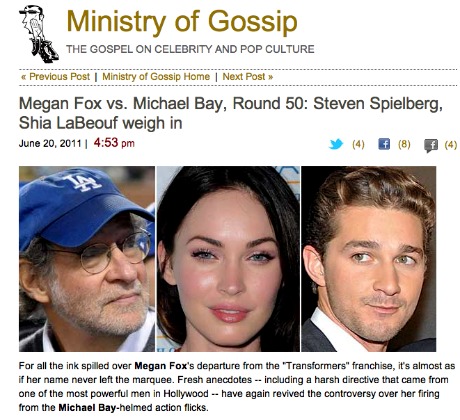
6.21, 8:30 am Update: The error was corrected last night around 11:15 pm. The Times‘ editor that “this post originally contained a picture mislabeled by the photo service as a shot of Steven Spielberg. It now contains a picture that’s definitely Spielberg.” Oh, I see….and if the photo service had sent the L.A. Times a photo of a giraffe and said it was Joel Cohen, the Times would just run it?
Mulholland Project
The only Warren Beatty project I know of that could reasonably deploy his talents as a director, producer, writer and star would be his Howard Hughes property. Because he’s too old to play Dick Tracy again…right? A septugenarian comic-book hero sounds like lunacy. TheWrap and Variety reported late this afternoon that a Beatty pic with the 74 year-old hyphenate doing all the above will roll later this year for Paramount. No title, no announced subject…keep ’em guessing.
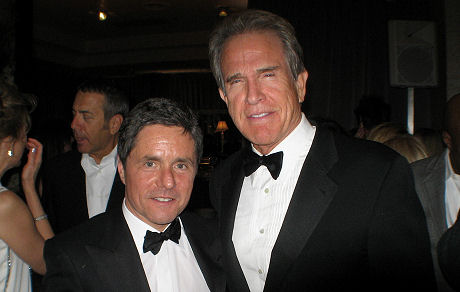
Warren Beatty, Brad Grey at 2007 Golden Globes after-party. (Pic taken by yours truly.)
Deadline‘s Michael Fleming reported last night that the project was a comedy.
Variety‘s Justin Kroll wrote that Beatty “[has] been shopping the script for the past few weeks.” “Warren’s script is quintessentially Beatty, elegantly written and wonderfully entertaining,” Paramount honcho Brad Grey said in a statement. “It is our privilege to have one of the great artists in the history of the film industry come home to Paramount.”
Update: Former hotshot entertainment business reporter Anita Busch posted the following last night, a bit after 8 pm:
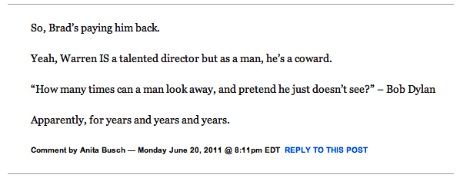
The gist is that (a) Grey owed Beatty for something, and now he’s paid him back with this deal, and that (b) Beatty, in Busch’s view, is some kind of coward because, she implies, he once refused to acknowledge and/or righteously respond to something heinous. It’s a very cryptic and teasing comment. Busch seems to be saying, “I remember and I know, and if you had my memory and knowledge of the dirty underbelly of things in this town, you would also. But I’ll never get specific because I’m out of the game.”
Oscar Poker #37
Awards Daily‘s Sasha Stone, Boxoffice.com’s Phil Contrino and I recorded Oscar Poker #37 this morning. We spoke of Drive and The Green Hornet and The Broken Tower and I-forget-what-else…but we covered eight or nine topics. Here’s a non-iTunes, stand-alone link. The intro-exit music is from a Bruce Springsteen + Clarence Clemons track that Sasha hasn’t yet identified.
Stat
This is a minor deal, but the first time I heard the line “we had creative differences…I was creative, he was different” was from Nicholas Meyer. I heard him say it at a party at Michael Phillips‘ home in 1985. He was referring to a dispute he’d had about a Spanish Civil War movie with the late Stephen J. Friedman, whom he described as “that horrible man.” Does the line go back earlier? Did it come from someone else?
Hey, that’s an idea for a discussion thread. What people have you come to know in the film industry whom you would honestly and without reservation describe as “horrible”? People who give off a vibe that is so poisoned and mustard-gassy and spiritually deflated and dismissive of human potential that they could truly be described as having passed along almost nothing in the way of warmth or charity or wisdom or comfort or laughter — people who walk around with steam-blasts of rage and resentment hissing out of their ears?
Left-Leaning
Last week at the Landmark I happened to see this trailer for Michel Leclerc‘s The Names of Love (2.24). t played right after the trailer for Crazy Stupid Love, and it seemed right away that the French film is more relaxed, less formulaic, more mature, funnier, more natural and less agitated.
Directed and co-written by Leclerc (along with Bya Kismi), The Names of Love is “a semi-biographical film documenting the life of a young woman who uses sex as a weapon to influence right-wing individuals and conservative Muslims.”
Bahia Benmahmoud (Sara Forestier), a young left-wing activist, sleeps with her political opponents in order to manipulate them to her cause until she finds her match in Arthur Martin (Jacques Gamblin).
Love won three Cesar Awards earlier this year, including best female lead for Forestier and best writing. It opens stateside on 6.24.
Better Sizzle Than Steak
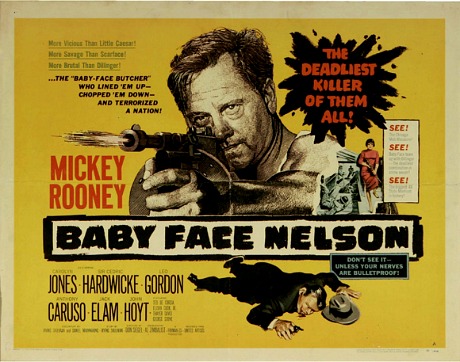
I’ve been saying for years that many Saul Bass one-sheets have seemed “better” than the films they’ve promoted. But Bass doesn’t have a monopoly on this type of thing. One example is the one-sheet for Don Siegel‘s Baby Face Nelson (’57) which, I feel, is more successful as a piece of high-impact design than the film is on its own terms. I don’t think Siegel’s gangster film stinks — it’s good pulpy fun, but the intense poster promises more than Mickey Rooney and Carolyn Jones deliver.
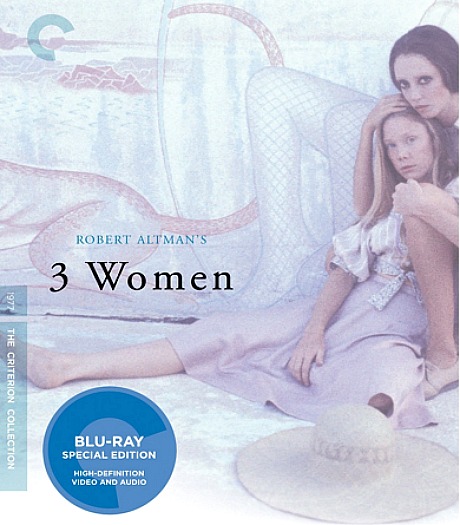
I feel roughly the same way about the poster for Robert Altman‘s 3 Women, which is reflected to some extent in the jacket art for the forthcoming Criterion Bluray. I’ve seen 3 Women only once, but it just doesn’t “do” anything. Sand and windstorms and Sissy Spacek and Janice Rule and Shelley Duvall and empty swimming pools with tiled mosaic floors and gunshots and more windstorms and sand.
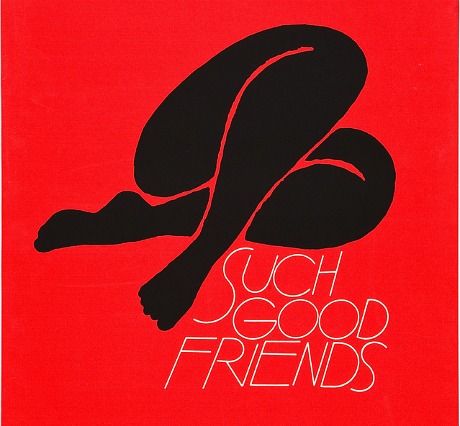
I’ve worshipped the poster for The Man With The Golden Arm all my life, but I’ve only been able to watch Otto Preminger‘s 1955 drama once or twice. Bass’s one-sheet for Preminger’s Such Good Friends (’71) is a more extreme example. The line-drawing artwork is Matisse-like in its simplicity, but the movie is all but unwatchable.
So what other posters are significantly more engrossing or profound or pleasurable or more satisfying on some level than the films they’ve been created to promote?
Sex, Poetry & Brooklyn Bridge
The LA Film Festival information page for James Franco ‘s The Broken Tower, a black-and-white drama about gay poet Hart Crane, says that “this program contains mature content…no one 17 and under will be admitted.” That’s one way of confirming that the film contains a graphic gay sex scene. It shows tonight at 8 pm at LA LIVE Regal.
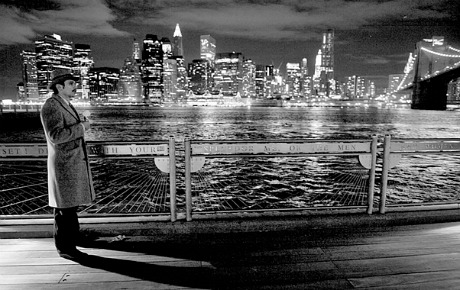
I still don’t have a ticket and no one I’ve appealed to has responded, so I guess my only shot is to wait in the rush line and hope for the best.
The Broken Tower had its very first screening at Boston College’s Robsham Theater on 4.15.11. Here’s a brief video clip of a post-screening chat between Franco and Paul Mariani, whose 1999 biography, The Broken Tower: The Life of Hart Crane, was the basis of Franco’s film. Mariani consulted on the screenplay and had a cameo in the movie as photographer Alfred Stieglitz.
In a January 2011 interview, Franco told EW‘s Keith Staskiewicz that his decision to portray gay characters in three recent films (Milk, Howl and The Broken Tower) and an announced intention to write direct a biopic about gay actor Sal Mineo is more about the quality of the material than any personal inclinations on his part.
Franco nonetheless ended the interview by saying to Staskiewicz, “You know what? Maybe I’m just gay.”
In a recently-posted Vanity Fair article about Crane, Franco wrote the following:
“[Crane’s] poetry was damn difficult, and he knew it. The poems are thick with metaphor, high diction, and compulsive allusions to myth. Not for Crane the accessible American idiom of a William Carlos Williams. He loved Whitman and filled his poetry with references to the modern era, but he wrote more like an Elizabethan. Nobody got it. People still don’t get it, at least not without effort.
Crane’s life was “about being unappreciated, gay, a romantic in an age of modernism. Crane loved movies, and actually likened himself to young adu’s tramp, downtrodden but skillfully using (and disposing of) the mechanisms of the industrial age. Poetry is not a form that is easily adaptable to film, and Crane’s is denser than most. The trip from the page to the screen is a long one. But what is most vital in Crane is the way he lived and his devotion to his work. And it is what I have tried to capture on film nearly 80 years after Crane’s death.”
