A rock-song bridge or “release” is when the guitarist, having absorbed the basic energy and thrust of a song, steps up and articulates the essence in some kind of heightened, contrasty way. Chorus-verse-chorus-verse-bridge-chorus-verse. The best are always short and succinct. One of the all-time shortest begins at the 45-second mark of The Who’s “The Song Is Over” and ends at the 56-second mark — 11 seconds total. One of the longest in this realm — 35 seconds — occurs in “Sympathy for the Devil,” starting at 2:53 and ending at 3:27. Two other perfect shorties — Robby Krieger‘s bridge in “You’re Lost Little Girl” (1:54 to 2:15, or roughly 21 seconds) and Eric Clapton’s in “She’s Waiting” (2:11 to 2:33, or roughly 22 seconds). Others?
Winning Slogan
I was shocked last night by Seth Abramson‘s tweet that special counsel Robert Mueller is “on pace” to complete his investigation of corrupt Trump-Russia ties in “under” three years. The investigation has been going for a full year now, but no completion until May 2020 or slightly before? That obviously works from a presidential campaign perspective, but somehow I had developed an idea that Mueller would finish sooner. As an actual Trump indictment apparently isn’t in the cards, it’s all about impeachment efforts in ’19 and ’20, which of course won’t happen unless the redhats lose their U.S. Senate and House of Representatives majorities next November.


Spike’s Poster, Palme d’Or Chances
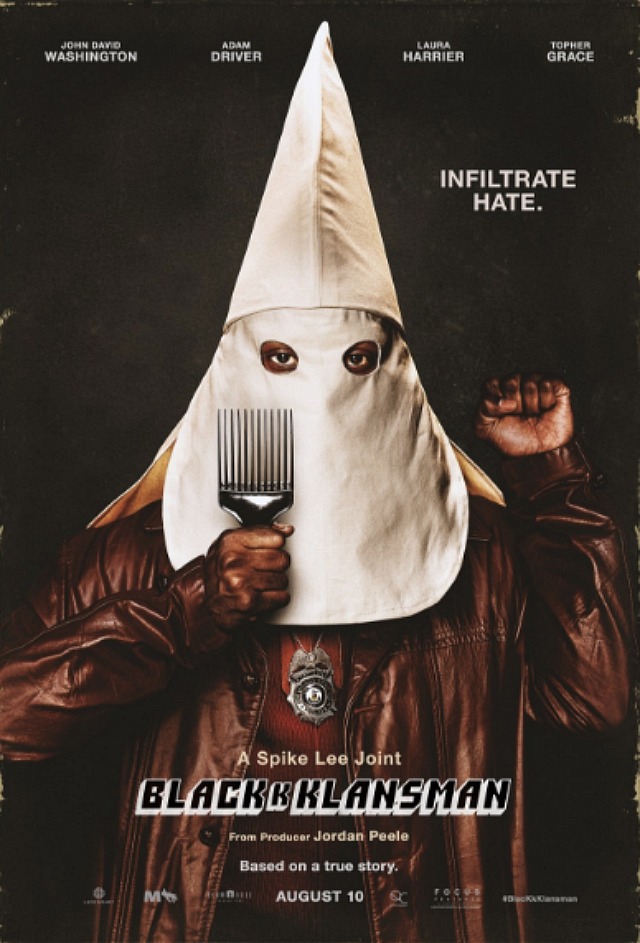
I wouldn’t call Spike Lee‘s BlacKkKlansman a “black comedy,” as the Wiki page maintains — I would call it a more or less straightforward ’70s police procedural flecked with ironic humor here and there.
And yet a partly humorous approach is clearly indicated in the just-revealed poster art (i.e., hood + soul comb + black power salute). Plus it obviously delivers the basic idea, even if John David Washington‘s Ron Stallworth character never actually dons a KKK hood or physically fraternizes with Klan members. In the film, Stallworth vocally pretends to be a white guy who agrees with and supports Klan goals (i.e., over the phone) while Adam Driver‘s Flip Zimmerman, Stallworth’s partner on the case, handles the actual face-time infiltration.
Another Shot at Gaspar
An additional Director’s Fortnight screening of Gaspar Noe‘s Climax has been slated for tomorrow morning (Friday, 5.18) at 11:30 am. More waiting-in-line torture! Hollywood Elsewhere will be there with bells on, but given what happened last weekend outside the Palais Stephanie ou Theatre Croisette, I’ll have to be there by 9:30 am or certainly no later than 10 am. Standing on a sidewalk for 60, 90 or more minutes drains the soul. I hate it.
5.18, 10:30 am update: I began the press pass line at 10:05 am. I have the #1 position. Press and hard-ticket holders are starting to gather. I’ll finally get to see this! But God, what a pain these Directors Fortnight lines are during the festival’s peak period.
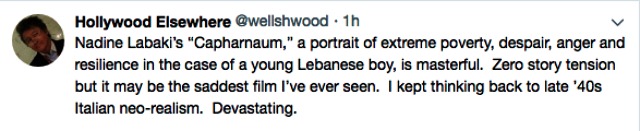
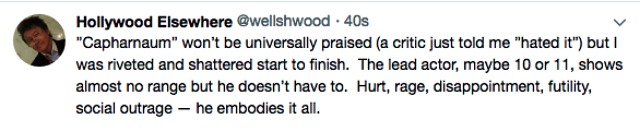
Predicting Palme d’Or Win for “Capharnaum”
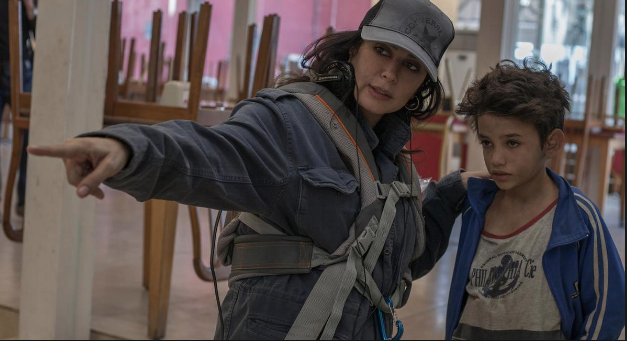

Capharnaum director Nadine Labaki, Zain Alrafeea during filming.
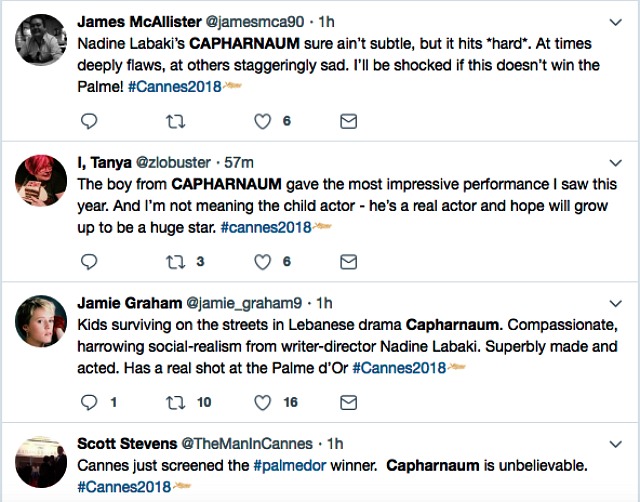
Nadine Labaki‘s Capharnaum will win the Palme d’Or because of (a) the humanist-compassionate theme and (b) the director is female. The statements and actions of the Cate Blanchett-led jury indciates they’re almost certainly looking to give the top prize to a woman-directed film. Before Capharnaum came along I was presuming the Palme winner would be Alice Rohrwacher‘s Happy as Lazarro.
Capharnaum isn’t really about a child (Zain Alrafeea) who files a lawsuit against his parents for giving him birth, as the point is never vigorously or extensively argued in a courtroom setting. It is, however, a deeply affecting hard-knocks, street-urchin survival tale in the vein of Pixote or Slumdog Millionaire.
The IMDB says it’ll be titled Capernaum in the U.S. and other English-speaking markets.

Special Needs
Right away you can tell that this low-key, middle-aged-curmudgeon romance is at least fairly well written. The director-writer is Victor Levin, whose 5 to 7 I didn’t much care for but whose writing credits also include Mad About You, The Larry Sanders Show and Mad Men. Part of the pleasure of this trailer is a notion that Keanu Reeves and Winona Ryder, whom I’ve recently felt sorry for (especially Ryder), may have lucked into a half-decent film that allows them to play semi-rounded, recognizably human characters. Or so we’re led to presume.
Dee Dee Warwick Did It
Poor Whitney Houston was found dead in a Beverly Hilton bathtub six and one-third years ago. “It took her many years to get there, but she’s finally bought it,” I wrote that day.
“The specific cause of the pop singer’s death is unclear, but c’mon…this has been in the cards for ages. Houston’s rep as a poster girl for drug abuse long ago eclipsed her fame as a singer. Many people are shocked by Houston’s death, but find me one person who’s genuinely surprised.”
The usual chorus of denial and complacency followed, of course. People always push that stuff away.
Now comes Kevin MacDonold‘s Whitney, an affectionate, deeply compassionate that nonetheless doesn’t play games when it comes to analyzing what went wrong in this troubled singer’s life.
When I read that Whitney was family-supported I presumed MacDonald might have felt obliged to take a softball approach. (An early teaser made no mention of Houston’s marriage to the notorious Bobby Brown, Houston’s husband of 14 years who has long been been regarded as a destructive influence in her life, particularly regarding her substance-abuse issues.) But Whitney is an exception to the rule. It digs right into the marrow and coaxes hard truths out of everyone.
Houston’s drug-use downswirl, the Brown relationship, her closeted sexuality and her daughter Bobbi Christina Brown, who died under regrettable circumstances at age 22 — it’s all there plus a surprise no one saw coming.
At the end Whitney’s aunt Mary Jones, who worked as her assistant (she was the one who found Whitney face down in that Beverly Hilton bathtub), claims that the late Dee Dee Warwick, the younger sister of Dionne Warwick and a blues-soul singer in her own right, sexually abused Whitney as a child, apparently in the late ’60s or early ’70s when the Houston family was living in East Orange, New Jersey.
Tom Wolfe, Whom I’ve Adored All My Life
The great Tom Wolfe passed…Jesus, two days ago and I’m only just getting around to this. The festival demands. And I still haven’t time to really sink into the sprawling legend of it all. Wolfe was one of the sharpest and most dashing literary figures of the 20th Century, and the very personification of ’60s and ’70s New Journalism. His spry, crafty, cranked-up prose, and the often astonishing wit and energy that he poured into his profiles and reportage…if you stepped back and considered his impact it just took your breath away.
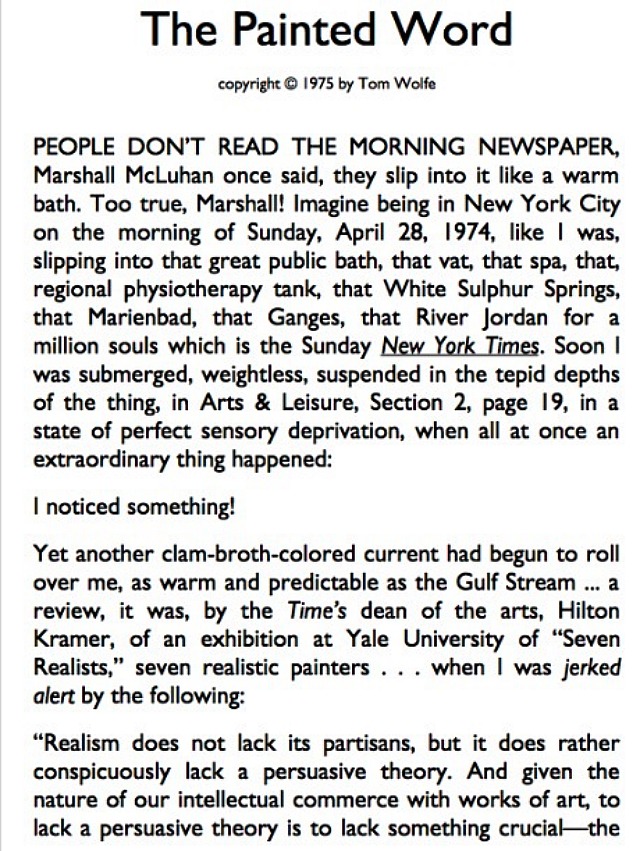
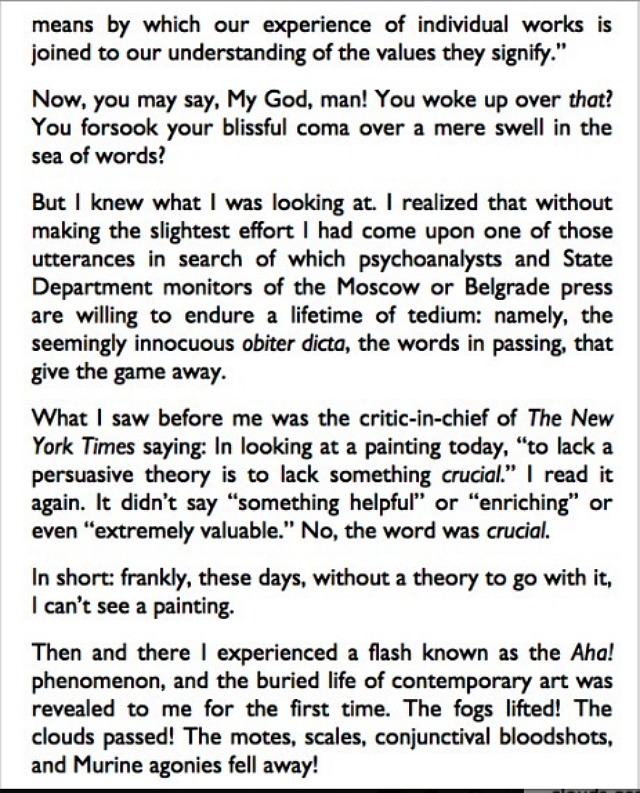
Wolfe’s was quite the tale, going all the way back to his New York Herald Tribune pieces that began in ’62 or thereabouts. A stream of titles pouring out of my head right now: “Tiny Mummies”, “The Painted Word”, “The Truest Sport:” Jousting With Sam and Charlie”, “The Me Decade and the Third Great Awakening”, “The Electric Kool-Aid Acid Test”, “Radical Chic & Mau-Mauing the Flak Catchers”, “The Kandy-Kolored Tangerine-Flake Streamline Baby”, “The Right Stuff”, “The Bonfire of the Vanities”, etc.
Here are three pages of HE material on Wolfe that I’ve generated over the last decade (page #1, page #2, page #3).
In lieu of whatever word spurt I might come up with down the road, Dwight Garner’s N.Y. Times appreciation (dated 5.15) is pretty good.
For those who’ve never read Wolfe or who only know him as the author of a celebrated book that resulted in the worst film Brian DePalma ever made, please start with these:
(a) Wolfe’s 1965 Junior Johnson Esquire story (“The Last American Hero Is Junior Johnson. Yes!”), which resulted in Lamont Johnson‘s < em>The Last American Hero (’73).
(b) “The Truest Sport: Jousting With Sam and Charlie” (October 1975), contained in “Mauve Gloves and Madmen, Clutter and Vine.”
Good As This Sort of Thing Gets
You can’t trust a trailer, but Chris McQuarrie‘s Mission: Impossible — Fallout (Paramount, 7.27) suddenly looks great because of this newbie. This may be the best-edited, put-the-hook-in trailer for an M:I film that I’ve ever seen, and we’re going back over 20 years now. This is exactly how you cut these things together — propulsive forward-motion action, a dab or two of character, plot complexity, a little dash of humor.
And I love Tom Cruise‘s increasingly weathered, faintly puffy face — a guy who used to be pretty but is losing that glow as time marches on, and this diminishment gives him all kinds of soul and gravitas.
Cruise, Rebecca Ferguson, Simon Pegg, Ving Rhames, Michelle Monaghan, Alec Baldwin, Sean Harris, Henry Cavill and Wes Bentley.
Beware of Late ’60s “Curtain” Hair
Earlier today I said “uh-oh” when I caught sight of David Robert Mitchell during a photo call before this morning’s Cannes Film Festival press conference for Under the Silver Lake. It was the middle-part hippie hair (i.e., Prince Valiant without the bangs) that gave me pause.
Any 2018 movie director wearing the same hairstyle that John Lennon had during the recording of “The White Album” or which Donald Sutherland wore during the filming of Paul Mazursky‘s Alex in Wonderland (’70) is basically saying “I’m off on my own trajectory…I’m following my muse, going with my process…I am who I am, and this is where I’m at, pretentious as this might seem.”
To me this indicates an attitude of undisciplined indulgence, which is what Under The Silver Lake is more or less about.
Mitchell’s hair during the making and promotion of It Follows (’14) was much more reasonable-looking — the hair style of an unpretentious, down-to-business guy who’s just looking to get the job done.
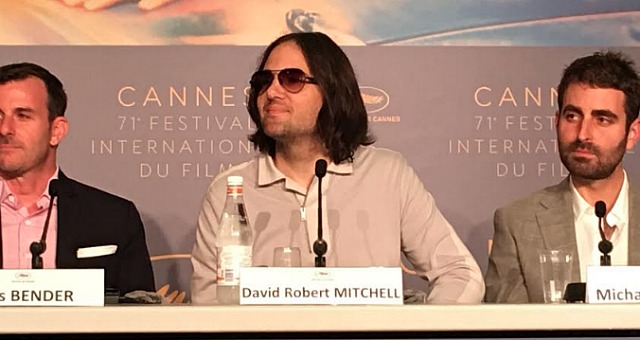
Under The Silver Lake director David Robert Mitchell during this morning’s press conference.
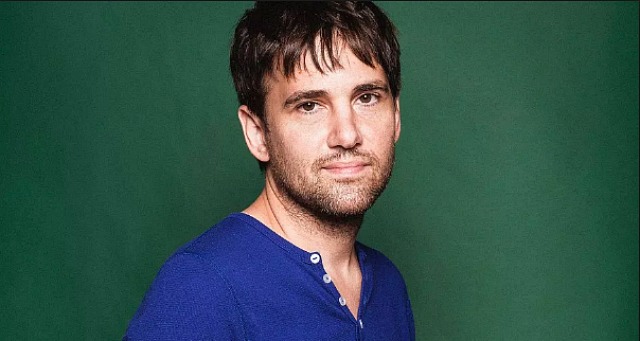
Michell during promotion of It Follows.
Keeping Tabs
Earlier today a friend passed along buzz about Nadine Labaki’s Capernaum, which will screen in Cannes tomorrow and Friday, allegedly being a hot Palme d’Or contender.
A 5.16 Screen Daily story by Melanie Goodfellow mentions that Sony Pictures Classics “has acquired North American and Latin American rights and is also planning an awards-qualifying release in December.”
Shot in Lebanon and “inspired by Labaki’s own research into child neglect,” drama focuses on a 12-year-old boy “with a miserable life who decides to sue his parents for bringing him into the world,” the story reports. Capernaum‘s Wiki page says it runs 120 minutes.