In For A Pound

After joining Carey Mulligan, Zoe Kazan and Paul Dano at the Lincoln Center Institute’s Junior Spring Benefit at the Grammercy Park Hotel, the N.Y. Observer‘s Nate Freeman asked Mulligan about a book adaptation she’ll be making soon.

“What book adaptation?” Ms. Kazan gasped.

“Oh, I’m doing this little known thing, The Great Gatsby.”

“Oh my god, that’s amazing!” Kazan said. “Are you playing Gatsby?”

“Yes,” Ms. Mulligan said. “I’m playing Jay Gatsby. It’s a really big role for me, I’m gonna wear a sock down my trousers, give it everything.”

The future Daisy Buchanan said filming would start in September, in director Baz Lurhmann‘s home country of Australia.

“In Australia, that’s where the book is set, right?” Ms. Kazan said.

Ms. Mulligan nodded.

“It’s a great Australian novel.”

Can you sense Mulligan’s undercurrent? What her whimsy is really about? She’s a bit skeptical about Luhrmann and the film and going to Australia and the whole thing. She knows what a cranked-up personality and style monster Luhrmann has become. She knows that he’s mad. She saw what happened to Nicole Kidman when she made Australia. If I were her, I’d be saying to myself, “Thank God for Nicholas Winding Refn and Steve McQueen and Lone Scherfig.”

Update: Kazan is obviously very sharp, very quick, just playing a game.
Gainers

HE reader Bill McCuddy suggested this morning that my recent riff about Midnight In Paris “being better the second time would make a good column where we all weigh in. Not the bona fides but surprises that underwhelmed the first time and then get better with each subsequent viewing.

“For me, two come to mind immediately. One is Michael Clayton, which I only liked the first time and love now. The other is Duplicity, which is so much fun to listen to now. Great writing, giant shaggy-dog story, good fun. Other suggestions?”

Wells to McCuddy: Tony Gilroy makes movies that take a while to settle in and make you realize how good they are. Last January I wrote a mea culpa piece about my not being more initially enthusiastic enough about Michael Clayton. But I’m not so sure about Duplicity.

Conservative Instinct

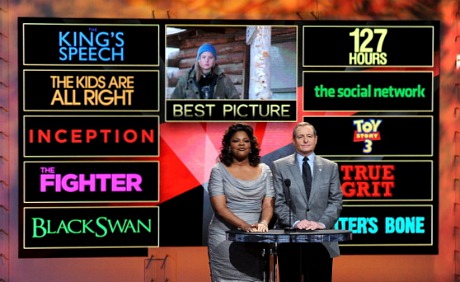
I don’t have a big argument with yesterday’s decision by the Academy to install a merit system into the voting for Best Picture, but I’m asking myself “what’s the upside?” In 2009 the Academy expanded the Best Picture field to ten nominations. Now the Academy is requiring a minimum of 5% of first-place votes in order to receive a Best Picture nomination, which could result in only eight or seven or nine Best Picture finalists. Or five, even.

So basically they’re declaring that it’s better to weed out some of the pikers — to focus a little more on discrimination rather than inclusion. This is obviously a conservative backlash to what some on the Academy board felt was an overly liberal policy of nominating ten films for the Best Picture Oscar.

I thought the idea of expanding the field to ten nominations was to pass around a little nomination-love to five soft contenders — i.e., the bottom five. Movies like The Dark Knight that were highly popular with the public but which didn’t fit the mold of a typical Best Picture contender. Or for movies which met some of the criteria (well-crafted story, stirring emotional theme, great performances, “important” subject) but didn’t quite have across-the-board acclaim. Or movies that are highly admired but considered to be worthy on a 7 or 8 or 8.5 level rather than a 9 or 10 level.

All that appears to be out the window now. Now to get a Best Picture nomination you’ll need 5% of Academy voters declaring on their ballot that your film is the absolute best of the year. This means that a lot of very good, perhaps less emotional, perhaps more “art for art’s sake”-type films (which are rarely embraced by the blue-hairs) aren’t going to make the cut.

The new system favors those older Academy members with lazy attitudes who’ve complained over the last two years that they find it hard to come up with ten nominees. Every year I come up with 20 to 25 films that range from excellent to very good to highly respectable.

Deadline‘s Pete Hammond wrote last night that “with the [2009 addition] of 10 nominees, such popular box office hits as Up, The Blind Side, District 9 and Inception earned Best Pic stripes, [but] they likely would not have received if only five films had been eligible.” The new “merit system” pretty much boil things down to a five- or-six- or-seven-nomination finale.

What You've Got

This morning a publicist working for Nicholas Winding Refn‘s Drive was wondering why I was so keen to see it at the LA Film Festival this weekend, since I’d already seen it in Cannes. That’s true, I said, but with only half of my hearing. My right ear was totally clogged during my Thursday evening screening (5.19) in the Grand Palais, I explained, and I’d love to see it again now that both ears are back in operation.

Nice things that put you in a great mood are rarely interesting. It’s always more fun to write about anger or irritation and opposition of some kind. But losing almost all of the hearing in my right ear made me feel weak and vulnerable in the most awful way, and getting it back two and half days later made me feel ecstatic, renewed…saved. There’s nothing like having one of your senses severely impaired to make you really appreciate, etc.

Bath water had seeped into my right ear canal on the morning on Thursday, May 19th, my last full day at the Cannes Film Festival, and I couldn’t get it out to save my life. I tilted my head back and forth and slapped the side of my head repeatedly. I jumped up and down like a pogo stick. I started applying some ear drops and an ear-cleaning solution that I’d bought at a pharmacy. Nothing worked. And no one had sharply yanked my ear (the cause of Thomas Alva Edison‘s hearing problem) or hit me on the side of the head (which is what Brian Wilson‘s father had done, causing his singer-songwriter son to go deaf in one ear) and I hadn’t allowed it to get infected or anything. It was just bath water! But after a while I began to wonder if it was something else.

My left ear was okay but I couldn’t hear a damn thing on the other side. All I could hear was a droning inner-ear noise that sounded like distant crickets or locusts on a hot summer night. My Drive viewing was probably affected in some vaguely negative way by this, although I didn’t let on in my review. I was feeling a bit freaked but I told no one.

My right ear was still clogged late Thursday night and all day Friday. I arrived in Paris around 10:30 or 11 am on 5.20 and lived with it all day and that night. The ear drops, etc. Everything that was said to me I had to lean forward and say, “Come again?” Saturday morning, same thing. And then around noon I was driving my rented scooter down a cobblestoned hill in Montmartre, and….whusshhhhhh. My ear opened up. I could suddenly feel air seeping in, and I was hearing in glorious stereo again. It was like escaping from prison but without any guards or cops chasing me. I was free. All the intense worry about possibly having to deal with some kind of ongoing hearing issue disappeared. Wow! It was the most the purely happy moment I’ve known in a long, long time.

Lay It On Lewis

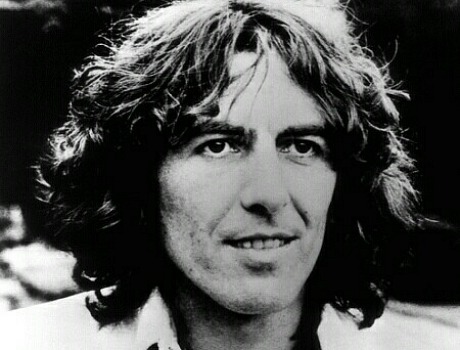
L.A. Times blogger columnist Randy Lewis (Pop & Hiss) is reporting that Martin Scorsese‘s George Harrison: Living in the Material World, a documentary about the deceased former Beatle, will be out later this year. Lewis recently got the skinny from Olivia Harrison, widow of the late George Harrison, in Las Vegas,

And that’s all — no extra questions, no digging, no curiosity, no nothing.

“I just came from New York and Monday I’m going to see [the film] again,” Olivia tells Lewis. “We’re real excited about it…Marty is such a great storyteller, and of course he always finds the story that you don’t expect.”

And what unexpected story might that be? Lewis doesn’t ask. What other Scorsese music documentary does the Harrison film most resemble, if any? Lewis doesn’t ask. Are there any heretofore unheard Harrison musical compositions in the film? Lewis doesn’t ask. Does Scorsese use some relatively obscure, in-depth filmed interview that Harrison once gave as a through-line, or does he use a hundred different interview clips? Lewis doesn’t ask. Does the Harrison film thoroughly burrow into G.H.’s childhood and early musical influences like No Direction Home took its time with Bob Dylan‘s early history and influences? Lewis doesn’t ask. Is the Harrison doc 2 1/2 hours or 3 hours or 208 minutes long, or is it a relatively tight and concise 90 minutes or two hours? Lewis doesn’t ask.

He Done Her Wrong

After having written what some considered to be a tone-deaf, doesn’t-wanna-get-it pan of X-Men: First Class, L.A. Weekly critic Karina Longworth has now slapped down Martin Campbell‘s The Green Lantern (Warner Bros., 6.17). Not that Longworth isn’t “right” — the across-the-board word is that this $300 million dollar film stinks — but she’s now presumed to be semi-unreceptive to this kind of film going in.

The Green Lantern “never bothers to suggest that [character and plot elements] really matter,” she laments. “Campbell’s ADD style privileges spectacle over story — so much so that the film never rewards the viewer for even trying to keep track of what is going on.

“So you give up, and instead try to grab on to the small pleasures, which momentarily distract from the fact that the narrative is nonsensical, the characters so boilerplate that their every action seem preordained from the earliest frames, even as the action on-screen is often incoherent.”

I love this passage: “While Ryan Reynolds isn’t a sharp enough actor to really find the crackle in his standard-issue superhero wisecracks, his body is a marvel of precision sculpting. As he breathes in and out in the skin-tight, digitally enhanced Lantern suit, each abdominal muscle seems to pulse independently. It’s transfixing — and the closest Green Lantern gets to character detail.”

Rundown

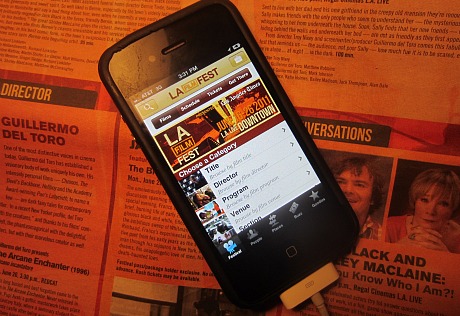
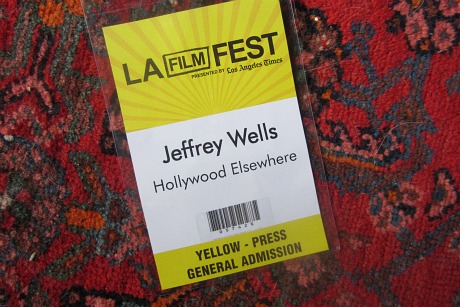
It suddenly hit me yesterday when I picked up my LA FilmFest press pass and newsprint schedule (which uses what looks like five-point typeface) that there are 15 if not 20 films and events that I’d like to catch over this 11-day film festival. Of which I might actually catch 10 or 12. The mitigating factor, of course, is that every one of them requires a 35- to 40-minute trek from West Hollywood to downtown, and then having to find parking, etc. I’m putting my red bicycle on my car’s rear bike rack…cooler that way.

As usual, I like the festival’s iPhone app a lot more than their website.

In no particular order I need to see/attend the following:

(a) Richard Linklater‘s Bernie with Jack Black and Shirley Maclaine (opening night attraction on Thursday, 6.16);

(b) Jack Black and Shirley MacLaine in conversation on 6.23 at 8pm;

(c) Troy Nixey and Guillermo del Toro‘s Don’t Be Afraid of the Dark with Guy Pearce and Katie Holmes (Sunday, 6.26);

(d) Julie Taymor in conversation on Sunday, 618 at Grammy Museum (i.e., machine-gun questions about her B’way Spider-Man debacle);

(e) a re-viewing of Nicholas Winding Refn‘s Drive (which I first saw in Cannes) on Friday, 6.17;

(f) Attack the Block on Wednesday, 6.22;

(g) Vera Farmiga‘s Higher Ground on either Saturday, 6.25 or Sunday, 6.26;

(h) Miranda July’s The Future (which I missed at Sundance 2011) on 56.24 or 6.25;

(i) Terri, a fat-kid movie with John C. Reilly that I really don’t want to see, on 6.25 or 6.26;

(j) a re-viewing of Paddy Considine‘s Tyrannosaur, which I saw and flat-out worshipped at Sundance 2011;

(k) Guy Maddin‘s The Seduction of Ingmar Bergman on Saturday, 6.28 at John Anson Ford Amphitheatre;

(l) Unravelled on 6.17, 6.18 or 6.20;

(m) The Bad Intentions;

(n) How To Cheat:

(o) You Hurt My Feelings;

(p) Elite Squad: The Enemy Within; and

(q) An Evening with James Franco (if I can get a ticket, I mean).

Think Back

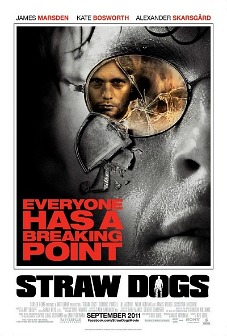
“Once upon a time in Louisiana, waaaaay back in early October 2009 when we were all 20 months younger and our hearts were lighter and Barack Obama was about nine months into the first year of his administration, I visited the Shreveport set of Rod Lurie‘s Straw Dogs…”


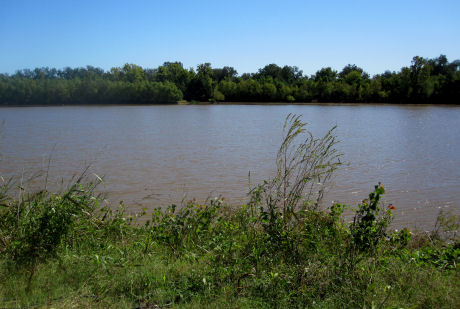
Red River (yes, the same one that John Wayne and Montgomery Clift crossed) adjacent to the Sumner house used for Rod Lurie’s Straw Dogs.

I’m sorry but it’s very hard for me to write up a set-visit story that happened this long ago. I tried to do it about an hour ago and I gave up soon after. The spigots won’t turn on.

I was told not to file anything story-wise during my Shreveport visit, although I posted a photo piece on 10.2. Two or three weeks ago I was told I could finally post. Straw Dogs is set to open in September 2011 and early-bird press screenings will be happening this summer so it’s time to start building awareness, etc. But I can’t find a way back into it. The experience aroma has to be fresh in my nostrils, or it has to be many years old.

Took Her A While

I heard this morning from an old friend whom I hadn’t spoken with since the early ’80s. He told me that his 2005 divorce from his former wife, whom I knew in the old days, was basically about her decision to become a full-time gay woman after flirting with bisexuality for many years. You have to roll with these situations when they happen, but imagine living in a kind of limbo state about your true sexual nature for five or six decades. My first thought is always, “What took you so long?”

The typical beer-drinking, ESPN-watching, straight-guy response to this kind of thing is to assume that the guy had something to do with nudging his formerly straight girlfriend into the clutches of lesbianism. I used to hear this crap when a highly significant ’70s girlfriend turned gay about four years after we broke up. If anything I was the one between us who took it in the neck and ate most of the pain.

I’ve been told time and again that most gay people have an inkling of their true nature fairly early in life, but I’ve also heard of older women going gay over frustration with their asshole husbands or boyfriends so maybe there’s something to it. Or maybe it’s simply delightful to be in synch with another woman who really gets you and makes you feel truly loved.

I’ve sometimes imagined that the ideal marriage situation for a straight guy might be to have a wife who’s passionately bisexual — a woman who genuinely loves being with her husband for security and love and straight sex, but who also has a yen for this or that girlfriend from time to time. That way things are always titillating on a certain level (and no, I’m not even thinking about three-way scenes) and the pressure is off the husband to be 100% responsible for his wife’s emotional and sexual satisfaction.

Catch Up


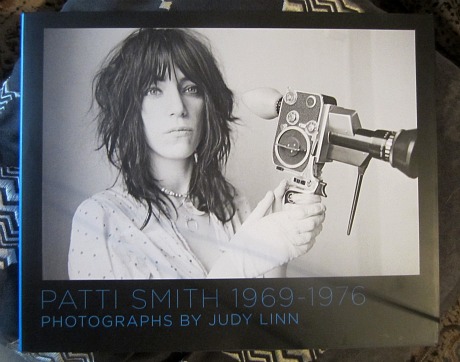
I’ve bought two or three Taschen coffee-table photo books, but generally I just flip through while browsing in book stores…cheaper that way. But I had to buy this Patti Smith-Judy Linn book. I’ve seen Smith perform four times in concert, and had the pleasure of interviewing her at Sundance ’08 where a doc about her life and career, Patti Smith: Dream of Life, played for the first time.

I didn’t arrive to pick up my LAFilmfest press pass at the JW Marriott until after 6 pm, which was past closing. But the FIND p.r. reps graciously stayed open…thanks, guys.

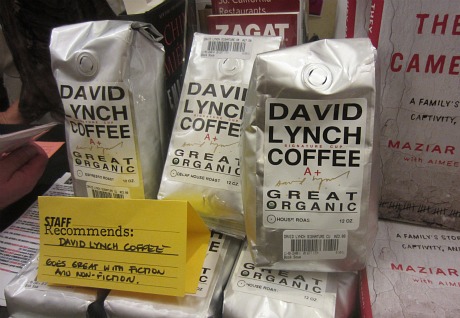
Lynch Coffee began getting a lot of press between March and May of this year, but a salesperson at Book Soup (where I took this shot two or three nights ago) said it’s been on the market for at least a couple of years.

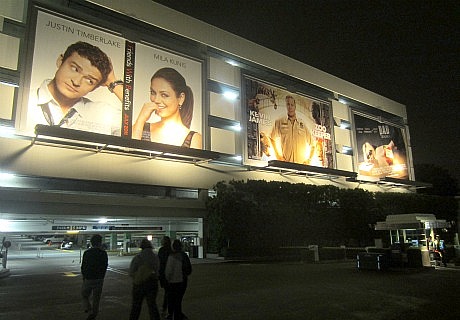
Taken after seeing The Guard last night at screening room #23 in the James Stewart building (formerly TriStar headquarters) on the Sony lot. The security guys called out “sir! sir!” from their booth near the entrance gate. “No photo-taking is allowed on the lot without written permission!” I waved back at them, smiled and said, “Sure thing!”

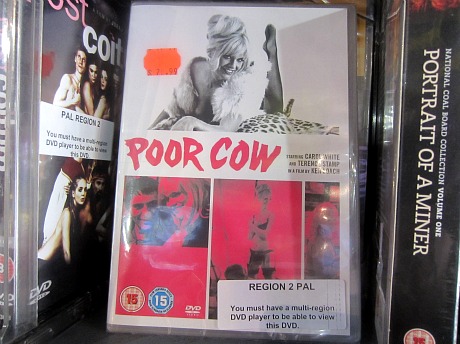
To this day I’ve never seen Ken Loach‘s Poor Cow (’67) except in those clips of young Terrence Stamp that Steven Soderbergh used in The Limey. The lead, Carol White, succumbed to alcohol and drug problems, and died at age 48 in 1991.

Serenity alcove inside lobby of JW Marriott hotel on East Olympic Blvd. — headquarters of FIND and the LA FilmFest.