“Pay The Man Again, Fats”

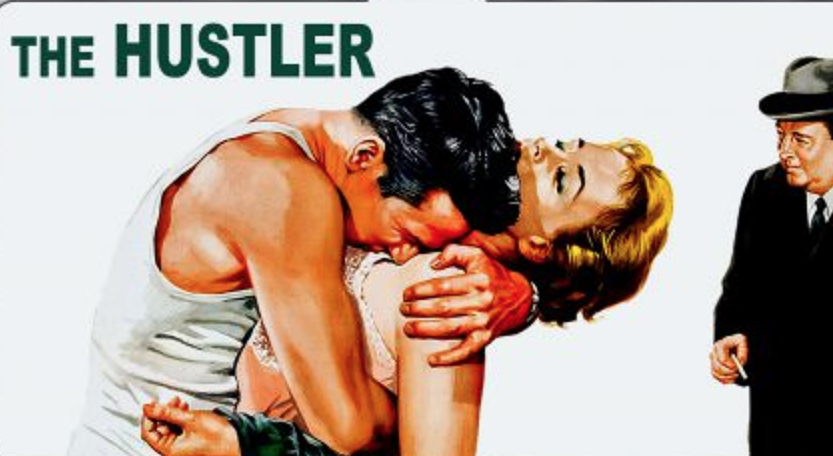
Yesterday Robert Rossen‘s The Hustler celebrated its 60th anniversary. It opened on 9.25.61.

All the principals except Piper Laurie are long dead — director Robert Rossen, costars Paul Newman, Jackie Gleason, George C. Scott, Myron McCormick, Michael Constantine, dp Eugene Shuftan, editor Dede Allen — and it’s still a thing of ripe beauty in many respects.

And yet for decades I’ve felt irked by the script’s nagging moral undertow, voiced by Laurie’s Sara character. In an Act Two scene (a picnic), Sara marvels at Eddie Felson’s gift for pool-shooting (“Some men never feel like that”), and yet she berates him for playing for money. What’s Eddie supposed to do, become a bus driver or short-order cook and play for free on weekends?

And I’ve always been irritated by the grim expressions of McCormick’s Charlie. Once Felson starts playing Minnesota Fats in the temple of Ames Billiards, Charlie seems intimidated and bummed out by the stakes, the vibe…by everything. Shuftan’s elegant cinematography tells you what a joy the game can be, but Sara and Charlie do nothing but groan and lament. They’re a drag to be around.

Hollywood’s Greatest Misanthropes

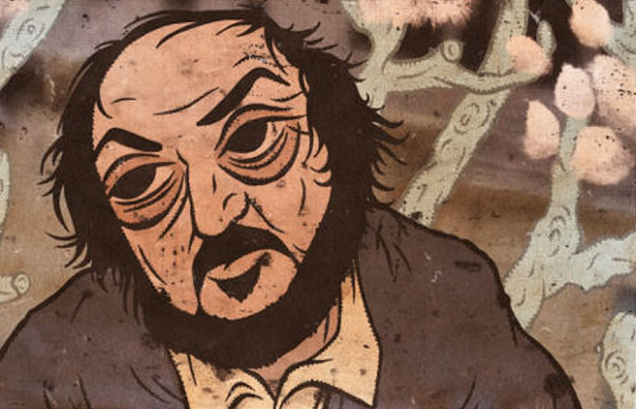
So which directors besides Stanley Kubrick have carved a reputation for having a low opinion of human beings? Kubrick has long seemed the king of this sardonic attitude, but who are his competitors? Or is Stan the only game in town in this regard? I really haven’t given it much thought.

Posted on 8.25.07: Charles Mudede, a dispenser of tight, clean sentences and un-minced thoughts, has written a short unambiguous piece for The Stranger, “Seattle’s only newspaper,” about what a misanthropic hard-case Stanley Kubrick was.

“Kubrick hated humans,” Mudede begins. “This hate for his own kind is the ground upon which his cinema stands. As is made apparent by 2001: A Space Odyssey, his contempt was deep.

“It went from the elegant surface of our space-faring civilization down, down, down to the bottom of our natures, the muck and mud of our animal instincts, our ape bodies, our hair, guts, hunger, and grunts. No matter how far we go into the future, into space, toward the stars, we will never break with our first and violent world. Even the robots we create, our marvelous machines, are limited (and undone) by our human emotions, pressures, primitive drives. For Kubrick, we have never been modern.

“‘I’m in a world of shit,’ says Private Joker at the end of Kubrick’s unremittingly dark Vietnam War film, Full Metal Jacket. That is what Kubrick has to say about the state of everything: The world is shit, humans are shit in shit, life is worth shit, and there is nothing else that can be done about the situation.

“In Kubrick’s movies, progress, sustained enlightenment, and moral improvement are impossible because the powers of reason, love, and religion are much weaker than the forces of generation and degeneration, desire and destruction, sex and death.”

Infinite Thanks to Bobby Zarem

Bobby Zarem, the whipsmart, highly-charged, occasionally volatile New York publicist who “conceived” the “I Love N.Y.” campaign and represented a cavalcade of big Hollywood clients (Sylvester Stallone, Jack Nicholson, Eddie Murphy, Alan Alda, Cher, Dustin Hoffman, Michael Caine, Sophia Loren, Arnold Schwarzenegger, Pee-Wee Herman) during his ’70s and ’80s heyday, and whom I dealt with as a Manhattan-based journalist from the late ’70s to ’83 and worked for in Los Angeles in ’85 and ’86….poor Bobby died today in his home town of Savannah.

Lung cancer got him. Zarem was 84. I somehow can’t imagine Bobby being in heaven or in hell. I kinda see him hovering over Savannah now, but without angel wings. That town is full of ghosts.

Somewhere along the way Zarem picked up the name “super-flack.” He certainly seemed to earn that title during his peak period. To me he became a p.r. legend when he was chased down a street by protestors during the shooting of Fort Apache, The Bronx, somewhere near City Hall. That’s when Zarem, already noted for his colorful manner and being a mainstay at Elaine’s and whatnot, seemed to become a brand…an embodiment of the spirit of rough-and-tumble, pre-corporate, pre-Giuliani Manhattan…the vaguely odorous city captured by Sidney Lumet‘s Prince of the City, and which no longer exists.

Bobby was a character…a tireless, Yale-educated, quintessential Manhattan operator…hustler, gadfly, human locomotive, idea man.
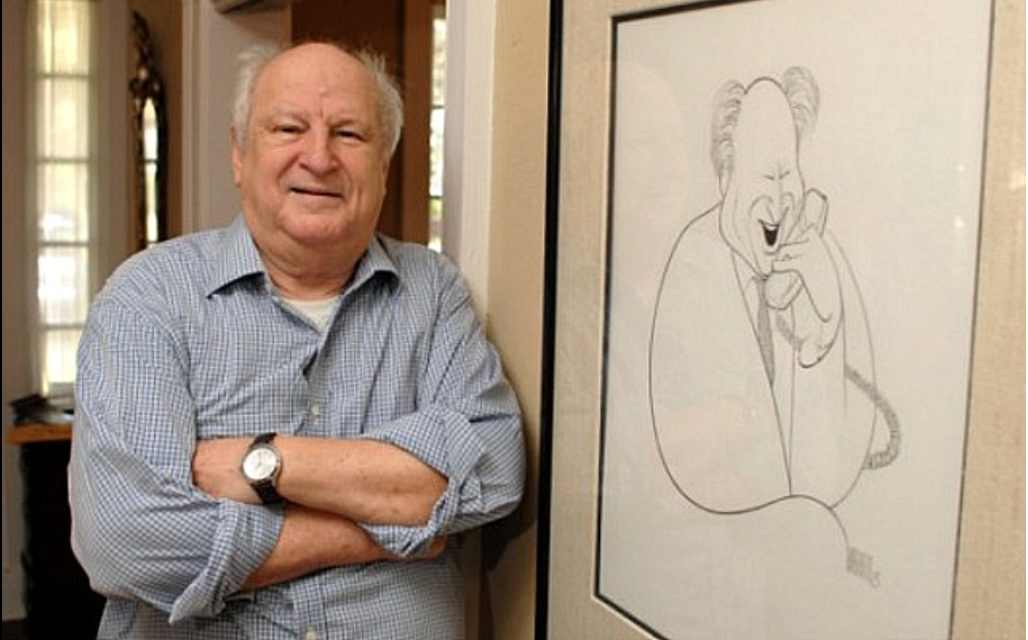
It’s not as if Zarem was often angry or arguing. He was primarily a charmer and an enthusiast. But when he got angry he was amazing. I remember being deeply impressed by his ability to tear people’s heads off without degenerating into sputtering incoherence. When Bobby was pissed he became a kind of dinosaur, a force of nature — the back of his neck and face would turn almost cherry red — but he was always lucid and razor-tongued. I remember saying to myself once, “Wow, I wish I could be that intellectually commanding when I get angry.” But I could never manage it, which is one reason why I’ve always turned it down.

Zarem was driven, neurotic, larger than life, meticulous, a bundle of nerves, occasionally volcanic and every inch a New Yorker. He was a magnificent schmoozer. His hair wasn’t as frizzy as that of Larry Fine of the Three Stooges, but I sometimes regarded him as Fine-like, if you could re-imagine Fine as one of the smartest stooges to ever walk the earth.

I last saw Bobby when he invited me to his Savannah home in…I forget, 2012 or thereabouts. I don’t want to dissect the arc of his wild career or his character traits, and I’ll leave the N.Y. Times-like obits to the Times and other major-reach organs, but Zarem’s Wiki page makes for great reading.

Here’s a rundown of things I’m thankful to Zarem about…things that happened or were made possible by his largesse or whim:

(a) By working with and for Zarem I savored occasionally glancing, sometimes fascinating face-time with Sylvester Stallone, Jack Nicholson, Jane and Peter Fonda, Mick Jagger and Keith Richards, Kirk Douglas, Andy Vajna and Mario Kassar, Pee-Wee Herman…more names and faces than I can actually recall off the top.

(b) I became one of Douglas’s flirtations back in ’82 after an Elaine’s luncheon thrown by Zarem on behalf of the yet-to-shoot Eddie Macon’s Run. I was subsequently flown to Laredo to report on the shooting of that film for the New York Post. Universal publicity conveyed a certain disappointment that my article didn’t mention Eddie Macon’s Run more often, and that I spent too many paragraphs talking about Douglas’s career. Bobby dutifully called to inform me of their disappointment, adding that “this isn’t the end of the world.”

Douglas talked about anything and everything during our chats, and I remember his being fairly wide-open with his impressions about Stanley Kubrick (i.e., “Stanley the prick”), with whom he’d famously partnered on Paths of Glory and Spartacus. I told him I half-loved the foyer freakout scene with Lana Turner in The Bad and the Beautiful. And much of The Devil’s Disciple. And almost all of Champion. And every frame of Paths of Glory and Lust for Life and Lonely Are The Brave.

Read more

“Dune” Will Be Diminished

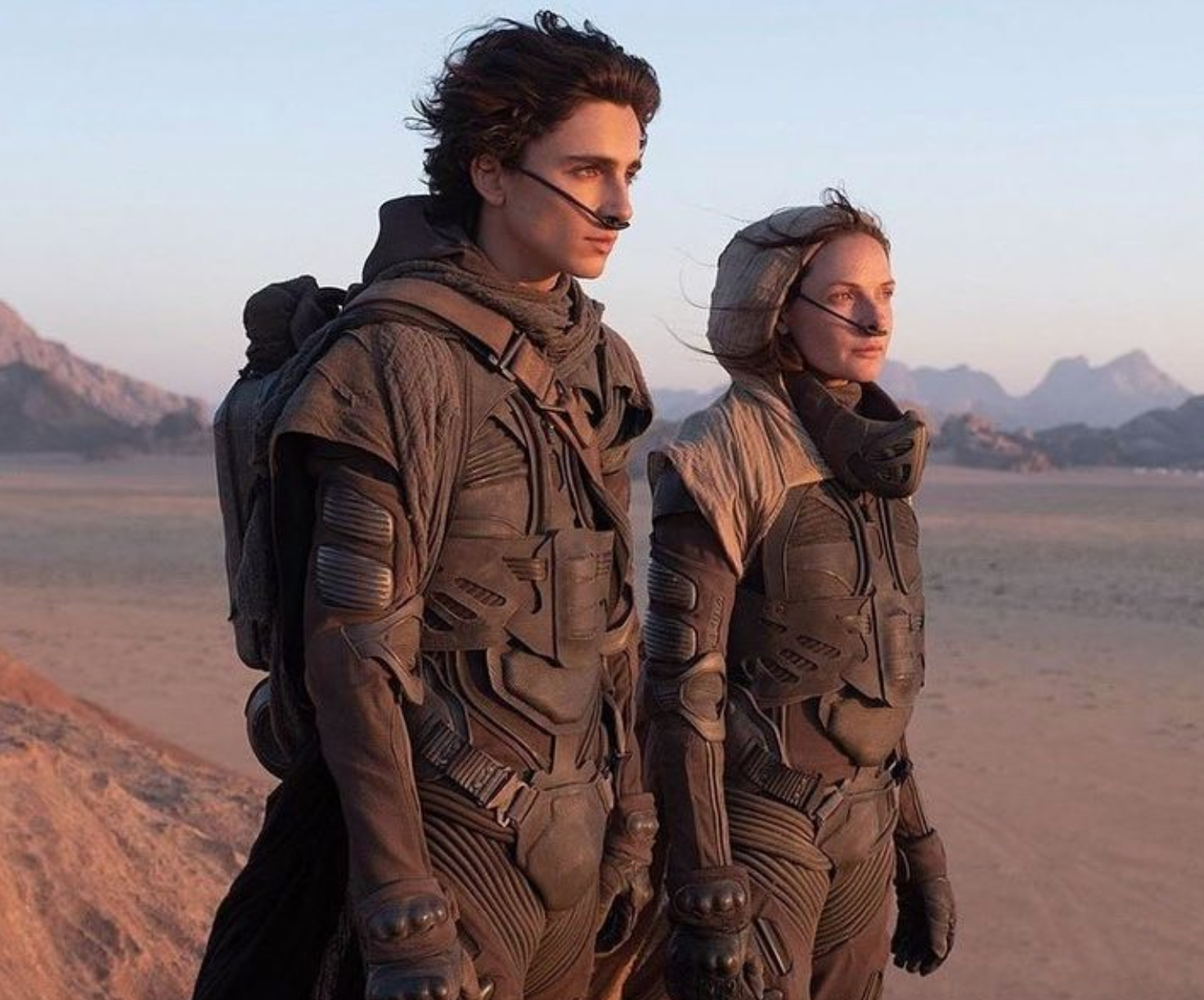
From Owen Gleiberman‘s 9.26 Variety piece about Dune‘s day-and-date, theatrical-plus-HBO Max opening on 10.22:

3. It’s going to play a lot less well on television. Growing up, I once watched 2001: A Space Odyssey on a 16-inch black-and-white TV set, and it actually worked. That’s how great a movie it is. Dune is a lot less great. I would argue that it’s a reasonably commanding sci-fi parable that begins to run out of gas in its last hour. That’s because Frank Herbert, in the Dune books, may have been a better world-builder than he was a storyteller.

“The world of Dune, like the world of Lawrence of Arabia or the original Blade Runner, needs to overwhelm and envelop you. But if you watch it at home, the film’s narrative — is Paul Atreides the Messiah? Watch the House Atreides go down to defeat, and look out for that sandworm! — is going to stand revealed as the rather patchy affair it is. When you shrink the grandeur of Dune, you shrink its appeal.

HE comment: I appreciate big-screen grandeur as much as the next guy, but given the high likelihood that the content of Dune (story, dialogue, pacing) is going to make me miserable and moaning and writhing in my seat, it might be a more interesting thing to watch it on a 16-inch black and white TV. Okay, I’m kidding. 16-inch black and white TVs no longer exist.

In 2012 I saw the digitally restored Lawrence of Arabia projected at the Salle du Soixentieme in Cannes, and it looked beautiful. Four or five years ago I saw a 70mm Lawrence on a moderately large screen at Santa Monica’s Aero theatre, and it didn’t look all that great — half the time I was thinking how much better my digitally streamed 4K Lawrence (issued around ’16 or thereabouts) seemed. After I watched Sony’s 4K UHD Bluray version in June ’20, I called it “the most exciting and orgasmic home video experience of my life — a mind-blowing eye bath.”

What am I saying? That 70mm isn’t what it used to be, that a big-movie presentation has to be a first-class, technically flawless thing or nothing, that watching a film without Millennial mongrels eating pizza and cheese nachos nearby can be a blessed thing, and that seeing a big movie like Dune on a 65-inch 4K HDR screen isn’t necessarily a tragedy.

Actual Best Picture Contenders

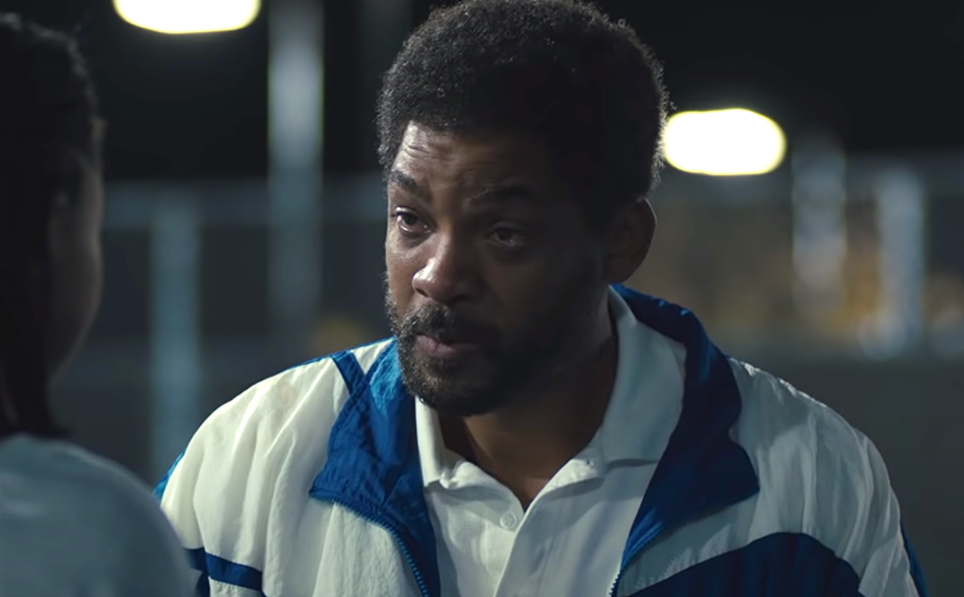
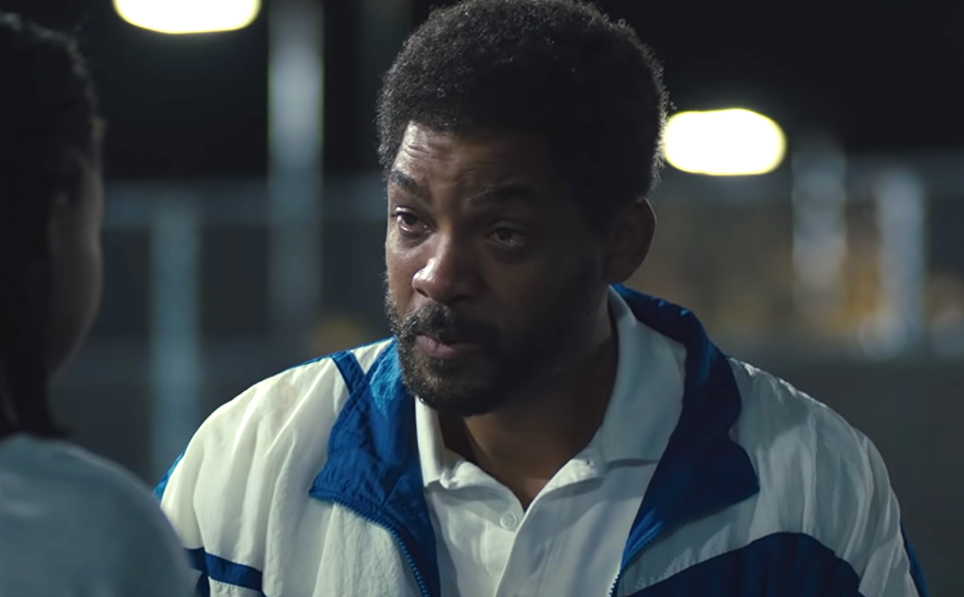
Four days ago The Hollywood Reporter‘s Scott Feinberg posted his first forecast about the Best Picture Oscar race, and he put Reinaldo Marcus Green, Zach Baylin and Will Smith‘s King Richard at the top of the list.

Feinberg was completely correct in doing so for a simple, undeniable reason. Of all the contenders seen so far King Richard is the only one that is (a) exceptionally well made, (b) perfectly acted and (c) makes you feel good in an honest, fully earned, non-pandering way.

There are no other Best Picture hopefuls that have even come close to managing this feat. No other 2021 film so far has delivered this kind of effective emotional pizza. Plus it’s a mostly all-black sports film** (the saga of tennis stars Venus and Serena Williams) about a super-competitive family from Compton, and in particular about a thorny, whip-cracking dad (i.e., Smith’s Richard Williams) who was far from perfect.

Smith is a Best Actor lock; ditto Aunjanue Ellis as his combative wife + mother of phenomenal daughters.

King Richard delivers a metaphor that everyone will understand and relate to — if you want to win, you have to be hardcore.

There are several films I haven’t seen, but I can still tell (or make a very good guess about) which ones will meet these three criteria.

Using Feinberg’s list as a template, here are my no-bullshit assessments as things currently stand. The boldfaced titles are the only ones that stand a fraction of a chance of beating King Richard. (I’ve also boldfaced King Richard for emphasis.)

1. King Richard (Warner Bros., 11.19) — The only Best Picture contender right now that looks like a real winner.
2. Belfast (Focus, 11.12) — Sentimental, cloying and manipulative family drama — an Irish Roma with an overly cute central kid character + wall-to-wall Van Morrison.
3. A Hero (Amazon) — Brilliant Asghar Farhadi film that will most likely be slotted in the Best Int’l Feature category.
4. The Power of the Dog (Netflix. 11.17) — Exceptionally well made, skillfully acted period drama about Montana ranchers writhing in denial and misery with a little touch of anthrax — makes you feel really, really bad. All hail Jane Campion, but the only time you feel good about The Power of the Dog is when it ends.
5. Dune (Warner Bros., 10.22) — Torture to sit through for some; delightful for genre geeks. Not a prayer of being nominated for Best Picture.
6. C’mon, Cmon (A24) — Haven’t seen it, but for years my basic motto has been “beware of Mike Mills.”
7. CODA (Apple, 8.13) — Appealing but not good enough — a feel-good sitcom about a hearing-impaired Massachusetts family in the fishing business, and a high-school age daughter who wants to sing.
8. Spencer (Neon/Topic, 11.5) — Not a chance. Agony to sit through. Strictly a platform for Kristen Stewart‘s Best Actress campaign.
9. The Lost Daughter (Netflix, 12.31) — Haven’t seen it but I’m told it’s somewhere between okay and not that great.
10. Cyrano (MGM/UA, 12.31) — Brilliant musical. Joe Wright‘s finest effort since Anna Karenina. Exquisite Best Actor-calibre lead performance by Peter Dinklage.

Read more

Will 1.6 Committee Subpoena Trump?

Why are they being vague about whether or not they’ll demand his testimony? Are they afraid of alienating Trump’s supporters? He’s an anti-Democratic bully-boy and sociopath who’s been steadily wounding and weakening the rule and fabric of democracy in this country. And right now he’s just a bloated Palm Beach asshole with a big mouth. Subpoena his ass, grill him, make him sweat, give him hell.

Cutting Through “Macbeth” Smoke

Now that Joel Coen‘s The Tragedy of Macbeth has opened at the New York Film Festival and drawn polite raves from 90% of the critics, it’s time to come down to earth and examine what people really think.

Friend of Jordan Ruimy: “I was very cold on this…the whole time watching I was thinking BORING. The performances are very subdued…Denzel has a couple of genuinely moving moments… but Frances McForman’s Lady Macbeth part is truncated and even the ‘out damn spot’ scene was heavily edited…the cinematography and sets have a stark theatrical look, which struck me as fake…\lots of artifice in general which I usually like but not this time…I’m frankly surprised by the over-the-top high praise…[the film] felt completely unnecessary… I’m sure the cast and crew had a great time doing it but why?”

[HE interjection: Because Frances McDormand wanted to play a 60ish Lady Macbeth, and so she asked her husband to direct a stage version and Joel, wanting to oblige, decided he’d prefer shooting it on film.]

Critic friendo responds: “What does ‘unnecessary’ mean? Why is a movie ‘necessary?’ This is a tale of corporate scheming and ruthlessness that fits very well into the spirit of our time. If this guy found it boring, so be it, but I wasn’t bored for a minute. The movie is visually transfixing. Denzel is terrific in it — emotional and alive.”

Guy who attended Tavern on the Green after-party: “Opinions were all over the map. I’d say two-fifths [or 40%] of the people I talked to were highly enthusiastic, and all in the same way — caught up in the film’s amazing look, and in Washington’s performance. Of the remaining three-fifths [or 60%]**, I’d say half of them thought it was decent but not better, and half actively disliked it. So it’s not for everyone. But I actually think it’s a commercial movie. At least, to the extent that a movie of Macbeth can be. (Even the Polanski version, I believe, was a box-office bomb.)”

** What he’s basically saying is that 30% of the people he spoke to, or close to one-third, hated it. And this was a crowd of swells, remember — invitees who probably felt it would be impolite to enjoy free food and drink while trashing the film. So you can probably raise that 30% to 40%.

Kings of Pain

Several weeks ago a brief clip from Adam McKay‘s Don’t Look Up (Netflix, 12.10) appeared online. It was an Oval Office moment in which astronomers Leonardo DiCaprio and Jennifer Lawrence are telling White House adviser Jonah Hill about an impending global disaster, and Hill is going “man, you guys are, like, freaking me out!”

The below clip is a longer version of the same scene, and features cynical dialogue from Meryl Streep‘s “President Janie Orlean,” who is also Hill’s mother. Funny stuff, but isn’t it time to give viewers a taste of another scene?

The costars include Hill, Rob Morgan, Mark Rylance, Tyler Perry, Ron Perlman, Timothée Chalamet, Ariana Grande, Cate Blanchett, Himesh Patel, Matthew Perry and Chris Evans.

You know what this is starting to remind me off, tonally and whatnot? Armando Iannucci‘s In The Loop (’09).

Mystery of King Orba & “The Cleaner”

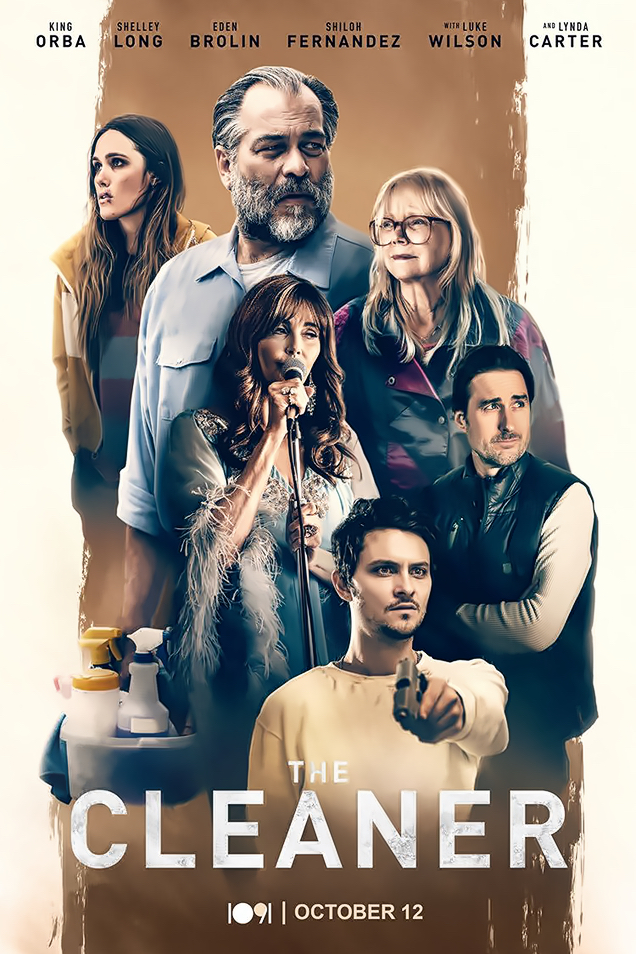
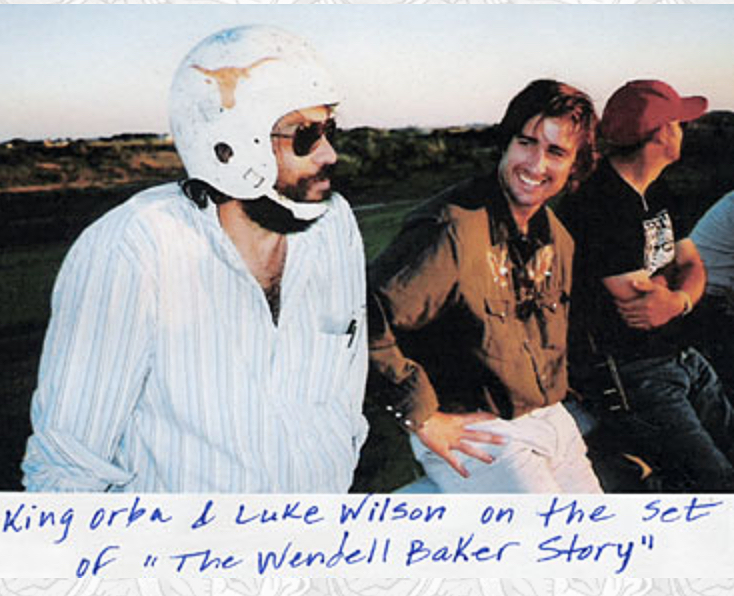
I haven’t seen Erin EldersThe Cleaner (1091 Pictures, 10.12), but I will. It appears to be some kind of mid-range noir about a financially struggling owner of a cleaning business (King Orba) who accepts a $1K payment from a singer (Lynda Carter) to find her estranged son, but eventually gets caught up in some bad shenanigans.

Exec producer Luke Wilson costars along with Shelley Long, Eden Brolin and Shiloh Fernandez.

I hadn’t actually heard of The Cleaner until I received an emailed invitation at 10:11 am this morning to see it this evening at the historic casino on Catalina Island, under the auspices of the Catalina Film Festival. The ferry (comped) leaves San Pedro at 5 pm, the screening begins at 7 pm, there’s some kind of after-party (although without the presence of Orba, Wilson, Carter or Long), and a ferry returns to San Pedro at 11:55 pm.

Yes, I was invited less than seven hours before the ferry departs San Pedro. “That’s insulting!” I muttered to myself. Then my mood changed.

I suddenly decided that I loved the idea of travelling 26 miles across the sea to see an iffy film noir and then returning to the mainland in the black of night…I loved the last-minute craziness, and there’s something perversely entertaining about being invited this late. I would’ve actually preferred being invited at noon or 1 pm — “please get yourself down to San Pedro in less than four hours!”

I especially loved the portion of the invite that said “we can take care of your DAY TRIP to the island via the San Pedro port,” which seemed to imply that I’d have to pay for the late-night return.

My reply to p.r. agency: “JEFFREY WELLS expressing thanks for invite & interest in seeing the film, but why am I being invited only hours before the ferry departs? Isn’t that a bit sudden? And why the Catalina Film Festival in the first place? And why are you emphasizing that the producers will cover the ‘DAY TRIP’, which seems to indicate that I’ll have to book my own passage back to San Pedro? And who’s King Orba? And how come King Orba isn’t attending the after-party, not to mention Wilson, Carter, Long and the others?”

Honestly? Orba seems like a nice guy and a reasonably appealing actor. He has a pleasing, mellow-type voice. I’m actually interested in seeing this.

I’m not sure how to process the line in which Carter offers him “one thousand dollars” to find her son. It might be a joke a la Mike Myers demanding a ransom of “one million dollars” in Austin Powers: International Man of Mystery (2011), or it could be sincere.

The agency has offered to send me a link for an embargoed review, available to post on 10.11.

Son of “I Can’t Apologize”

…for being male, cisgender, gender-conforming, heterosexual, a fertile parent, tall and reasonably attractive, able-bodied, healthy, not fat, a product of an upper-middle-class upbringing, urban, qualified in writing, editing and column-writing, literate, English-speaking, a former Episcopalian, descended from Anglo-Europeans and therefore white.

I realize that these traits usher in all kinds of presumptions about me being a bad person with the mark of Satan on the back of my neck. All I can say that I’m sorry…not for who and what I am, but for your asinine presumptions. [Originally posted on 3.28.21]

Read more

Original Danish “Guilty” Is Better

Antoine Fuqua and Jake Gyllenhaal‘s The Guilty (Netflix, 10.1 — currently in theatres) is a fairly exacting remake of Gustav Moller’s same-titled original, which starred Jakob Cedergren as a suspended beat cop working as a 911 call-center responder, and dealing with an apparent abduction of a youngish mother by her ex-husband.

The Fuqua-Gyllenhaal uses almost the same story, mostly the same dialogue (written or more precisely polished by True Detective‘s Nic Pizzolato), many of the same shots, same tick-tock suspense factor.

I watched Moller’s film before the Fuqua, and I’m telling you right now that the Danish version is way better. Like Moller’s, Jake and Antoine’s version is a single-set thriller that’s all closeups and MCUs and computer screens. The Moller takes place in a Copenhagen call center; the Fuqua-Guyllenhaal is set inside a Los Angeles complex during a major fire and is constantly reaching for the big moments, and is marred by Gyllenhaal’s over-acting.

Moller’s version unfolds in a straight, matter-of-fact fashion — the story happens on its own terms and the suspense isn’t diminished by the subdued tone.

I’m sorry that Fuqua didn’t tell Gyllenhaal to turn it down and ease up. The result is too much sweating, too many hostile outbursts, and too much showboat weeping at the end.

And speaking of weeping, Riley Keough‘s voice performance as the abducted wife is infuriating as she cries and whines and moans in a one-note way. Her character has every reason to feel traumatized and terrified, of course, but the Danish actress in the same role (Jessica Dinnage) occasionally downshifts and delivers a change-up or two, and is much more interesting for that.

As the 45-minute mark in the Fuqua version approached, I was muttering to Keough “Jesus, can you deliver one line of dialogue without sounding like Minnie Mouse on a bad acid trip, fighting back the terror and the tears?”

Peter Sarsgaard, Ethan Hawke, Eli Goree and Paul Dano also do some voice-acting, but there’s no recognizing them.