HE to Formerly Decent Person

Email to a guy I’ve roomed with a couple of times at Sundance: “All I noted in a certain quickly-deleted conversational post was that the Atlanta shootings (by a 21 year-old white guy with stringy chin whiskers) didn’t appear to be racially motivated as much as by some kind of weird sexual addiction thing.

“I didn’t associate the Oscar race with the shootings. A person I occasionally speak to did…big deal. I just listened and thought ‘hmm, that’s an unusual angle but whatever.’

“And this person may have had a point, really, because of the way everything gets associated with everything else these days….it all mixes and swirls together in a big cultural whirlpool. Anyway it seemed like an interesting exchange at first, but then Twitter weighed in with shock and horror and I took it down.

“It’s just words and opinions, man….words and musings and associations. If you had been engaged on this particular angle or topic at a party somewhere, you would have listened and chimed in. You might have disagreed or told the person who shared this perspective that it was insensitive or whatever, and maybe you would have had a point. But because you’re a Twitter hyena, you tried to make it into a big thing.”

Actively Rooting For Eradication

As of today, Indiewire‘s Eric Kohn is primarily known for three things. One, writing smart, sage, fair-minded assessments of films as they come along. Two, being one of the New York Film Critics Circle members who allegedly lobbied to give Best Actress trophies to Support The GirlsRegina Hall in 2018, and to Never Rarely Sometimes AlwaysSidney Flanigan last December, and to bestow the NYFCC’s 2020 Best Film award to First Cow. And three, becoming possibly the first top-ranked film critic to actively push for the end of the career of a major-league filmmaker. Not saying this or that movie stinks, but “this guy needs to be erased, Goodfellas-style.”

I’m not certain if critics of past decades have advocated for this or that career to be fully and finally killed. Many looked the other way when certain screenwriters were blacklisted in the late ’40s and ’50s, of course, but that was a different thing. Maybe some influential critic of 60 or 70 years ago actually wrote “it’s time for the career of John Garfield or Abraham Polonsky or Carl Foreman to be suffocated” and I simply haven’t read about it. I’m just saying that I went “whoa” when I read the headline above Kohn’s article. Because actively lobbying for the final eradication of a filmmaker’s career…well, Kohn’s rep before today has always been that of a congenial, nebbishy, mild-mannered fellow…even-toned, comme ci comme ca, let the chips fall, roll with the tremors.

Not Necessarily A Good Idea

I have a discreet, longstanding relationship with the Movie Godz. They’re basically spiritual remnants of once-living filmmakers who hover and contemplate the filmmaking world. There are 12 as we speak. They all have Twitter accounts, of course, and are constantly refreshing. Once a month they assemble and hash things out, and sometimes they’ll share a thought or two.

All I can say is that during last week’s meeting, some said that they feel left out of things. Nobody cares who they are or what they think. Their frustration is so great that they’re now talking about cancelling someone or something because (I’m not saying this makes a great deal of sense) if they can destroy the reputation of a film or filmmaker, they’ll somehow feel more engaged with the 21st Century world, a good portion of which is driven by terror and intimidation.

Except that, unlike Indiewire‘s Eric Kohn, they don’t hold with the idea of cancelling this or that individual filmmaker or actor for perceived moral or ethical crimes. They shared great relief, for example, that they didn’t get into the brief and idiotic Ansel Elgort flare-up that happened last June.

They finally decided that the best approach would be to cancel certain films retroactively…films that the world could have done without when they were first released, and which the presently-constituted film world would be better off not watching as we speak. As in “get rid of even the memories of these movies…eliminate their existence on Bluray, no streaming, no nothing.”

I’m not saying this is a good thing (HE believes that all films should be preserved and available for new generations to watch and react to) but if you happen to agree with the Movie Godz and feel that some films should be permanently exterminated, what titles would you suggest?

Legendary Movie Homes

Yesterday afternoon Variety‘s Clayton Davis and Jazz Tangcay began a Twitter discussion about their favorite movie houses. There’s a certain strata of younger GenX, Millennial and Zoomer movie mavens who immediately default to scary movie houses when the topic arises. Hence Clayton’s mention of….now I’m forgetting but it might have been the Amityville house, something in that vein. And then Jazz kicked in with her favorite — “the house in Mother!“…scary Darren Aronofsky!

The Psycho house, The House on Haunted Hill, the huge gothic mansion in Robert Wise‘s The Haunting…some people just think this way.

Here are Hollywood Elsewhere’s top-five favorite movie homes: (a) Phillip Van Damm‘s semi-fictionalized Frank Lloyd Wright-designed home near Mount Rushmore in North by Northwest, (b) the sprawling Connecticut ranch-style home (French doors, sycamore trees) owned by Katharine Hepburn‘s wealthy mother in Bringing Up Baby (Howard Hawks and his wife “Slim” built a Bel Air home based on the Bringing Up Baby house, and called it “Hog Canyon”, (c) The side-by-side homes owned by Aurora Greenway and Garret Breedlove in Terms of Endearment, located on Locke Lane in Houston’s River Oaks neighborhood (which I actually visited in April 2006); (d) the Spanish-flavored Double Indemnity home, which I just visited a few days ago, (e) the elegant mountainside home owned by John Robie (Cary Grant) in Alfred Hitchcock‘s To Catch A Thief (Sasha Stone, her daughter Emma and I actually visited the Saint-Jennet home just prior to the 2011 Cannes Film Festival).

The second cluster of five (#6 thru #10): (f) The Evelyn Mulray home in Chinatown, located at 1315 South El Molino Drive in Pasadena; (f) the Leave It To Beaver-styled home in Nancy MeyersFather of the Bride, which is just down the street from the Mulwray home at 843 So. El Molino; (h) Joel Goodson’s bordello home in Risky Business, located at 1258 Linden Avenue, in Highland Park, Illinois; (i) Lester Townsend‘s Glen Cove mansion (brick facade, long curved driveway) in North by Northwest, known in reality as the Old Westbury Gardens (71 Old Westbury Road, Old Westbury, New York, NY 11568); (j) Teresa Wright and Joseph Cotten‘s Shadow of a Doubt home (904 McDonald Avenue, Santa Rosa).


Jack Nicholson and Shirley MacLaine’s homes in Terms of Endearment, located on Locke Lane in the River Oaks section of Houston.

Read more

Second Attempt

Earlier this morning I wrote that “Asian women in three massage parlors shot = not necessarily what it sounds like. The Atlanta shootings don’t appear to have been a racial hate killing. Some kind of weird mucky-muck having to do with sexual obsession and the perpetrator wanting to cleanse himself or some such hooey. In short, another lurking loony-tune from the American underbelly.

A friend commented that “the reality doesn’t matter — woke media is playing it as a racial hate killing, so that’s what it ‘is.’

Second Jab

Last night Hollywood Elsewhere cruised over to the UCLA campus (one of the world’s wealthiest academic, administrative and residential communities) and received a second Pfizer stab. I’d read quite a lot about how the folow-up Covid vaccine tends to deliver more side effects than the first, including tiredness, headaches, chills, fever, nausea and muscle pain. Usually with 12 to 24 hours, and then the effects subside after 48 or so. I was therefore prepared for some kind of adverse reaction.

Well, here I am some 18 hours later and nothing even slightly adverse has manifested. Okay, a very slight soreness in the area of the jab but it’s nothing. In the past I’ve described my constitution as “all but bulletproof,” which was a way of saying it’s very strong. I’m no longer allowed to repeat what my mother told me as a child, but I was blessed at birth with good genes.

Dancing Sneaker Feet

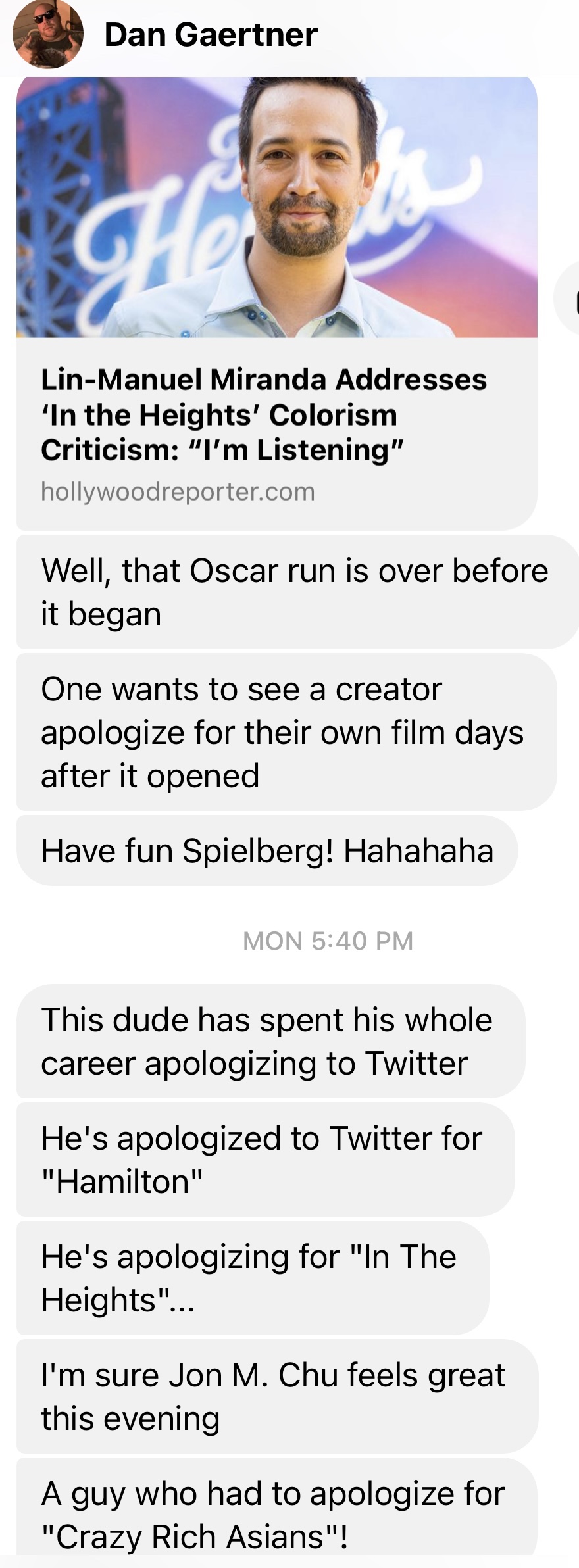
For months I’ve been thinking that Quiara Alegría Hude and Lin-Manuel Miranda‘s In The Heights (HBO Max, 6.18) may be a better, more rousing thing than Steven Spielberg‘s West Side Story (20th Century, 12.10), which I’ve been secretly scared of for a long time. The original West Side Story B’way musical is over 63 years old, having came out of the Upper West Side jungle of the early to mid ’50s. In The Heights is based on a 2007 Off-B’way show, and is therefore at least part of this century. The only thing that scares me about the film version is the possibility that director John Chu might inject some of the same glossy emptiness that made Crazy Rich Asians such a painful thing to sit through.

Which 2017 Best Pic Nominees…?

Three years on, what are your honest, deep-down, no-bullshit feelings about the nine Best Picture Oscar nominees of 2017? Which, if any, would you gladly see again and perhaps would be down with re-watching repeatedly as the years pass on? Here are my current feelings…three are keepers, the rest you can put in the freezer.

The Shape of Water — I liked Shape well enough to give it a pass when I first saw it in Telluride ’17, but because of Michael Shannon‘s detestable Colonel Strickland character I’ll never, ever see it again.
Call Me by Your Name — I could easily catch it again tonight. Great love story, blissful laid-back Italian countryside vibe….it all falls into place.
Darkest Hour — Never again.
Dunkirk — Sure…would watch it again any time. A Nolan knockout.
Get Out — Truly sorry that I saw this fucking thing even once. I’ll watch The Stepford Wives again any time, but this? Never.
Lady Bird — Excellent “heart” film, made by a real filmmaker…I’d watch it again tonight.
Phantom Thread — A small, well-made, mostly infuriating film. Never again.
The Post – I’ll re-watch All The President’s Men any time, but this? Saw it twice in ’17. Meryl Streep is quite good as Katharine Graham, but I’m not that interested in a third viewing. Okay, maybe.
Three Billboards Outside Ebbing, Missouri — Never again, ever.

Tall and That’s Not All

If I had cast the smallish Gael Garcia Bernal as a husband and family man, I would cast an actress who was either his height (officially 5’7″ but rumored to actually be 5’6″) or perhaps a tiny bit shorter. Because 98% or 99% of the time the guy is usually a bit taller or the same height as his significant female other. I certainly wouldn’t cast an actress who’s a good two or three inches taller.

I don’t regard myself as a size-ist (I dealt with a certain amount of pushback from classmates when I was young for being a “giant”) but it’s quite rare to see a husband or boyfriend who can obviously be beaten in a wrestling match by his wife or girlfriend. C’mon, be honest.

And yet that’s exactly what director M. Night Shyamalan has done in Old (Universal, 7.23) — he’s cast the 5’9″ Vicky Krieps (Bergman Island, Phantom Thread) as Bernal’s wife and mother of their three kids.

There are so many actresses of the right age (late 30s, early 40s) and the right height who could’ve played Bernal’s wife without half the audience saying “jeez, she’s obviously too big for him.” Or Shyamalan could’ve stayed with Krieps and cast a taller actor as her husband…easy. Why create credibility problems?

Did anyone ever cast a tall, leggy actress opposite Alan Ladd or Dustin Hoffman? It’s not a male-ego thing — it’s a reality thing. Yes, runty guys occasionally hook up with tallish women…5’11” Nicole Kidman was four inches taller than Tom Cruise, and Katie Holmes was two inches taller. But generally this doesn’t happen. Not in 7-11 land, they don’t.

The Bernal-Krieps casting is actually part of a pattern. In Bergman Island, Krieps is paired with the 5’7″ Tim Roth. And in her private life she’s reportedly married to actor Jonas Laux, who’s also 5’7″.

“What Grade Are You In?”

This is easily the most emotionally affecting scene from Martin Brest‘s Midnight Run (’88), and generally speaking action road comedies don’t do this kind of thing at all. But Midnight Run, written by George Gallo, was different.

A violent chase-caper flick with a quippy attitude, fine. But a film of this calibre delivering this kind of emotion would be all but inconceivable today…be honest.

Robert DeNiro (as bounty hunter Jack Walsh) and Danielle DuClos (as DeNiro’s 12 year-old daughter Denise) handle the heavy lifting, making the most of non-verbal currents. But the silent-witness vibes from Charles Grodin (as white-collar criminal Jonathan Mardukas) and Wendy Phillips (as Walsh’s ex-wife) are poignant in themselves.

When Midnight Run opened 32 and 2/3 years ago somebody wrote that it was a hamburger movie that occasionally tasted like steak, but if you re-watch it (as I did a year or two ago) you’ll recall that it wasn’t that great, not really — that it was formulaic and goofy and rarely subtle.

But it was good enough to temporarily “lift all boats,” as the expression goes. Brest peaked four years later with Scent of a Woman (’92), and then he hit the rocks with Meet Joe Black (’98) and then Gigli (pronounced “Jeelie”).

Imagine how this scene might’ve played if Brest hadn’t cast DuClos or someone else on her level. Born in ’74, she was 13 when this scene was filmed. DuClos is now 46 — a crisp salute for excellent work.