Pelosi Understands

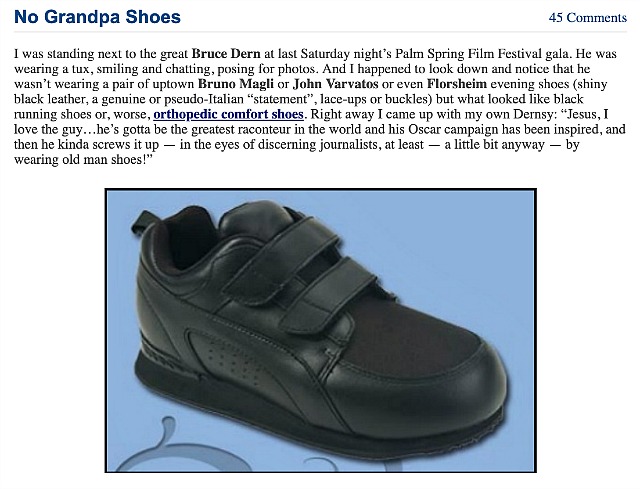
Five years ago I repeated one of the most important rules for famous guys attending public events, which is to never wear orthopedic old-man shoes.

I was derided for saying this, of course, but you can’t explain this aesthetic to deplorable-shoe types. Either you get the importance of wearing elegant shoes in public or you don’t. Wear your grandpa shoes all you want when you’re at home or shuffling around the mall, but never in front of the paying public. The wearing of comfort shoes is a sign of frailty and the lack of a vibrant future.

Nancy Pelosi obviously understands this philosophy, this reality. During last week’s pride parade in San Francisco, the 80-year-old Speaker of the House wore purple Manolo heels. While marching in a parade! Nobody would’ve blinked or said a word if she’d worn sensible shoes or even hiking boots, but she toughed it out because she gets it. She understands what Bruce Dern, Robert De Niro and other guys of that age group refuse to acknowledge.

You know who also gets it? Martin Scorsese. Dude’s pushing 77 and he always wears Italian-style black leather lace-ups.

Disc Pie

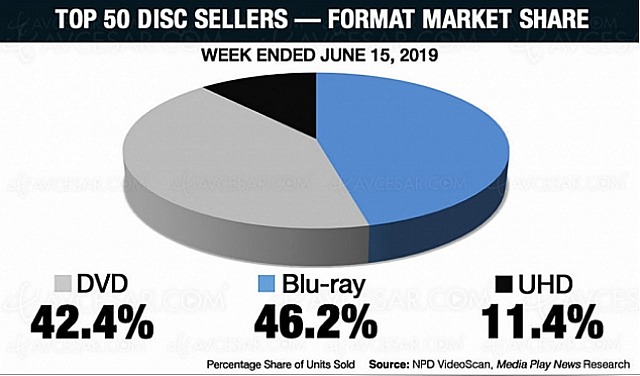
Physical media is living on borrowed time, of course, but how much longer discs will continue to be sold on Amazon and carried by Best Buy is anyone’s guess. I’ll always cherish the idea of owning choice Blurays and 4K UHD discs, but will I still be adding to the collection in 2030? Will everything be streaming in five years? Ten? Amazing that 40-something percent of the purchasing public is still buying DVDs.

Ghost of Mark Robson

My first reaction to yesterday’s 7.1 earthquake was one of surprise but not alarm. It lasted longer than the 6.4, yes, but was just another mild roller. My second reaction was to wonder if life would be imitating Mark Robson‘s Earthquake (’74), a mezzo-mezzo disaster flick in which the Big One was preceded by two midsized shakers. (Indiewire‘s Anne Thompson seemed to have the same thought.) Yesterday a seismologist said there’s a one-in-ten chance of “another 7” within the next few days.

Earthquake was no great shakes. It struck me as odd that the same-aged Charlton Heston and Ava Gardner were cast as an unhappily married couple, mainly, I suppose, because they seemed unevenly matched. (She looked like a boozy wreck while Chuck was holding his own.) The model makers and special-effects team did the best they could, of course, but for me the Big Shakedown sequence never surpassed the level of a good try. The dp was the respected Phillip Lathrop, and yet Earthquake had that flat TV-show lighting that so many Universal films were burdened with back then. The only remarkable aspects were (a) the Sensurround rumble effect and (b) the fact that Heston died at the end.

Read more

Read No Further…

…if you haven’t seen Ari Aster‘s Midsommar. From a guy who saw it last night. Without further ado:

“Loved Midsommar, and was with it all the way: the more bonkers it got, the more I was lapping it up. I howled when the old lady grabbed Jack Reynor‘s ass and started shoving it up and down. His bug-eyed ‘WHAT THE FUCK IS HAPPENING?’ face is priceless. Ari has the fucking goods, imbued with the go-for-broke guts of Ken Russell and the sinister precision of Roman Polanski. I will now go see anything this guy does, knowing that it may not be perfection but will be skilled, intelligent and original.

“I felt the whole thing was less about dealing with a romantic break-up and more about the lead female character” — Florence Pugh‘s — “finding a support group that was able to share and absorb and help her channel the incalculable grief stemming from the loss of her sister, mother and father. I think the shitty boyfriend is less of a problem than the galactic rage and pain she needs to expel from her soul. He unfortunately gets caught in the crossfire, but he’s hardly EVIL…he’s just a crappy boyfriend. What man in his early 20s is mature enough to be a good boyfriend, really?

“Pugh’s character is much more culpable, especially since her new ‘family’ plotted the whole thing. THEY coerced & roofied her boyfriend into a pagan mating ritual while they distracted her with a flowery carriage ride coronation. When Dani returns and sees her boyfriend fucking the pube-cake girl, she runs into the dorm and all the young women surround her, drop down to the floor with her in solidarity and scream along with her. Their screams are ALL genuine — a shared howl of female pain and rage because all of them have felt this kind of betrayal before. It’s an extremely powerful moment that felt so real and was such a smart choice.

Read more

Suspended In Time

There’s a subtle whiff of danger that comes with even mentioning Roman Polanski these days, but I’ve been watching his 12.22.71 interview with Dick Cavett, and it’s really quite fascinating. You can just watch and watch and forget about everything else.

The Cavett drop-by happened two and half years before Chinatown opened and was primarily about promoting Polanski’s Macbeth, which had opened two days earlier in Manhattan. Nobody saw it and Hugh Hefner took a bath, but it’s so fully charged and tinged with such ripe, matter-of-fact horror. I still regard it as the best film version of Shakespeare’s Scottish tragedy, hands down.

My point (and I do have one) is that you can’t watch this interview without feeling stirred by…I don’t know, the strange and complex and sometimes horrific nature of the human experience and especially the one that Polanski went through as a child. We’re all mindful of the rote associations that spring to mind when his name comes up, of course, but I’m talking about considering his remarks without reflecting on the sexual abuse incident that would mark his and his victim’s life for several decades to come, starting on 3.10.77. The Cavett chat happened four and 1/3 years before he would make his bed in that regard.

Cavett to Polanski (26:35): “You’ve said that you’ve faced death several times. Your own death, closely, several times. Does that give you a feeling of…I’m trying not to make some fatuous comment…after these experiences is there a sense that every day you’ve gotten has been a bonus of some kind?” Polanski to Cavett: “It took me a very long time to come to this conclusion. Strangely enough, I think it was only two years ago. Every day is a bonus.”

Polanski’s wife Sharon Tate had been brutally murdered, of course, roughly two years earlier. (28 months and two weeks.) I was thinking about this in lieu of the approach of Once Upon A Time in Hollywood, which opens less than three weeks hence. Quentin Tarantino went to great effort and expense to recreate the film-biz realm of 1969, and for all of it the movie never feels like a time machine, not really. Like every film he’s ever made or will make, it’s basically another visit to Quentinworld.

If Necessary, I’ll Vote for Joe Biden

It’ll bum me out to some extent, but I’ll do it if there’s no other choice. Of course I will. Joe Biden is a decent and responsible fellow as far as it goes. I could even call him reasonably visionary within certain perameters. But dammit, he’s not “the guy”. Yes, he’s an okay fellow. Yes, he’s moderately appealing. But who’s genuinely excited by Uncle Joe? Who? Sidenote: I love that Biden addresses Chris Cuomo as “man” seven or eight times here.

Here We Go Again — “Green Book”, White-Guy Attitudes, Wokeness

A 7.5 N.Y. Times opinion piece called “The Dominance of the White Male Critic” has been written by Elizabeth Mendez Berry and Chi-hui Yang. My first thought was that the article could have been co-authored by Sundance honcho Keri Putnam, who voiced a similar beef at the beginning of the 2019 Sundance Film Festival.

During a 1.24 Sundance presser Putnam said that organizers had noticed “a disturbing blind spot” in the press credential process. “Diversity isn’t about who is making the films,” Putnam said. “It’s about how they enter the world.” She said that the festival noticed that they were admitting “mostly white male critics,” adding that “this lack of inclusion has real-world implications.”

Excerpt from Berry-Yang piece: “For decades, those given the biggest platforms to interpret culture [have been] white men. This means that the spaces in media where national mythologies are articulated, debated and affirmed are still largely segregated. The conversation about our collective imagination has the same blind spots as our political discourse.
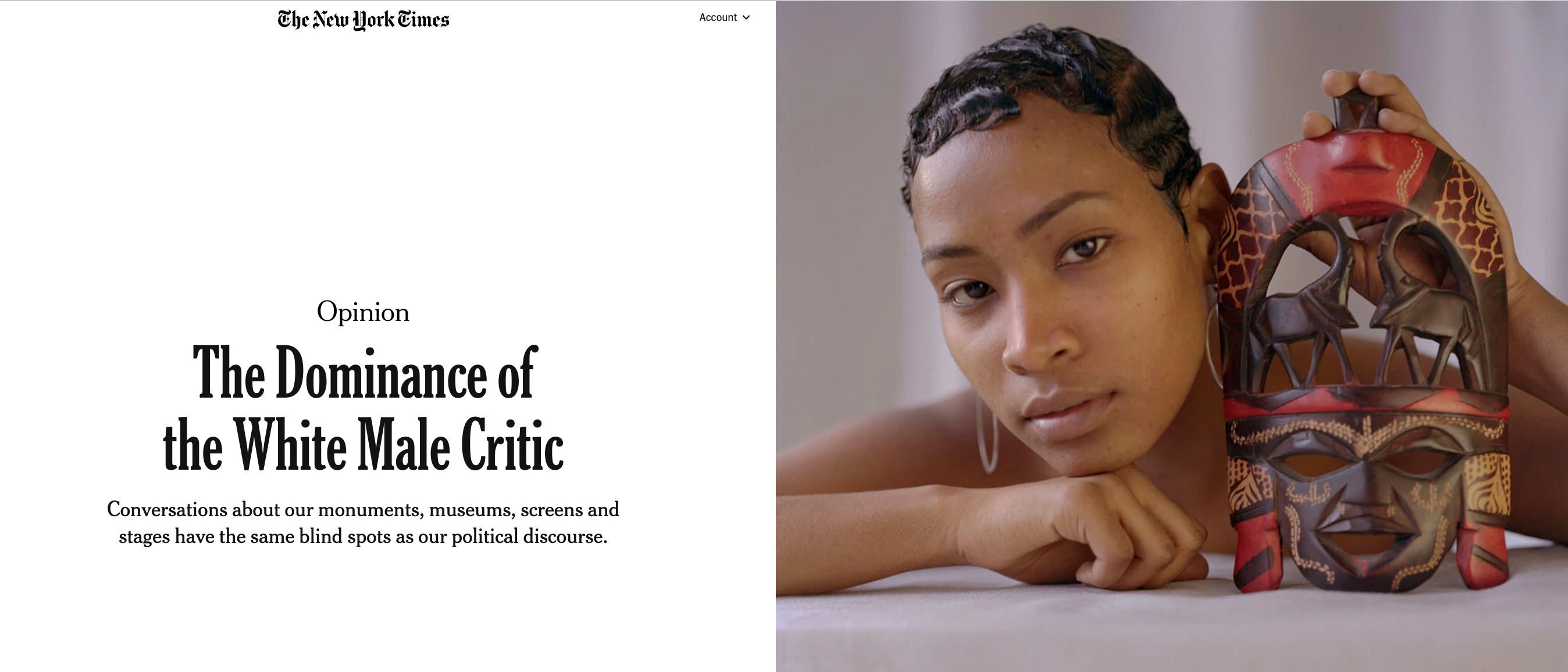
“Consider how this played out around the movie Green Book,” Berry and Yang observe, adding that “when it premiered at the Toronto Film Festival in September, most of the reviewers heralded it as a heartwarming triumph over racism.”

HE response: Yes, a number of reviewers who attended the Green Book premiere at the Elgin on the night of Tuesday, 9.11.18 (myself among them) passed along rave reactions, but mainly because the crowd had really flipped for it. Not because anyone saw it as any kind of “heartwarming triumph over racism” — that certainly wasn’t my impression — but as a well-mannered, nicely buffed capturing of the various shades and permutations of American racism coursing through the body politic back in the Kennedy era, and that’s all.

“Is Green Book anywhere close to daring or nervy?,” I wrote after the Elgin screening. “Nope — it’s a nice, safe, entertaining middle-class dramedy, tidy and affecting and right out of the big-studio handbook, but man, it really hits the spot. You can call me a square or a sap for succumbing to a film of this sort, a liberal-minded social-issue dramedy that could’ve easily been made 20 or 30 years ago, but you should’ve heard that audience go nuts when the closing credits began. I mean, it was like thunderbolt and lightning.”

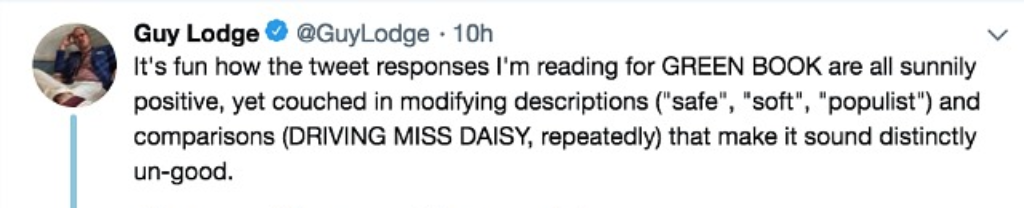
But the Toronto afterglow didn’t last long. One day after the Elgin screening — one day! — I posted a piece called “Fussies & Pissies Mulling Green Book Pushback.” How did I know that the film snobs would be coming for it? Because of a tweet posted by Variety snootmeister Guy Lodge, a living, breathing barometer of elitist critical disdain in our day and age. Sure enough the grenades were soon lobbing in.

Berry and Yang: “But two months later, when [Green Book] started screening in movie theaters across America, black writers saw it as another trite example of the country’s insatiable appetite for white-savior narratives.”

HE response: Over and over last fall I explained that there’s nothing the least bit white savior-ish about Green Book, and that it’s basically a parent-child road dramedyMahershala Ali‘s Don Shirley is the strict if constricted father, and Viggo Mortensen‘s “Tony Lip” is the casually brutish adolescent. It’s a spiritual growth and friendship flick. If anyone does any saving it’s Mahershala who saves Viggo from his crude Italian-meathead-from-Queens attitudes. Peter Farrelly‘s film is simply about listening, kindness and compassion. But that’s me.

Did the white-savior thing get thrown at Green Book regardless? Yeah, of course, but those who took potshots in this vein were hardly confined to critics on the urban fringes. It was mostly attacked during award season (and in some cases savagely) by under-40 white wokesters along with know-it-all palefaces who’d been around for decades. Trevor Noah‘s much-discussed Daily Show billboard slogan (“Don’t Green Book This One, Guys!”) wasn’t aimed at critics of color, trust me.

The Green Book haters included Indiewire‘s David Ehrlich, the N.Y. TimesA.O. Scott, Variety snootmeister Guy Lodge, London TimesKevin Maher (who actually called it a “botch job”), Claudia Puig (“insensitive”), NPR’s Mark Jenkins, eFilm Critic’s Peter Sobczynski, The New Yorker‘s Richard Brody, Toronto Globe & Mail’s Barry Hertz (“not quite Racism for Dummies, but close”), The Wall Street Journal‘s Joe Morgenstern, Screen International‘s Tim Gierson, etc.

Berry and Yang” “The initial positive buzz [for Green Book] set such a strong tone that its best-picture win at the Academy Awards seemed a foregone conclusion. But that didn’t stop the white filmmakers from going after black reviewers like K. Austin Collins of Vanity Fair who found it problematic.

“’What the makers of this movie are missing is just that many black critics didn’t get to see this movie until it came out‘ during Oscar season, well after early screenings for critics, Mr. Collins said during a panel at the Sundance Film Festival. ‘When black critics do finally get to see this movie, it is seen as disrupting the Oscar campaign. I don’t think any of us really care about that. We care about representation.'”

Obviously critics of merit should be given a chance to see and review the big films at the same time as established hot-shot critics. No one’s arguing against this.

What has my attention are the last four words in the above quote, for they constitute the kind of admission that Tom Wolfe once wrote about in “The Painted Word” when he described the classic “obiter dicta” — words in passing the give the game away.

When people talk about Oscar-season distinctions they’re usually referring to qualities that have touched or impressed a wide swath of viewers by way of theme, metaphor, emotional poignancy or commanding applications of skill and craft — the kind of stuff that moviegoers and Academy members tend to associate with classic keepers.

Correct me if I’m wrong, but Collins seemed to be saying that he and like-minded fellows regard this kind of thing as less than vital or perhaps even peripheral when considered alongside the much important issue of representation, which basically means “rewriting codified racist narratives and in some cases evening the score by way of progressive approaches to casting and story-telling.”

Maybe, but if you ask me that sounds like a rather limited and politically-minded place from which to absorb and assess the wondrous and delicate art of filmmaking. Making great movies and using movies to alter social consciousness can be achieved in the same effort, sure, but can also be understood as separate challenges, no? At least in some instances.

There are more things in heaven and Earth, Horatio, than are dreamt of in your philosophy.

Satirical Monthly That Held On For Decades

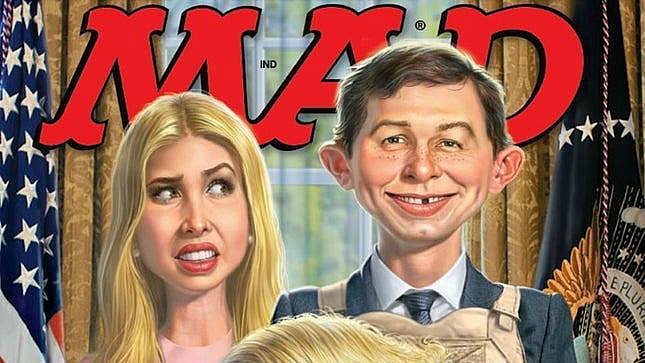
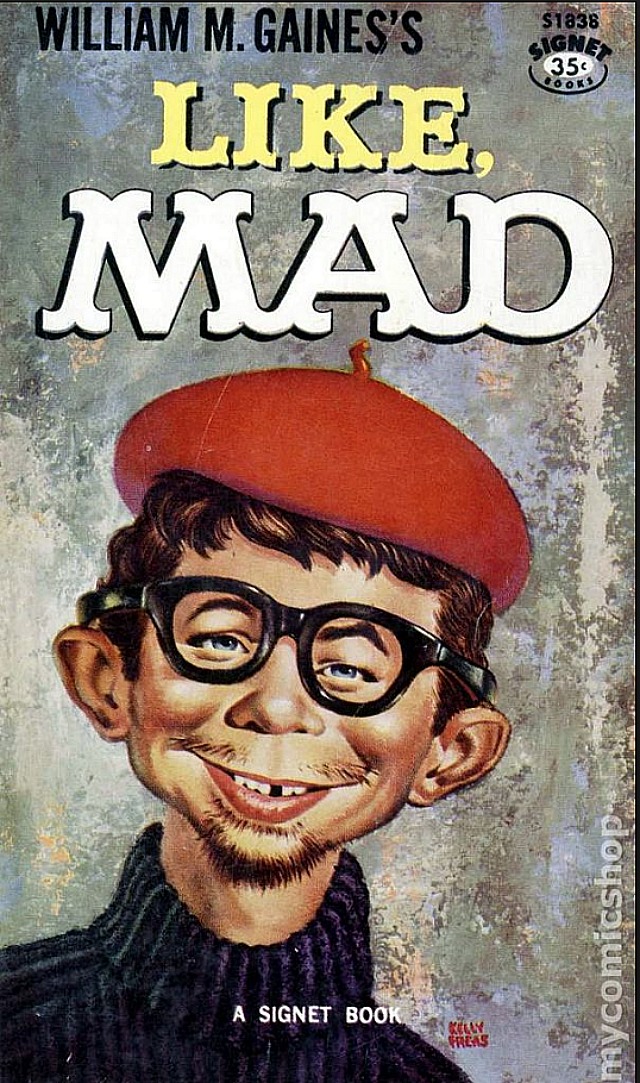
I didn’t mention the death of Mad magazine because in my mind it stopped being a truly influential cultural satire publication 40something years ago. Seriously — Mad stopped being a necessary thing sometime in the early to mid ’70s. (The vital era was really the mid ’50s to mid ’60s.) I respect the fact that they kept publishing well past peak cultural potency — who doesn’t admire drive and tenacity? — but every publication has its day, and Mad‘s was during the Eisenhower and Kennedy administrations.

Somehow or some way Mad, Steve Allen, Lawrence Ferlinghetti, Tuli Kupferberg and Lenny Bruce were part of the same ’50s comic-hipster mindset; they all seemed to be sipping from the same attitude well. Mad and Bruce both ascended around 1955, when Mad dropped the comic book format and became a magazine. Bruce died in ’66; the Mad vitality began to ebb or dilute around that same time. More and more people getting stoned changed the game — in the ’50s and early ’60s Mad delivered its own kind of pot high in a way. Yes, it hung on for decades after that (and hats off to those who kept the brand burning), but now it’s really over and done with.

Read more

Hassling Falk in Hardware Store

Filed on 6.24.11, or the day after Peter Falk died: “I was milling around a Hollywood hardware store sometime in the early ’80s, looking for a screwdriver or something, when I heard raised voices. Two or three Joe Sixpack meatheads were having fun at the expense of poor Peter Falk, who was poking around like me, just wandering down the aisles.

‘Aaaaay…Detective Columbo!,’ one of them was saying with the rest joining in. They just had to treat Falk like some kind of visiting celebrity alien. They couldn’t be decent about it. They had to be assholes.

“And I remember how Falk walked by me as these jerks were taunting him and making their little nickle-and-dime, lame-ass cracks, and how he was trying to ignore them but at the same time was fiercely cussing and not all that quietly, going ‘Jeezus!….Jeezus!’

“I remember thinking to myself and trying to telepathically say to Falk, ‘Yes, yes…keep going! Turn around and let’ em have it! You can do it, Peter!’

“Did Falk ever have a movie role in which he hit it out of the park? Did he ever even hit a long triple? Yes — in Raymond De Felitta and Paul Reiser‘s The Thing About My Folks (’05). Which nobody saw, of course.

“He was also memorable in a relaxed and settled and kindly way in Wim WendersWings of Desire (but less so in Far Away, So Close). And he was especially fine (and perhaps delivering his career best) in John CassevettesHusbands and A Woman Under The Influence.

“Falk’s peak run was from ’69 to ’74, when he was 42 to 47 years old. He began the streak in ’69 when he costarred as Sgt. Ross in Sydney Pollack‘s Castle Keep, and then played Archie Black in Husbands (’70) and did A Woman Under The Influence (’74) , and all of this while starring as Lt. Columbo from ’68 to ’03.

Read more

Reactions to “Midsommar”?

On 6.25 I said the following about Ari Aster‘s Midsommar (A24, now playing): “No matter how you feel about elevated horror, chilling Swedish pagan rituals, shitty boyfriends or Florence Pugh, this is a 100% essential summer freakout flick.”

In other words, it’s a film you have to see no matter what your particular interest levels may be. Because it’s currently understood by everyone to be culturally unmissable right now.

So a fair number of people went to see it yesterday, and…?

Excerpt #2: “Yes, Midsommar is a breakup film — David Edelstein called it ‘a woman’s fantasy of revenge against a man who didn’t meet her emotional needs’ as well as ‘a male director’s masochistic fantasy of emasculation at the hands of a matriarchal cult.’ That’s about as concise and on-target as a capsule description could be.”

From Owen Gleiberman’s 7.4 Variety column, posted at 2 pm:

“What we mean when we say ‘the ’60s’ may be ancient history, but the hidden legacy of the ’60s is that we’re increasingly a nation of sects, tribes, people obsessively seeking out those of like-minded desire. There’s a case to be made that we’re now evolving, in our thinking, into a nation of cults, which is why, when it comes to politics, rationality seems, more and more, to have vacated the building — not only on the right (though primarily there), but on the left as well. Debate, more and more, seems over. It has been replaced by the fundamentalism of belief.

“The horror of Midsommar is that innocent people die, in gruesome ways. But the real horror of Midsommar is that Florence Pugh’s Dani, drawn to the center of her own shattered identity, replaces it by becoming the self-actualized queen of her surroundings. Dani, in this movie, is really all of us. She loses herself, only to find her new self. She sheds her skepticism and joins the group. She fixes her broken relationship with her lover by reducing him to a piece of timber. She heals her trauma by giving her benediction to flowers of evil. And she does it, in the end, with a smile.”

Greed Is Grim

13 years ago Forbes magazine asked three critics (Richard Roeper, Neil Rosen, Jeffrey Lyons) “which are the ten best films ever made about money?”

What a question! Aren’t 70% to 80% of all the films ever made in one way or another about people trying to make, steal, hold onto or somehow get hold of more money?

The ten that Rosen, Roeper and Lyons chose suggest their real criteria was choosing the best movies about the corrosive effects of greed: Wall Street, Trading Places (what?), The Sting, Boiler Room, Ocean’s Eleven (’60 version), It’s a Mad Mad Mad Mad World, Casino, Glengarry Glen Ross, The Treasure Of The Sierra Madre (good choice) and American Psycho (another good one).

HE’s top 13 as of right now: The Wolf of Wall Street, A Simple Plan, Glengarry Glen Ross, The Treasure of Sierra Madre, L’eclisse, Wall Street, There Will Be Blood, Inside Job, The Big Short, Margin Call, Capitalism: A Love Story, The Queen of Versailles and Eric Von Stroheim‘s Greed.

A Roller, Not A Rocker

The significant thing about this morning’s Ridgecrest quake was how long it kept going. At first it was a faint nudge, and then a vague two-step shimmy. And then I went into my usual “okay, this is happening, show me what you got” mode. (Quakes don’t upset me because I’m constantly quaking inside — I regard them as interruptions in the ongoing uncertainty and anxiety of day-to-day life.) Then came the soft, semi-serious rolls…”hominah-hominah-hominah.” Then it was over.

If you’d asked me to gauge I would have said 5.8 or 6, tops. They’re saying it was a 6.4. HE rule: If no framed photos fell off the wall, it was no biggie.

Tatyana has vivid memories of the 1986 Vrancea earthquake, which was centered in Romania. She was 12 years old and living in Moldova. (Known at the time as Moldova Soviet Socialist Republic.) That quake killed more than 150 people, injured over 500, and damaged over 50,000 homes.