“Night of Camp David” Is Yesterday’s News

Published in ’65, Fletcher Knebel‘s “Night of Camp David” was a chilling, half-gripping “what if?” thriller about a first-term Senator who comes to believe that President Mark Hollenbach has become a mentally unstable paranoid nutbag and needs to somehow be relieved of his duties.

51 years later Donald Trump was elected president, and right away people were saying that Hollywood should adapt Knebel’s book before reality overtakes fiction.

And then reality did overtake fiction, and Trump…I don’t think I need to re-summarize his presidency but his calamitous four-year-term ended with (a) the needless deaths of tens of thousands due to Covid, (b) the storming of the U.S. Capitol based on the Big Lie about the 2020 election having been rigged, and finally (c) Trump’s second impeachment trial.
If someone had suggested such a scenario to Knebel while he was outlining “The Night of Camp David” in ’63 or ’64, he would have rejected it for being too extreme. Critics and readers would regard such a tale as a deranged farce, he probably would’ve thought — Dr. Strangelove meets psychotic delusion.

It goes without saying that in the world of 2021, a film based on “The Night of Camp David” would be a so-whatter. It would have been a bracing thriller in the mid ’60s and possibly a dark unhinged farce if adapted at the start of the Trump administration, but now? Seriously?

Yes, seriously — THR‘s Borys Kit is reporting that Paul Greengrass (News of the World, Captain Phillips) has cut a deal with Universal to develop and direct Knebel’s novel.

The Resistable Rise of Arturo Ui,” posted on 11.28.16:

In Stanley Kubrick‘s Dr. Strangelove (’64), it is made clear early on that General Jack D. Ripper (Sterling Hayden) is insane. The basic proof is Ripper’s adamant belief in what he calls a “monstrously conceived” Communist plot to inject fluoride into the U.S. water system.

Those who insist on their own facts are, by any fair measure, detached from reality and therefore short of a 52-card deck. There are other signs of mental instability but surely the key factor must be a commitment to fantasy and imagination over anything else.


Read more

“Degenerate Gambler With a Badge”

From HE’s John Heard obit, 7.22.17: I knew Heard slightly in the early ’80s. He wasn’t a friend but I was close at the time with Keith Szarabajka (Missing, Marie, A Perfect World, The Dark Knight, Argo) and he was genuinely friendly with Heard and so I kind of absorbed the camaraderie of that. (Szarabajka and I met while working as waiter-busboys at the Spring Street Bar & Grill in the late ’70s.)

I ran into Heard a few times at Cafe Central and The Allstate, another popular actor haunt on West 72nd Street. He had an off-and-on alcohol issue at the time, but he was a good egg and a seriously emotional guy.

In ’82 or thereabouts Heard experienced a momentary attraction to a woman I’d been involved with a few months earlier — i.e., photographer Sonia Moskowitz. He approached her at a bar one night with “you wanna get married?” But when I told him a day or two later that Sonia and I had gone out two or three months earlier, Heard apologized, as if he’d done something improper. “No, no, it’s cool, man…life moves on,” I said, but Heard was all “Jesus, man, I didn’t know…shit, sorry.”

In the spring of ’83 I saw Heard knock it hard and straight in Total Abandon, a courthouse stage drama written by Larry Atlas. Or so I recall. I certainly remember going up to Heard after the matinee ended and saying “Wow, man…that’s a tough role to play twice a day” and him smiling and shrugging and saying “naaah, just a workout.”

Heard’s Vin Makazian, a Newark detective with a gambling-slash-alcohol problem, was one of the most indelible Soprano characters.

Read more

“Benjamin Button” In Roughly 165 Words

“In my next life I want to live my life backwards. You start out dead and get that out of the way. Then you wake up in an old people’s home feeling better every day. You get kicked out for being too healthy, go collect your pension, and then when you start work, you get a gold watch and a party on your first day. You work for 40 years until you’re young enough to enjoy your retirement. You party, drink alcohol, and are generally promiscuous, then you are ready for high school. You then go to primary school, you become a kid, you play. You have no responsibilities, you become a baby until you are born. And then you spend your last 9 months floating in luxurious spa-like conditions with central heating and room service on tap, larger quarters every day and then Voila! You finish off as an orgasm!”

I know this a familiar Woody Allen riff, but it hit me this morning that aside from the remarkable digital FX in David Fincher’s 2008 Oscar-nominated epic, Allen’s summary delivers everything a viewer could hope to get, philosophically and substantively and in roughly 40 seconds, from sitting through this 166-minute-long saga about Brad Pitt de-aging his way through a long and colorful journey of a life. I’m not saying I dislike Button — I certainly respected it on technical grounds — but I did glance at my watch three or four times. And I’ve never re-watched it. I’m sorry but I haven’t.

Irksome Character Name

For reasons I couldn’t fathom at first (and which I didn’t dare mention a year ago for fear of #MeToo condemnation), I was consumed by a primal dislike for the name of Margot Robbie‘s character in Jay Roach‘s Bombshell — i.e., Kayla Pospisil.

To me, Pospisil sounded like the name of an exotic South American marsupial.

If her name had been Poppins or Popinjay, fine. Or Passel or Possible (a lascivious tease name). But pronunciation-wise, Pospisil was too strenuous. It certainly stood out, and in my mind sounded pretentious and showoffy. I took an instant dislike to it, and tried hard not to think about it one way or the other.

Pospisil is a Czech name that derives from the word “pospisit,” which means “to be in a hurry.” It’s also a Midwestern name. Ancestry.com reports that “the Pospisil family name was found in the USA between 1880 and 1920, and that the most Pospisil families were found in the USA in 1920. In 1880 there were 8 Pospisil families living in Wisconsin. This was about 53% of all the recorded Pospisil’s in the USA.”

Any other movie-character names that struck anyone as instantly bothersome?

Again — Don’t Blame Mulligan For Variety’s Apology

To be perfectly frank, I fear that Variety (Claudia Eller, Cynthia Littleton) screwed the pooch when they offered a blanket apology to Carey Mulligan for that one paragraph in Dennis Harvey‘s 1.26.20 review of Promising Young Woman, despite editor Peter Debruge not changing a word of it during Sundance ’20 and no one else changing it for nearly a whole year after that.

Plus the faux pas of Variety not even allowing Harvey to write a follow-up to explain where he was coming from and to remind everyone that he LIKED Promising Young Woman.

I suspect that was a bad move in that it created empathy on Harvey’s behalf (and resentment of Variety‘s needless bludgeoning) among male Academy members of a certain age. All I know is that the buzz was building and building in Mulligan’s favor up until Kyle Buchanan‘s 12.23.20 N.Y. Times interview with her, and then a few days later came the Variety apology and then it all started to change. I know that the Carey momentum seemed to slow down if not stall after that.

I can’t believe that the Academy will give the Oscar to Viola Davis for lip-synching with a fat suit; I expect that despite Frances McDormand having won twice before, they might hand it to her. I personally would love to see the Oscar go to Mulligan, perhaps as a referendum on all her performances since 2009’s An Education as much as her work in PYW, but, like I said, I think Variety may have messed things up for her. Perhaps not but maybe.

HE to Academy members: It wouldn’t be fair to blame Mulligan for what Eller and Littleton did. She didn’t ask for an apology, remember. She just took issue, briefly, with Harvey’s alleged or perceived view that she wasn’t hot enough to play Cassie, the Promising Young Woman avenger.

Read more

Ira Levin’s “The Man From Springfield”

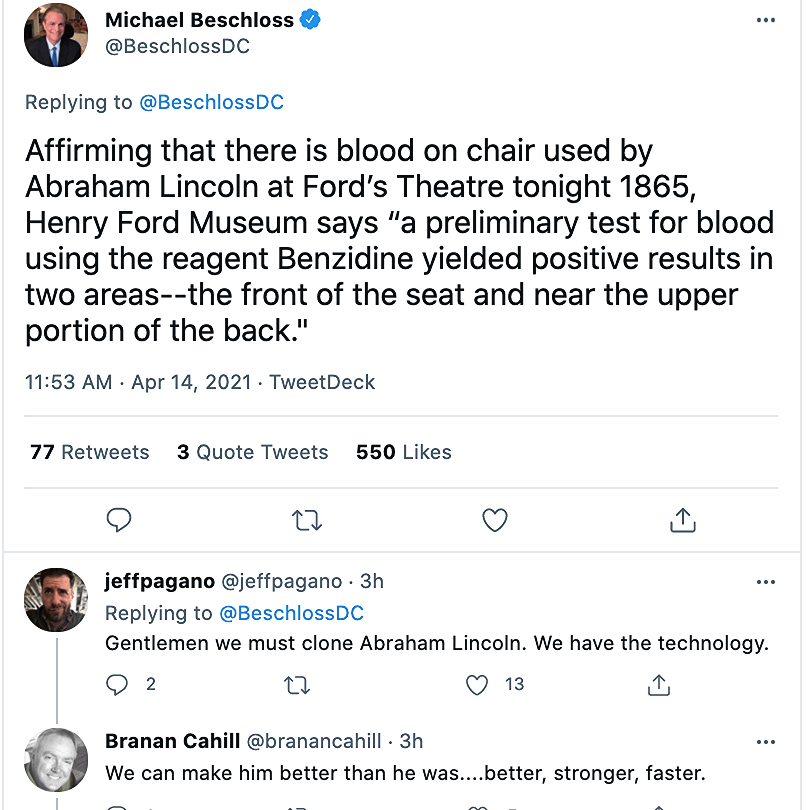
Let’s imagine I had absolute power and a group of scientists and financiers came to me and said, “We can take Abraham Lincoln‘s blood from that Ford’s Theatre chair and clone him…literally recreate him head to toe…an exact duplicate, voice and all…do we have your permission to do this?”

My first reaction would be that the idea sounds more than a little macabre and that it’s probably better to leave well enough alone and that none of us can go home again, etc.

But in all honesty, a part of me would be intrigued by the idea of creating Abe 2.0. Not with any expectations that he would enter politics and become a statesman, of course. If I approved the cloning I would insist, in fact, that the creation of said being be shrouded in total secrecy and that he would be free to live his own life by his own steam and create his own personality and take any path that seemed appropriate, unhindered by anyone’s expectations.

But I would also think it fair that Abe 2.0 (who could end up as a CVS manager or an Uber driver or a basketball player) should be informed of his genetic lineage at age 30, I would think.

Why would I want our 16th President to re-experience the world a second time? Because I would want certain people to interview him and hear his voice — that would be one thing. And because he might take to writing or political activism, and I would want to know what judgments he might have about Twitter, Trump and QAnon, wokesters and the film assessments of Glenn Kenny and David Ehrlich. And secondly, where would be the harm? A person of exceptional genetic tendencies and inclinations would join 21st Century America along with tens of millions of others. How would that be a bad thing?

HE to commentariat: Which historical figures, if any, would you like to see cloned and re-introduced to planet earth?

Apparent Purge of Indiewire Comments

World of Reel‘s Jordan Ruimy reports that Indiewire has taken down its comments section, as in permanently.

“I’ve been keeping an eye out the last three or so weeks to see if the comments section would be re-installed,” Ruimy reports, “but it still hasn’t. I think [Indiewire owner Jay] Penske just nixed it. Older articles have also had comments taken down.”

HE to Indiewire editors Dana Harris, Erick Kohn and Anne Thompson (9:55 am Pacific): “Is is true about Indiewire comments being removed? I’ve just heard this — I know nothing. But if true, why did Indiewire do this? I can guess, of course. Too many commenters were saying Indiewire has become too woke, too p.c., too Stalinist comintern. Then again running for cover is never a good look.”

Indiewire had no response.

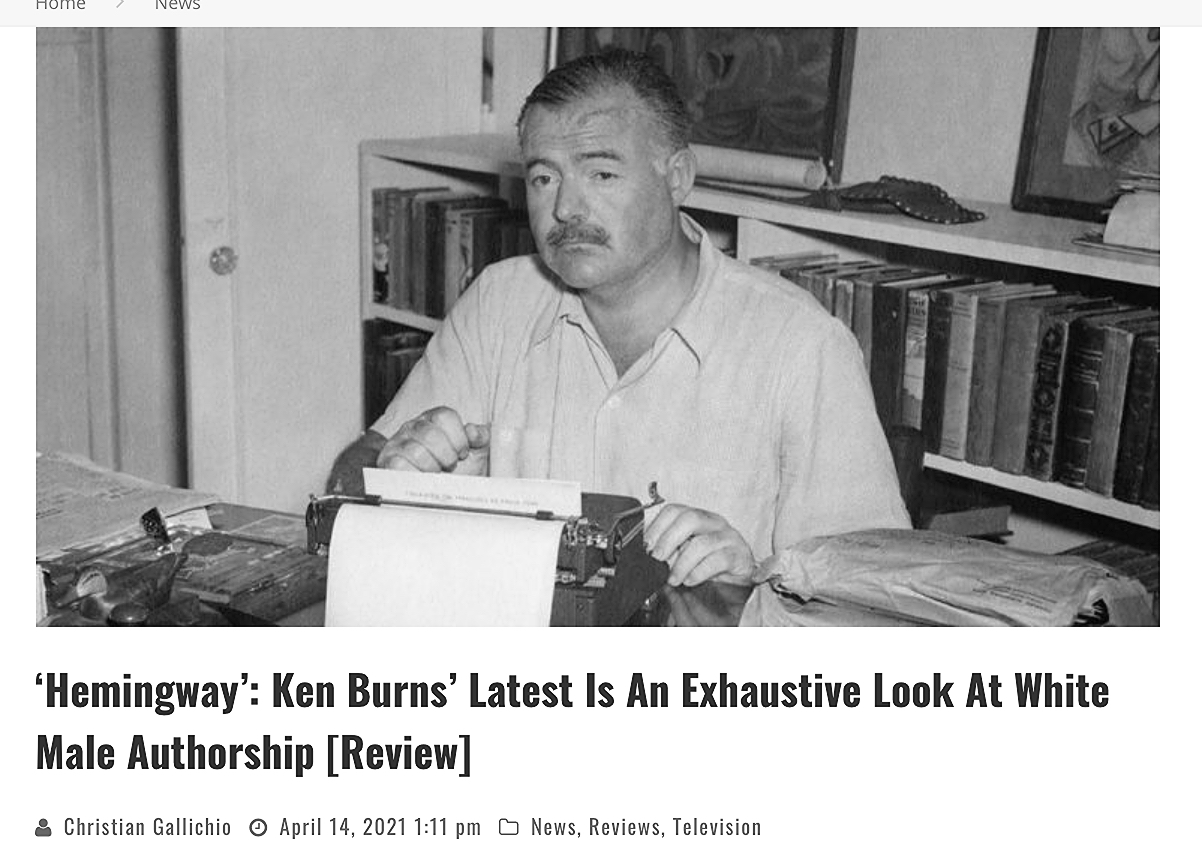
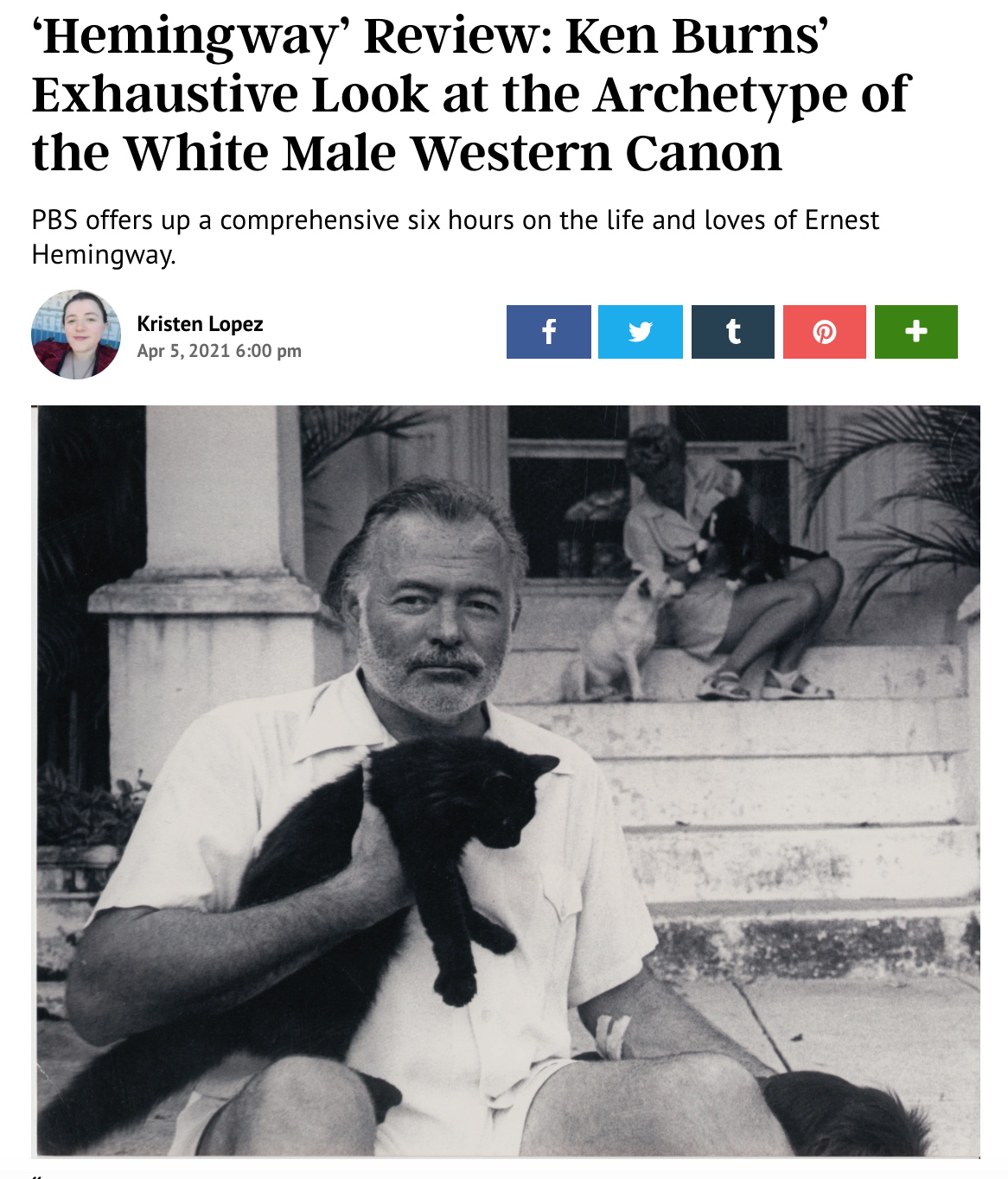
For the last three years or so Indiewire and The Playlist have become Woke Central, or the Fox News of wokesterism. I was noticing last week how so many of these Hemingway reviews point out how he was a boozing, brawling old-school white male, etc.

Dishonest Spin

In a 4.9 Indiewire “Screen Talk” piece called “Academy Members Are Tuned Out: This Year’s Oscar Voters Have Some Work to Do,” co-authors Eric Kohn and Anne Thompson write the following:

“The Oscars are just a few weeks away, but many voters still have a lot of work to do. While awards season usually finds Academy members getting deeply familiar with every category, from Best Picture through the crafts and short film sections, the lack of traditional screenings has yielded a more diffuse process.

“And when catching up on the nominees is easiest if you have a good at-home streaming setup, some voters” — i.e., 2021 versions of Ma and Pa Kettle with their 1986 Sony Trinitron on a living-room table along with a VHS player — “have been slow to adapt.

“In this week’s episode of Screen Talk, Eric Kohn and Anne Thompson discuss the strange nature of an awards season hampered by a lack of awareness.”

“Awareness”? That’s bullshit, guys. The ’20 and early ’21 award season is hampered by a lack of interest. As in relatively few people give a shit. As in “go woke and go broke.” As in “all this cerebral, socially attuned woke shit makes me want to take a nap.” As in “why is Hollywood doing this to us?”

Not Helen Mirren’s Finest Hour

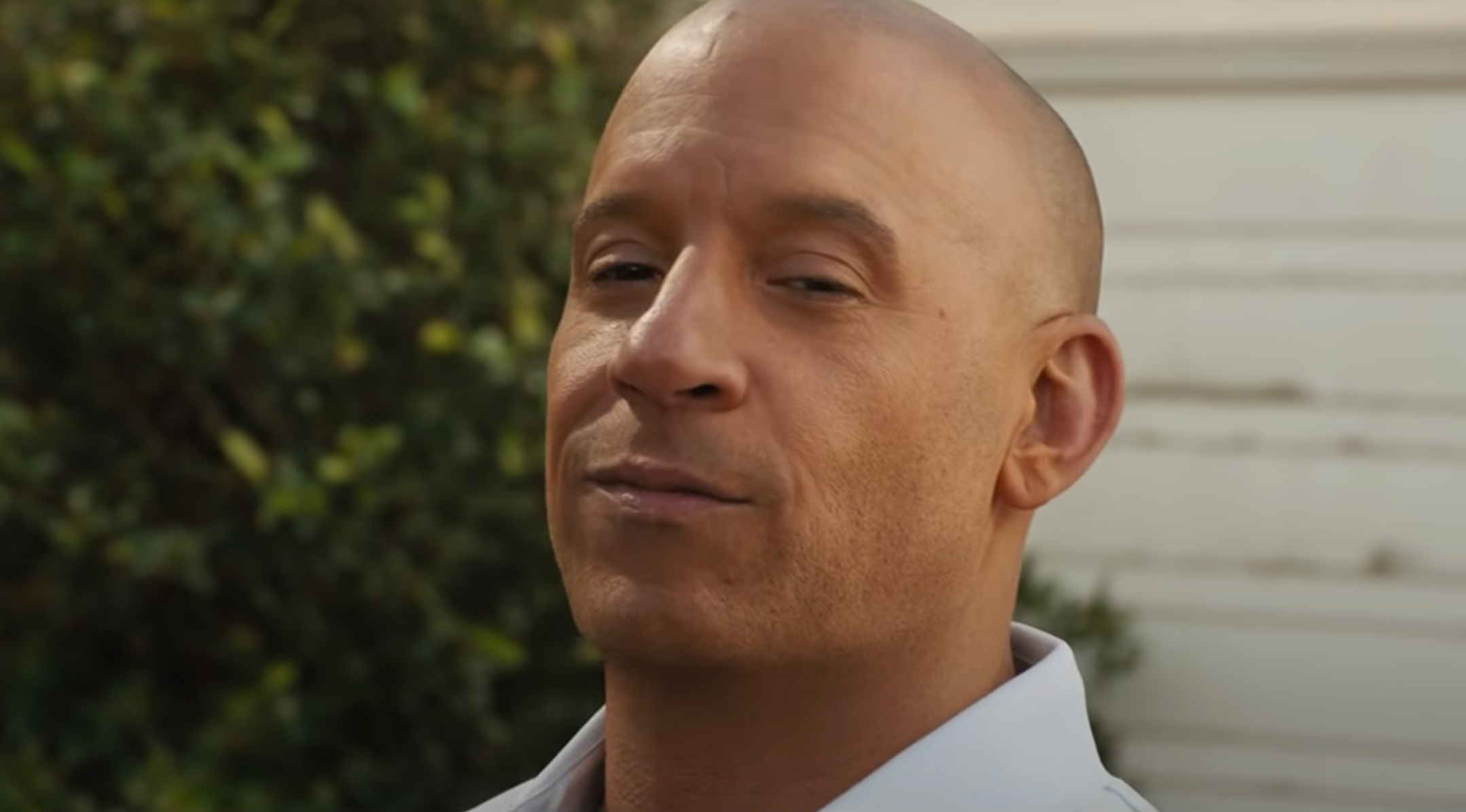
The idiots who pay to see Fast & Furious movies aren’t going to turn in their idiot cards and develop a sense of taste any time soon. The F9 trailer speaks for itself. The people behind it — principally Justin Lin, the cyborg whore who’s now directed five of these fucking things — help found the satanic death monkey training school that Godzilla vs. Kong‘s Adam Wingard graduated from a few years ago.

Eternal shame upon the F9 cast members who are capable of feeling it: Vin Diesel (does anyone recall his genuinely winning performance in a sublime little Sidney Lumet film called Find Me Guilty?), Michelle Rodriguez, Tyrese Gibson, Chris ‘Ludacris’ Bridges, John Cena, Jordana Brewster, Nathalie Emmanuel, Sung Kang, Helen Mirren and Charlize Theron.

Excerpts from “Gleeful Action Porn Provides Glimpse Into Hell,” posted on 3.31.15:

James Wan‘s Furious 7 (Universal, 4.3) is, of course, a cyborg muscle-car flick made for people who despise real action flicks and prefer, instead, the comfort of cranked-up, big-screen videogame delirium inhabited (I don’t want to say “performed”) by flesh-and-blood actors and facilitated by a special kind of obnoxious CG fakeitude that grabs you by the shirt collar and says “eat this, bitch!”

I hated, hated, hated this film like nothing I’ve seen in a long time.

“What’s wrong with silly, stupid four-wheel fun?” the fans ask. What’s wrong is that movies like this are deathly boring and deflating and toxic to the soul. They’re anti-fun, anti-life, anti-cinema, anti-everything except paychecks.

Furious 7 is odious, obnoxious corporate napalm on a scale that is better left undescribed. It is fast, flashy, thrompy crap that dispenses so much poison it feels like a kind of plague. Wan’s film is certainly a metaphor for a kind of plague that has been afflicting action films for a good 20-plus years.

In Act 3, Scene 2 of William Shakespeare‘s Julius Caesar, Marcus Brutus is asked by a crowd of alarmed plebians why he conspired to murder their leader. “T’was not that I loved Caesar less,” Brutus answers, “but that I loved Rome more.” By the same token I spit upon Furious 7 and the whole cyborg action muscle-boy genre not because I love sitting through cranked-up, power-pump, beyond-silly action flicks less (although my feelings of revulsion are as sincere as a heart attack) but because I love real action movies more.

Read more

Rusty and Rinty

The histories of Kurt Russell and Natalie Wood aside, a significant percentage of child actors haven’t transitioned all that successfully into adult TV and movie careers. By all accounts poor Lee Aaker, the ‘50s star of The Adventures of Rin Tin Tin, was one of Hollywood’s less enterprising (or less lucky) fortunate sons.

After his career fizzled out in the mid ‘60s Aaker did this and that (including carpentry). The fact that he passed two weeks ago at age 77 and the world is only just hearing about it now is instructive. Ditto the following paragraph from his Wiki page: