He Doesn’t Deserve Them

My Warner Archive Bluray of They Won’t Believe Me (’47) arrived yesterday; I watched it last night. Produced by Joan Harrison, written by Jonathan Latimer and directed by Irving Pichel, this RKO release has acquired a reputation in some circles as a tasty, extra-dark potboiler — required viewing if you’re any kind of film-noir fanatic.

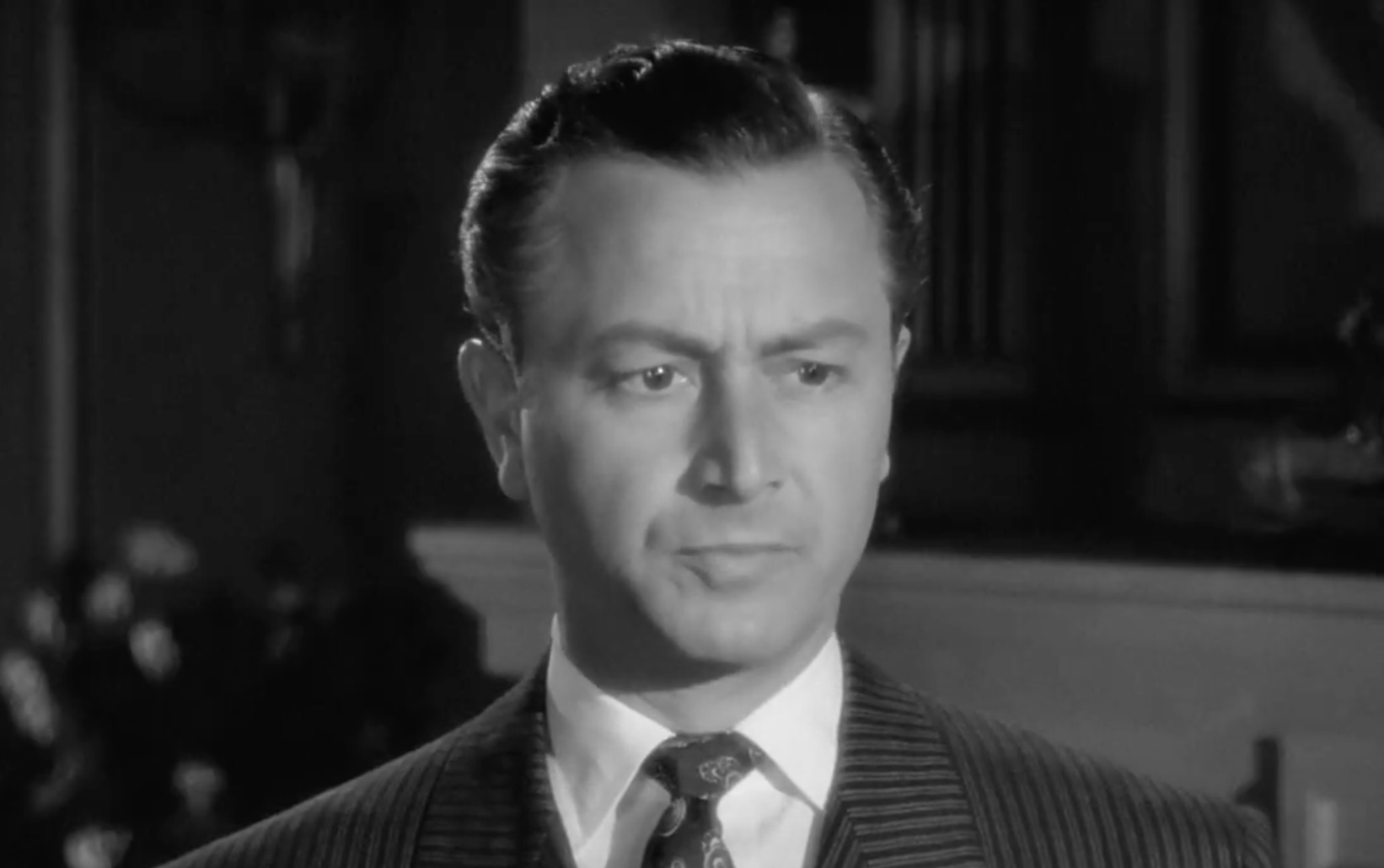
It’s dark, all right, and I’m not sorry I saw it, but it’s a completely unbelievable, ridiculously over-plotted piece about a doomed nogoodnik — Robert Young‘s slimey, squishy, wholly unsympathetic Larry Ballentine**. The plot is mainly about how Ballentine hoodwinks, strings along and betrays three women — a gold-digger (Susan Hayward), a journalist (Jane Greer) and his rich, endlessly forgiving wife (Rita Johnson).

It makes no sense that Hayward, Greer and Johnson are each in love with Young — he’s obviously a waste of skin. If “they won’t believe me” is Ballentine’s lament, the obvious reply is “why the hell should they?”

The only aspect that really works (in a WTF, blunt-trauma way) is the bizarre ending when Ballentine, on trial for killing his wife Greta, tries to commit suicide by leaping out of a courtroom window on the fifth or sixth floor, just before the verdict is announced. A trigger-happy marshall shoots and kills Ballentine as he reaches the window ledge. And then they read the verdict.

I’ve honestly never disliked a lead character as much as this, and Young’s performance is no help. He’s playing an absolute cipher and a cad — a Shallow Hal with no smarts, no passion, no cunning, no wit, no sense of irony about himself, no style. Robert Mitchum‘s sardonic private detective in Out of the Past is shady but likable — Young is detestable. Within minutes you’re rooting for his demise. It’s no surprise that They Won’t Believe Me flopped.

If your idea of an A-level noir is Out of the Past, Double Indemnity or The Big Sleep, rest assured that They Won’t Believe Me is at best a C.

The 4K transfer has been nicely finessed — the 74 year-old film looks as good as it ever will. A nice silvery sheen, excellent black levels, finely detailed.

I was so bored I began thinking about Young’s actual life, and how he was plagued by alcoholism and depression despite a career that enjoyed a fair amount of comfort from playing the title roles in two popular, long-running TV shows, Father Knows Best (’54 to ’60) and Marcus Welby (’69 to ’76). The poor guy tried to commit suicide when he was 84. (Who does that?) He passed in ’98 at age 91.
Read more

Another Ellen Convulsion

I thought last year’s Ellen DeGeneres “mean boss” melodrama (which lasted for several weeks during August and September) had cooled down and that things were more or less chill. Nope! After moving in with Courteney Cox following the sale of her Beverly Hills home, Ellen has decided to quit her show next year. Because…? Ratings, I guess, but the real reason will be kept under wraps as long as humanly possible.

Flare-Ups Becoming War

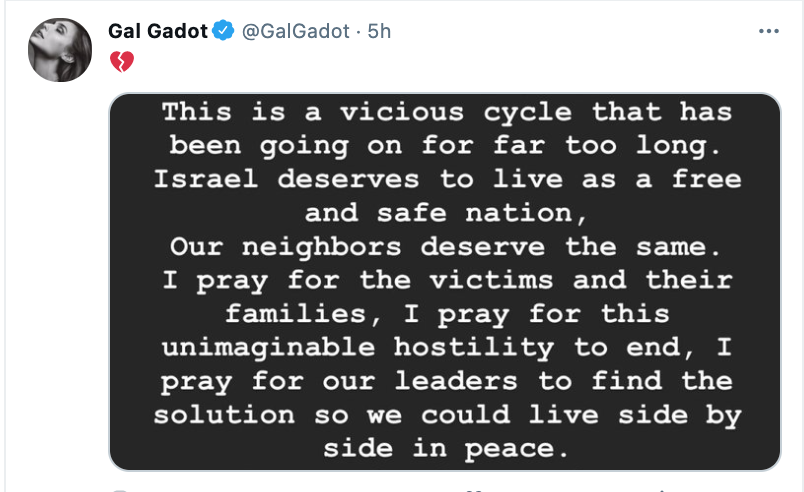
I remember the smell of burning wood and melting rubber during the ’92 Rodney King riots (4.29.92 to 5.4.92), and of course the looting and fire-starting in the east-of-Fairfax district on Melrose during the George Floyd protests (late May to early June). Both were vaguely alarming — the prickly mood, faint currents of discord — but were level 2 or 3 disturbances. This is nothing compared to what people are dealing with in certain pockets of Israel (West Bank) and Gaza right now — level 7 or 8 conditions, war-like, missiles, explosions, black smoke plumes, collapsing buildings, civilian bodies. Imagine being there.

Read more

She Stoops To Firefight

Roughly five weeks ago I caught a trailer for Taylor Sheridan‘s Those Who Wish Me Dead (Warner Bros./HBO Max, 5.14), and it sure seemed like a no-go and a no-sale.

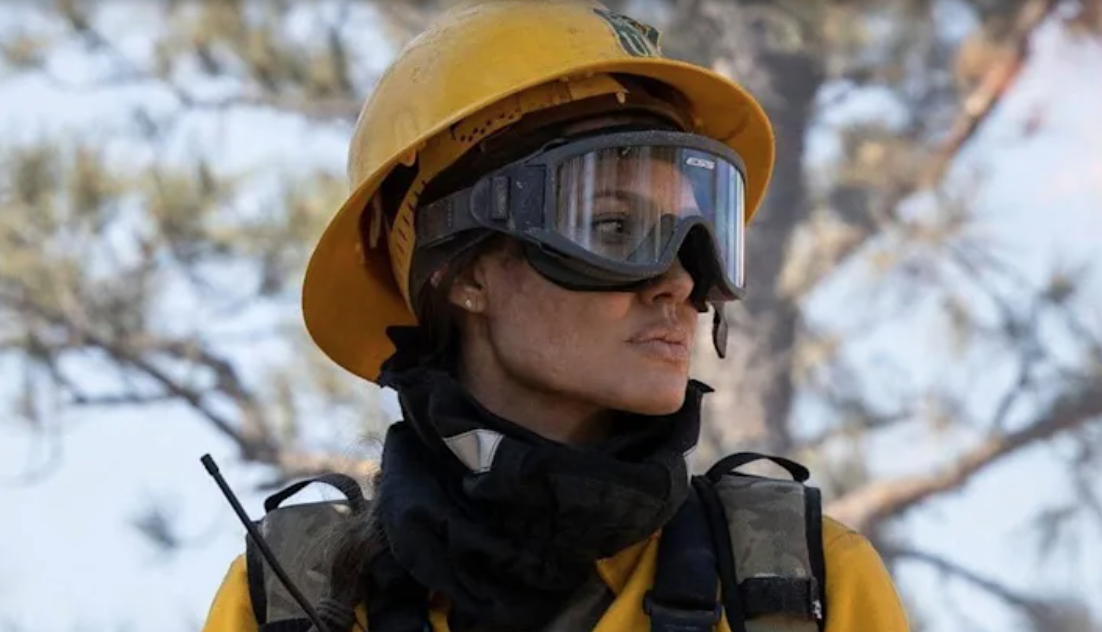
“An aggressively produced, go-for-broke action exploitation flick,” I noted, “shot and edited in a slam-bang, visually searing, Bruce Willis-in-the-’90s way…loaded with jet fuel and cranked WAY TOO HIGH (black-attired bad guy sadists firing automatic weapons at a woman and a kid in the middle of firestorm?). And if you believe, by the way, that a beautiful, super-rich, fashion-magazine icon slash Brad Pitt-ballbuster with her own personal pedicurist can be (or ever could be) a Montana firefighter…well, that’s up to you.”

This just-posted footage tease implies more of the same,

If you read between the lines of David Rooney‘s review of the film itself, posted this morning in The Hollywood Reporter, it’s obvious he has concerns.

Excerpt #1: “If you can get past the miraculously dewy complexion and on-point smoky-eye look of Angelina Jolie as a toughened Montana Forest Service firefighter…”

Excerpt #2: “[Then again] her role provides scope for gnawing demons, maternal warmth and kick-ass survival skills — including some cool retribution with an ax.”

Excerpt #3: “[Pic] doesn’t match the finely etched characterizations and contemplative writing of his original screenplay for Hell or High Water, but even if the genre quilting isn’t entirely seamless, it’s a ruggedly entertaining throwback to studio movies of the ’90s about real people navigating hairy life-or-death situations.”

Excerpt #4: “Production designer Neil Spisak [has created] an artificial forest set with a creek running through it, as well as watchtowers.”

Read more

George Romero’s “The Crazies”

In the wake of this morning’s ouster of Rep. Liz Cheney, the former House Republican Conference chairperson, I’m contemplating Thomas L. Friedman‘s “The Trump G.O.P.’s Plot Against Liz Cheney — and Our Democracy,” posted in the N.Y. Times on 5.11:

“In effect, the Trump G.O.P. has declared that winning the next elections for the House, Senate and presidency is so crucial — and Donald Trump’s ability to energize its base so irreplaceable — that it justifies both accepting his Big Lie about the 2020 election and leveraging that lie to impose new voter-suppression laws and changes in the rules of who can certify elections in order to lock in minority rule for Republicans if need be.

“It is hard to accept that this is happening in today’s America, but it is.

Cheney’s removal “will not constitute the end of American democracy as we’ve known it,” Friedman wrote, “but there is a real possibility we’ll look back on May 12, 2021, as the beginning of the end — unless enough principled Republicans can be persuaded to engineer an immediate, radical course correction in their party.

“If someone tried a dishonest power play at the P.T.A. of your child’s school like the one in the House, you’d be on the phone in a flash, organizing the other parents to immediately denounce and stop it. If you read about something like this happening in another pillar of democracy, like Britain or France, you’d be sick to your stomach and feel like the world was a little less safe. If you heard that a banana republic dictator had forced such a Big Lie on his sham parliament, you’d want to picket his embassy in Washington.

“But this is us — today, right now. And I fear that we’ve so defined down political deviance in the Trump years that we’ve lost the appropriate, drop-everything, Defcon 1, man-the-battle-stations sense of alarm that should greet the G.O.P. crossing such a redline.”

Read more

Costa Gavras’s “The Confession”

Forgot the boilerplate homophobic stuff, and start at the 4:04 mark:

“A tall fuckin’ order, I’ll tell you that. You can talk about every day bein’ a gift, stop and smell the roses. But regular life’s got a way of pickin’ away at it. Your house, the shit you own…it drags you down. Your kids, what they want. One bad idea after another. Tryin’ to work a cell phone menu…it’s enough to make you scream.”

“Who Killed The Golden Globes?”

Richard Rushfield‘s hard-boiled Ankler assessment of the maneuverings and backstories that led to the (temporary) death of the HFPA and the Golden Globes makes for excellent reading.

“It’s like a cheap murder mystery,” he analogizes, “in the small town where everyone had a motive.” Great line!

Key passage: “The HFPA last week issued their plan to overhaul the organization, the centerpiece of which was a commitment to ‘to fulfill the HFPA’s commitment to add at least 20 new members by August 2021 and increase membership by 50% in 18 months.’

“If the main objection on the table was the racial composition, 50% in 18 months seems like a pretty serious overhaul from where I sit. It’s a lot bigger and faster, proportionately, than the Academy transformed itself. This pledge was also accompanied by a timeline for new board elections, the adoption of new bylaws, etc. etc.

“All of which would seem to amount to just about a complete reworking of the entire group. I don’t recall the Academy, for instance, pledging that its entire board would step down.

“In response to this, the publicists’ letter was a complete dismissal that this represented change at all. So essentially they [seemed to be] demanding that the HFPA double [its] membership and the current members vote themselves out of control of the organization entirely within a year. A big ask! In the face of a pretty significant overhaul. Again, has any organization ever been asked to do that, short of criminal indictments and war crimes?”

Honoring Mr. Lloyd

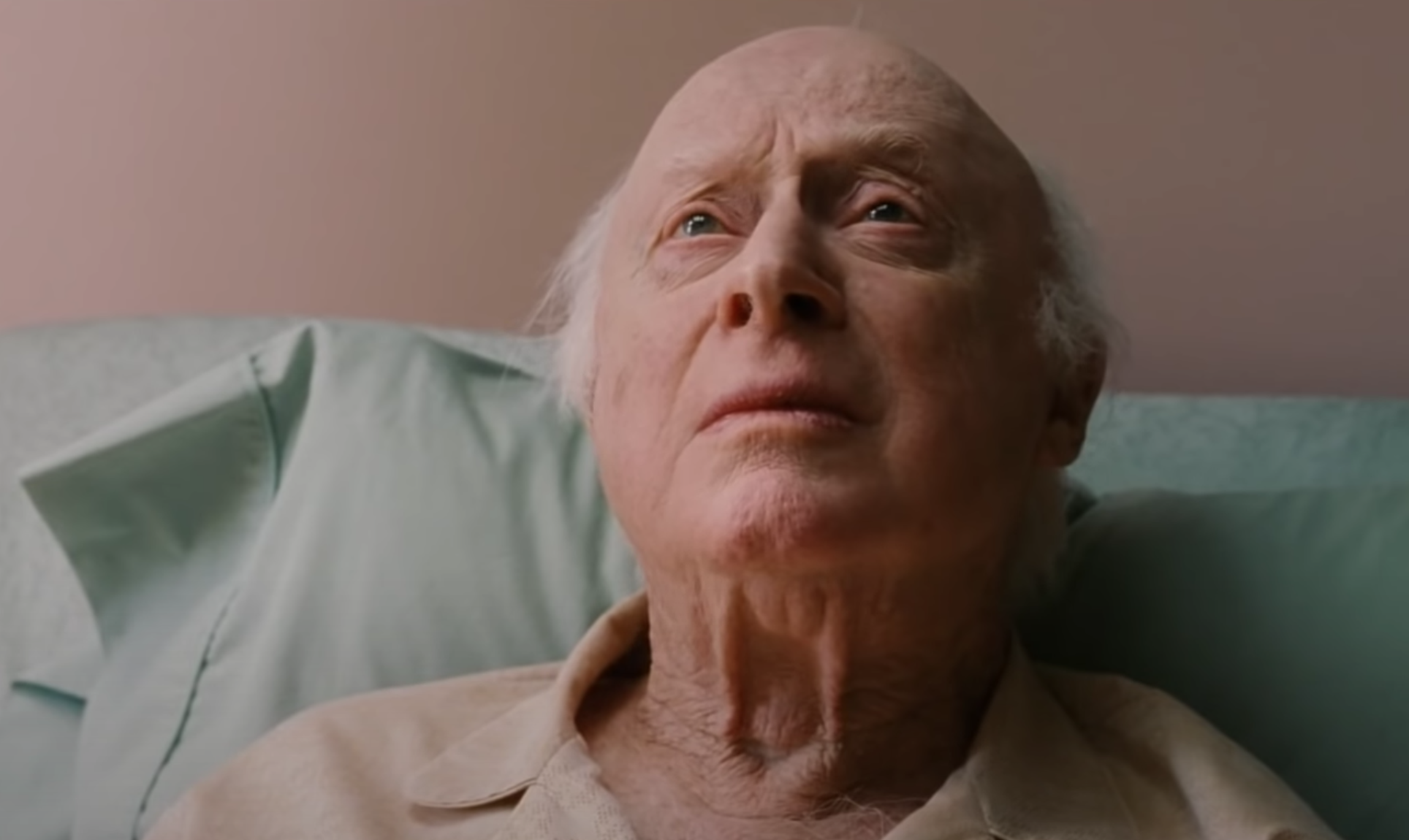
The great actor, producer and director Norman Lloyd passed earlier today at age 106.

I was so taken by his performance as a blind but very skilled English professor in Curtis Hanson‘s In Her Shoes that I asked to chat with him. Two encounters happened, both in September ’05. We did a phoner, and then I was invited to take snaps at his Mandeville Canyon home. We talked for another hour or so.

Here’s the piece:

Norman Lloyd, 90, is in only three scenes in In Her Shoes and is on screen maybe seven or eight minutes, but his performance is one of the most poignant notes in a film that has more than a few of them.

It’s not one of those burn-through-the-screen performances (along the lines of, say, Beatrice Straight‘s fight-with-Bill-Holden scene in Network). It’s more like a coaxer. You can sense Lloyd’s intellectual energy and zest for life despite his character’s withered state, and you can feel and admire the tenderness he shows to Maggie …tenderness mixed in with a little classroom discipline.

He plays a sightless retired college professor who prods Diaz’s Maggie character, who is dyslexic and can’t read a billboard slogan without stumbling, into reading poetry to him — specifically a poem about loss and emotional guardedness by Elizabeth Bishop.

At first Maggie is reluctant, then she agrees to read to him…slowly, almost painfully…I have a dyslexic friend and she doesn’t read this slowly…but she gradually improves.

Then Lloyd prods her into explaining what she thinks of the poem. She tries to duck this, but Lloyd — relying on skills from a lifetime of teaching — won’t let her.

This isn’t just the heart of the scene — it’s a pivotal scene in the film. It’s the moment when Maggie turns the corner and starts taking steps to be someone a little better…because she starts believing in her ability to see through to the core of things, and in the first-time-ever notion that she has a lot more to develop and uncover within herself.

I know how cliched it sounds to say a character “turns a corner” and so on, but sometimes these moments happen in life. You just have to be able to hear the little voice in the back of your head that says, “You’ve taken a small step…you’ve just moved along.”

Read more

“Good Lovin'”

From “Lisey’s Story” Wikipage (the Stephen King book, not the Pablo Larrain/J.J, Abrams miniseries): “The genesis was an incident in June 1999 in which King was hit by a van in Lovell, Maine, and seriously injured; while he was in the hospital, his wife Tabitha decided to redesign his studio. Coming home from the hospital and seeing his books and belongings in boxes, King saw an image of what his studio would look like after his death.”

The eight-parter starts on 6.4.21, concludes on 7.16.21.

Damon’s Yokel Accent

I’ve listened nine or ten times to a line spoken by Stillwater costar Camille Cottin, and for the life of me I can’t understand what she’s saying.

It happens at the :43 mark, and she’s saying it quietly to Matt Damon‘s character — a beefy, burly, cap-wearing 40something bumblefuck type — and is apparently referring to his incarcerated daughter Allison (Abigail Breslin). The line she says to Damon is “the father of duhkat?…he left in six” something-or-other.

Three minutes later: I’ve listened to this damn line 13 times with my excellent headphones, and it’s driving me crazy.

This plus Damon as a yokelish Midwesterner who probably loves Donald Trump has raised my hackles slightly. I’m sorry but I don’t care for heavy-set fellows who swallow their words…vaguely surly, low-key clock punchers who drawl “yes sir” and “yes ma’am” and who resemble those beasts who stormed the Capitol on 1.6 and who still insist the election was stolen. I love hanging with super-smart reporters who work for the Boston Globe, but not gutty-wuts like this…sorry.

A good portion of Stillwater was shot in Marseilles, and apparently depicts Damon running up against some local thugs while searching for evidence that might free his daughter. An American primitive clashing with Marseilles baddies = John Frankenheimer‘s French Connection II.

Basic Stillwater logline: “A father works to exonerate his estranged daughter of a murder she never committed.” Tom McCarthy‘s film pops on 7.30.21.

Glover Is On To Something

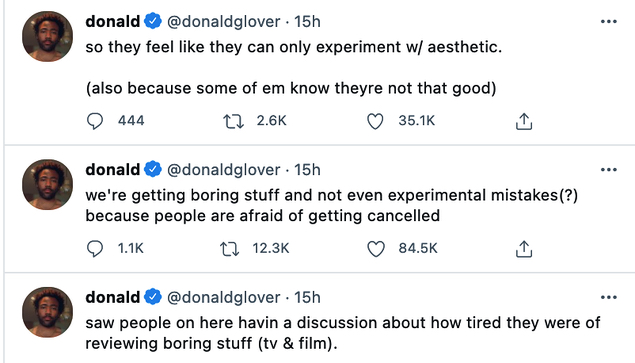
Atlanta creator, star and sometime director Donald Glover believes call-out culture is diminishing or dulling down creativity in movies and TV series. “We’re getting boring stuff and not even experimental mistakes because people are afraid of getting cancelled,” Glover tweeted. “So they feel like they can only experiment with aesthetic.”

Glover was responding to Twitter users who’d complained about feeling deflated and bored due to too many cookie-cutter films and TV series. Yeah, he said — that’s because terrified screenwriters and show runners are afraid to step out of the box and risk offending Twitter jackals.

Some of the usual rationales were posted in response. Scriptwriter Lisa Hofacker reminded that “(1) There are only 7 basic plots so only so much can be done & redone with that in mind, and (2) script reviewers basically only review the 1st 5-10 pages of a script…if it doesn’t have the inciting incident or exciting enough it gets thrown out.”

The proverbial “inciting incident” has to happen within five to ten pages? When I took Robert McKee‘s class in ’88 the inciting incident had to happen no later than 25 pages in, and preferably within 20 pages.

Not to discount Hofacker or even McKee, but Glover’s tweets sounded a lot like something I tapped out a couple of months ago. At the risk of irritating regular readers, here’s the gist of it:

From “Wolfe Reminds, History Repeats,” posted on 3.22.21: “For since wokeness began to take hold in ’18 and certainly since the pandemic struck 13 months ago, the movie pipeline has been losing steam and under-providing, to put it mildly. Nothing even approaching the level of Spotlight, Manchester by the Sea, Call Me By Your Name, Dunkirk, Lady Bird, La-La Land, the long cut of Ridley Scott‘s The Counselor, Zero Dark Thirty or Portrait of a Woman on Fire has come our way from domestic filmmakers. **

Read more

“Separate Art From Artist”…Again?

18 months ago on Quora, British poet-artist Rod Summers attempted to answer the eternal question, “Should we learn to separate the art from the artist?” Here’s what he said:

“You love the art work, it speaks to you, it fascinates you, it stimulates your desire to appreciate the finer, less debased things in human creativity. Then you discover that the creator of the art was less than perfect, just like the rest of humanity. So then you decide you don’t or shouldn’t like the art any more.

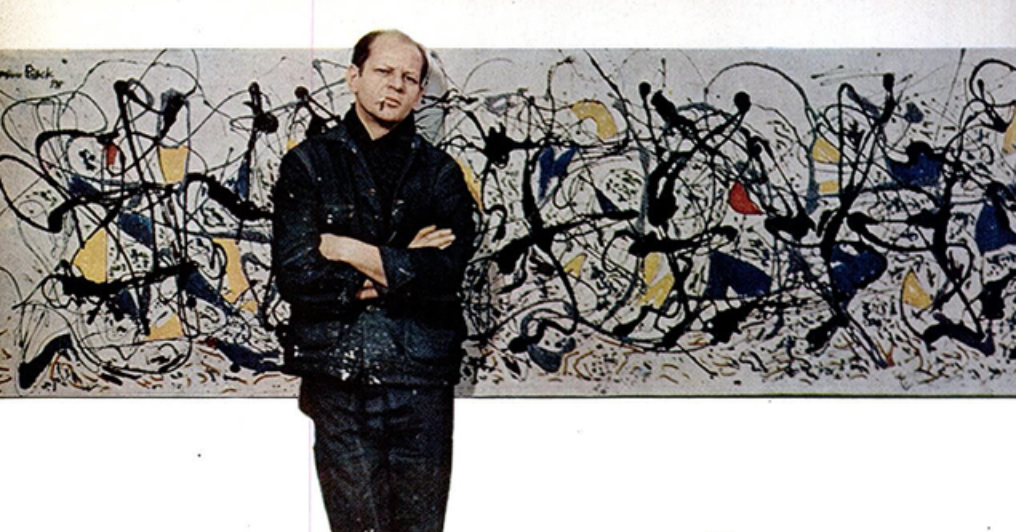
“Art is part of the artist, as a child is part of his/her parents. You can separate them geographically, but they will always be connected. The mistake you’re making is judging the art by how the artist lives, or has lived. Morality has nothing to do with it. Morality is just you putting your value template over someone else and dismissing if he/she doesn’t fit in the slots. Artists rarely fit in the slots, and those who do probably aren’t very original or very good either.”

Lucy McKinney, posted on Quora on 10.31.19: “I cannot support an artist once I know that person is horrible. The problem is that art can be technically excellent but still, unfortunately, reflect only their own horrible worldview. A goal of art is to evoke the emotions of the viewer, some universal theme or abstract concept or even visualization that transcends words, independent of the horrible person who created it. Supporting the work of a horrible person is just another way of letting the person bully you emotionally. Passive-aggressive + hostile = TOXIC.”

HE to McKinney: “In the case of Roman Polanski, what you’ve written is exactly, precisely and absolutely dead wrong. The worldview contained in Polanski’s Chinatown, The Pianist and J’Accuse, to name but three, is sane, frank, sensible, compassionate, at times delicate, sometimes open-hearted, wise, unblinking, on the side of the angels.”

Open Letter to Polanski Haters,” posted 4.2.20: “Anyone can watch Roman Polanski’s The Pianist, but no one in the U.S. and England can watch J’Accuse in a theatre, on a Bluray or even via streaming.

“Because of a certain percentage of #MeToo progressives. Because they believe that Polanski’s rep must be permanently tarred and feathered and therefore J’Accuse, too, must be buried or otherwise scrubbed from existence. Because of reputedly credible accusations of Polanski having behaved badly and perhaps even criminally with certain younger women several decades ago. And so the distribution community is terrified of what #MeToo-ers might say and do if anyone even considers offering an English-subtitled J’Accuse for U.S. or British viewers.

“Here’s the thing — Polanski the man is not the same thing as Polanski the artist. His depiction of awful or ghastly things in his films (he’s never explored Pollyanic fantasy and escapism) has never conveyed a corrosion or poisoning of his own spirit. He understands what goes, how it all works, who the good guys are. This is quite evident in The Pianist and J’Accuse. But the latter is nonetheless going to be buried for a long time to come, or so I’m told. This is not a good look for #MeToo.

Read more