Like everyone else I wish this could be an actual live event that everyone could attend, but of course it can’t be. This is but one more aspect of Hollywood life that used to be but no longer “is” in any kind of physical sense.


Like everyone else I wish this could be an actual live event that everyone could attend, but of course it can’t be. This is but one more aspect of Hollywood life that used to be but no longer “is” in any kind of physical sense.
From Peter Bradshaw’s 9.22 Guardian review: “Supernova at first reminded me uneasily of The Leisure Seeker, a syrupy picture in which Helen Mirren and Donald Sutherland play a squabbling old married couple taking a last Winnebago road-trip in the shadow of dementia and mortality.
“But that was hammy and sugary: Supernova, for all its occasional heartstring-plucking and button-pushing, is much more restrained, both in the relative calm of the performances and in the unadorned way the countryside is shot.
“Tucci and Firth have a sweet and gentle chemistry…they have an almost Eric-and-Ernie rapport. Elsewhere, Macqueen interestingly builds on the established personae of his leading men to show how their various mannerisms have been brought into play to deflect or neutralize difficult topics. Firth’s Sam is dry, reticent and pretty English; Tucci’s Tusker is quizzically amused and amusing in ways we have seen from him many times before — which makes a key scene, when his voice quivers on the verge of tears, even more affecting.
“The key issue, as with all movies about dementia, is the exit strategy: this was famously an agonis\zing moment in Richard Glatzer and Wash Westmoreland’s Still Alice, with Julianne Moore, and even more agonis\zing in Michael Haneke’s Amour, with Emmanuelle Riva dwindling into immobility and silence after a stroke.”
…if you’re Harry Styles, a super-rich pop star, Vogue cover icon, movie actor and occasional cross-dressing fashion plate. Very easy. No sweat. You just need to glide along and feel the fizzy, dreamy mood, which, for Styles, currently includes an ongoing romantic rapture with Olivia Wilde.
Nobody wants the company of toxic males, of course, but how many guys look, live and dress like Styles? Be honest. When the wages have stopped and the pressure is on, it’s generally very, very hard to “be” Harry…to fly anywhere, wear anything, try on this or that ball gown or pearl necklace or adopt this or that identity with coolness and confidence…it’s very hard (if not damn near impossible) for struggling 20somethings of whatever sexual persuasion to wear that Styles profile.
Wilde to People‘s Ale Russian, in a 1.4.21 piece: “To me, [Harry is] very modern, and I hope that this brand of confidence as a male that Harry has — truly devoid of any traces of toxic masculinity — is indicative of his generation and therefore the future of the world. I think he is in many ways championing that, spearheading that. It’s pretty powerful and kind of extraordinary to see someone in his position redefining what it can mean to be a man with confidence.”
At least from my perspective…

HE: Tomorrow is the big one. If Ossoff and Warnock win, everyone gets $2000 checks. If not, $600 and go fuck yourself.
A win will mean legislative opportunity for Biden-Harris for at least two years and a temporary end to the malignant turtle reign of Mitch McConnell; if they both lose the general Republican insanity will continue unabated.
Friendo: Ossoff and Warnock are going to win. Trump has convinced Republican voters that the voting system is rigged against them and so there’s no point in voting.
HE: I hope you’re right. They’re slightly ahead in the polls but I think you’re right — it’s going to come down to Republicans staying home.Friendo: A majority of Republicans in Georgia actually believe their vote got scrubbed, deleted, or something like that during the 11.3 election count.
Latest 538 projection, by Nathaniel Rakich and Geoffrey Skelley:
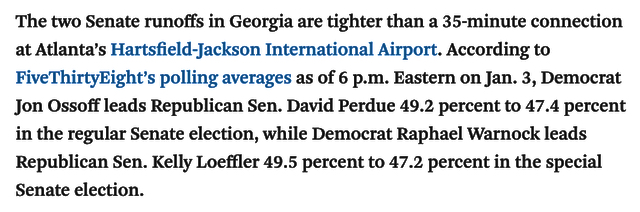
“What We Know About the Voting in Georgia So Far,” N.Y. Times, 1.4.21, reported by Lisa Lerer: “Three million people have already voted in the runoff races, nearly 40 percent of all the registered voters in the state, according to data compiled by the University of Florida’s U.S. Elections Project. That total surpasses the 2.1 million ballots cast in the state’s last Senate runoff election, which happened in 2008.
“The early voting data suggests that the races are very competitive. There are some indications that Democrats had a bigger share of the early-voting electorate than they did in the general election, raising hopes for a party that has traditionally been the underdog in runoff races. The Atlanta area, the Democrats’ political base, has seen some of the highest turnout rates in the state’s early voting.
“The outcome now depends on whether Republicans can overcome the Democrats’ early gains when they head to the polls on Tuesday. Rates of early voting have been lowest in the conservative northwest corner of the state, worrying some Republicans. But others argue that their supporters typically vote in higher numbers on election day and hope that President Trump’s rally on Monday in Dalton, a city in the northwest, will push more Republicans to the polls.
“Democrats’ early voting advantage helped them beat Mr. Trump in the November election, when Mr. Biden won nearly 400,000 more absentee ballots in the state.”
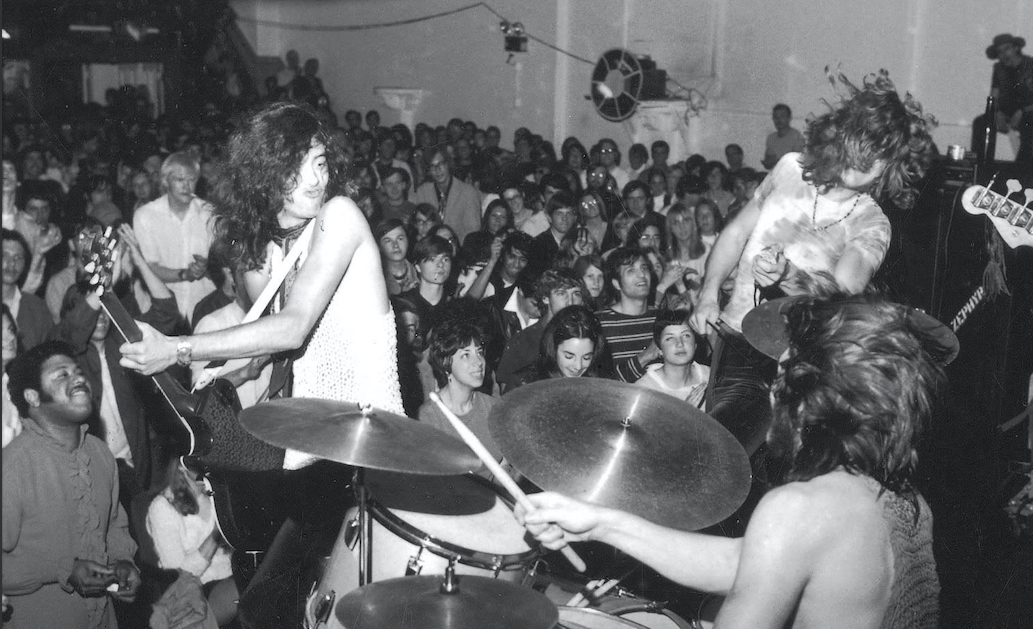
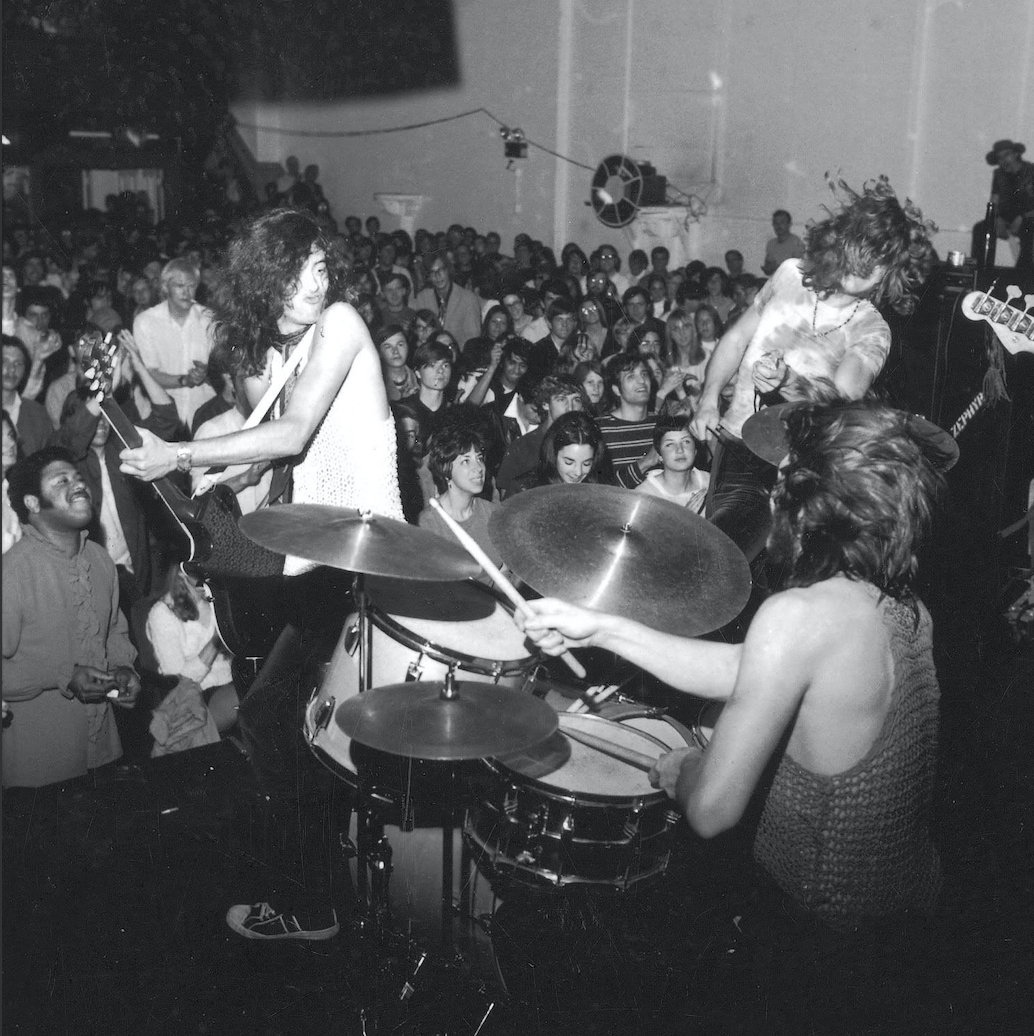
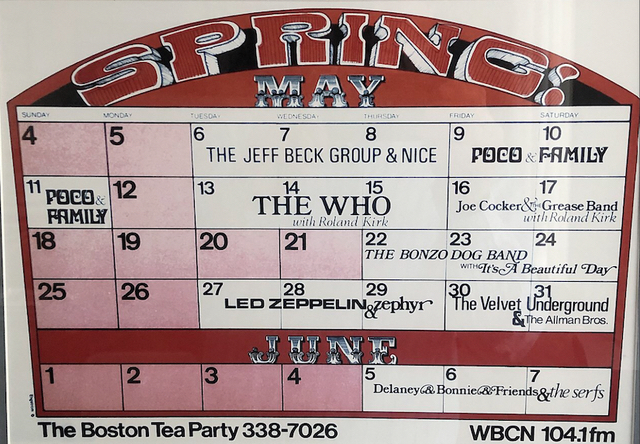
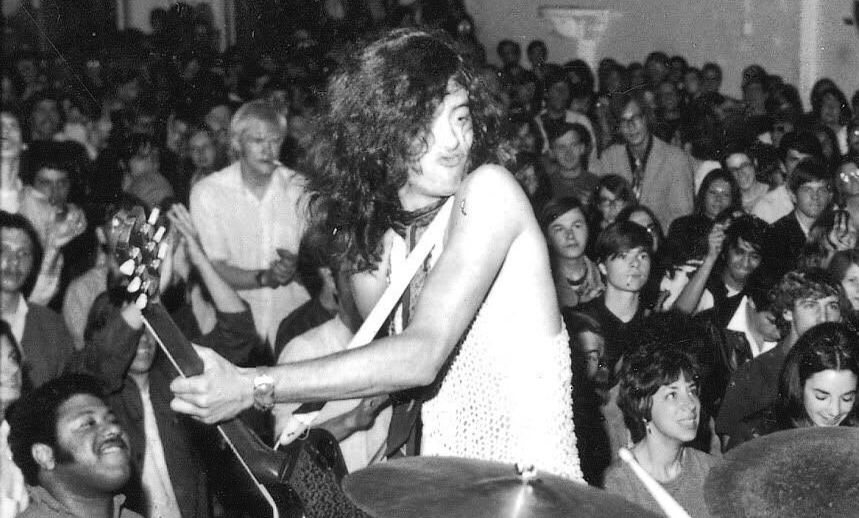
The Boston Tea Party (which ran from early ’67 to early ’71, and was really cooking during ‘69 and ‘70) was arguably the most glorious, super-charged small venue for live rock bands ever…smaller than the two Fillmores and with one serious headliner after another, or at least part of the time.
Here’s the whole four-year schedule. Three-night bookings for the most part. During one two-night engagement in May ’69 they actually had the Allman Brothers open for the Velvet Underground.
The first BTP venue was at 53 Berkeley St, Boston, MA 02116. In July ’69 they moved to 15 Landsdowne Street, near Kenmore Square.
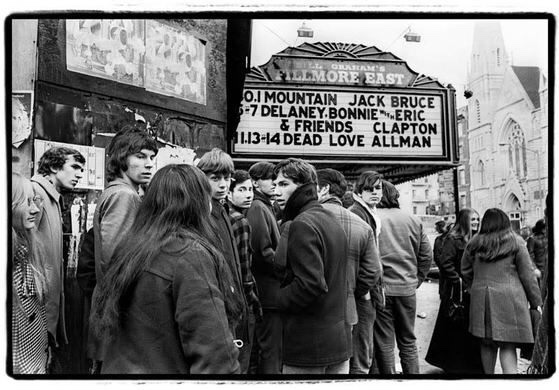
HE to seasoned rock journalist: “Big-arena concerts allegedly didn’t become a major thing until ‘71 or ‘72 or thereabouts. Small venues like the two Fillmores and the Boston Tea Party flourished during a certain window that began in ‘67 and ended around ‘71, which is when major groups began declining these venues because there was so much more dough in big arenas.
“Do I have this right? You were right in the thick of it back then.
“The golden era for the Tea Party was ‘69 and ‘70. My God, look at the acts they had! The BTP was the size of a typical high-school gymnasium. Maybe a tad smaller. I caught three or four shows at the Fillmore East but nothing compared with the sheer physical closeness of the Tea Party…you could get close enough to smell their sweat. It was glorious, tangible, alive.
Seasoned rock journalist to HE: “You’re pretty accurate with this. The big arena shows started around ’69 too, with the Rolling Stones and Led Zeppelin usually being the ones who pushed the envelope into stadiums later, around ’73.
“Tea Party was famously one of the hot places where the audience and band could [groove as one]. The Fillmores, of course. The Grande Ballroom in Detroit was also one of those small, hot places where the British bands would often play…bands like Jeff Beck Group and they’d blow the roof off. Santa Monica Civic on the West Coast was in between, a little bigger, but amazing for crowd/music/intimacy, like David Bowie’s first show there.
“Also one of the small rooms that bands loved was the Warehouse in New Orleans, home of many explosive small-room nights. The Allman Brothers Band would tear it up at a place like that. Basically, even through the mid-70’s, you might catch a big band playing one of those smaller places just to blow off steam and have a no-pressure gig or record something live with a smaller, great crowd.”
“The BTP closed it in early 1971 as the face of rock & roll was changing to larger venues. The Tea Party’s demise followed that of Philadelphia’s Electric Factory and shortly preceded the same for the two Fillmore’s.”
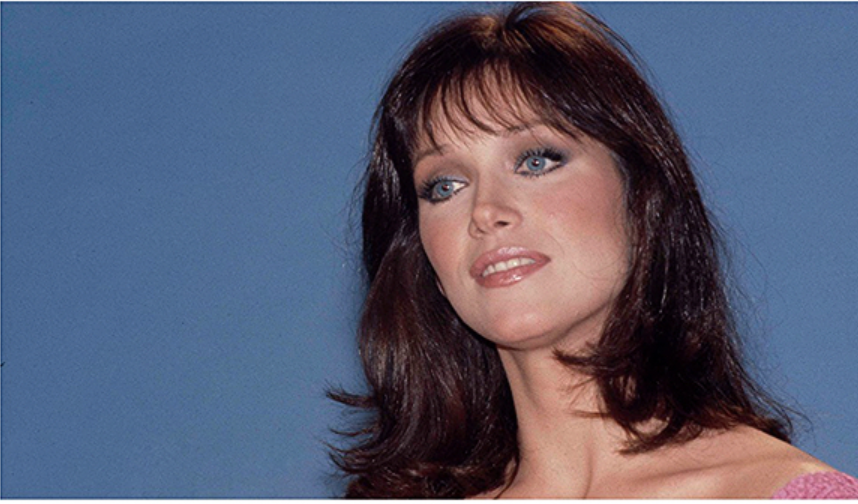
1.5.21, 7:15 am: Tanya Roberts has sadly passed for good this time. No mistakes or take-backs. Sorry.
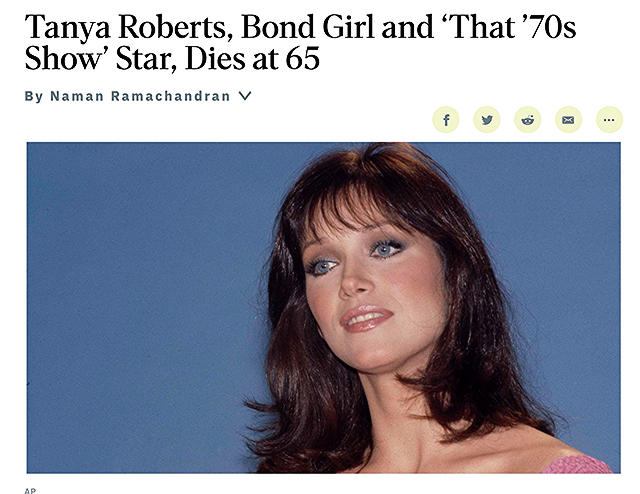
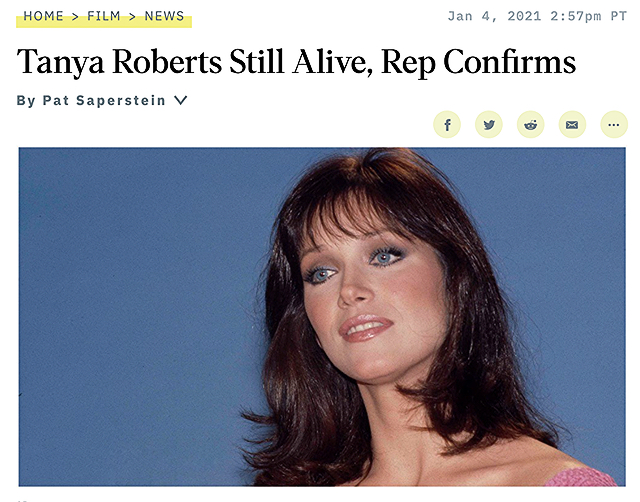
1.4.21: Although View To A Kill costar and Sheena: Queen of the Jungle star Tonya Roberts is reportedly in dire condition, she is nonetheless alive. Late last night Variety‘s Naman Ramachandran reported that Roberts had died after being stricken with something or other on Christmas Eve. But this afternoon Variety‘s Pat Saperstein reported that Roberts is still with us. Hollywood Elsewhere is pleased to hear this, and hopes that Roberts, 65, will survive whatever it is that’s threatening her life.
“In an ideal world, this [Oscar] year would bust up the well-oiled machine and allow for a wide variety of films to be let in the door. We’re not quite there yet, partly because Hollywood is still in the grips of what might be best described as a kind of woke scare, which is like the Red Scare only it’s about monitoring films for potentially ‘problematic’ concepts and themes, [some being that] the casting may be ‘too white‘ or the directors are male or someone has a history of ‘problematic’ behavior, etc.
“Twitter is the judge and jury but no one wants to be seen as complicit [in anything outside the approved wokester safety zone, and so] they vote accordingly.
“Thus, the bloggers and critics are modulating for this potential blowback with [careful] choices. We’re all predicting the Oscar using the same method. In an ordinary year we might pick a movie [that] Oscar voters would likely go for, given what we know of the Academy’s taste. This year, we compensate for the ‘woke scare’ and we say ‘this is the movie they might go for if they are wanting to send a message that they are not racists or sexists or transphobes.’
“This was, after all, the year the Academy announced they would be mandating inclusivity in their productions and narratives going forward. That means they will likely be voting from a place of defending themselves from potential attacks.” — from Sasha Stone‘s “Best Picture – Films that Reflect The Story of America in 2020,” posted today.
A friend has warned me to watch my back. “As a white man you are vulnerable, and thus you must modulate as anyone would,” he said. “Okay, it’s not quite as bad as [a threat of] being thrown in jail but it is like blacklisting, for sure.” Which is obviously a kind of jail except that you’re not kept in but locked out.
In other words, give the Khmer Rouge a reason to slit your throat and they will slit your throat without blinking an eye. Or…you know, they’ll slip a blue plastic bag over your head. I’m not exaggerating.
Jordan Ruimy: What do you think are the odds on Sound of Metal getting a Best Picture nom?
HE: Excellent odds, no? It’s by far the most spiritual film of the lot.
JR: It just needs to be seen by enough voters. There’s no way the Academy doesn’t respond positively to this movie.
HE: Agreed. What tells you it isn’t being seen? Or has been insufficiently seen?
JR: Insufficiently, but word of mouth is starting to build. The IMDB and Rotten Tomatoes ratings are very positive, audience-wise. Isn’t it now available to stream on Amazon Prime? There is no reason.
There’s one thing I regret about Sound of Metal, and that’s the title. The only sound you can get out of metal is something blunt or raw or screechy, and that doesn’t represent where this film is coming from at all. A better title, if it hadn’t been claimed by a mid ’60s Simon & Garfunkel tune, would have been Sounds of Silence.
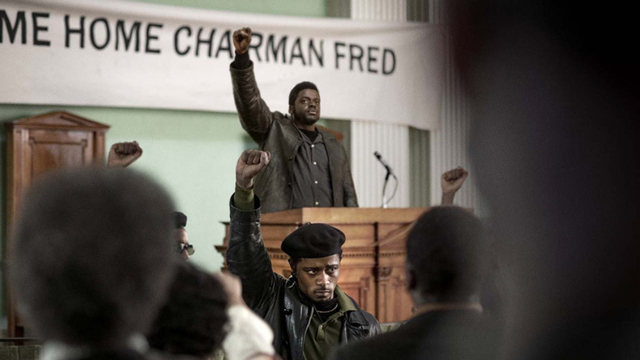
Everyone knows how Scott Feinberg‘s award-season forecasts break down. The ten films included in his Frontrunners tally are well-situated to the extent that most (i.e., Scott always includes a couple of stragglers) are likely to be Best Picture-nominated.
It’s axiomatic in this highly political year, especially in the wake of last summer’s George Floyd protests, that any well-reviewed, professionally assembled film featuring a primarily POC cast will be Best Picture nominated, and so Feinberg, being no fool, has included Netflix’s Ma Rainey’s Black Bottom, Amazon’s One Night in Miami and Pixar’s Soul in his Frontrunners roster.
None of these three films even approaches the quality of Steve McQueen‘s Mangrove, Lovers Rock and Red White & Blue, but McQueen’s “Small Axe” quintet is Emmy material and so we’re left with what we’re left with. No disrespect intended, but two of these features are basically filmed plays, and Soul is emotionally indecisive and all over the map and fairly infuriating for that.
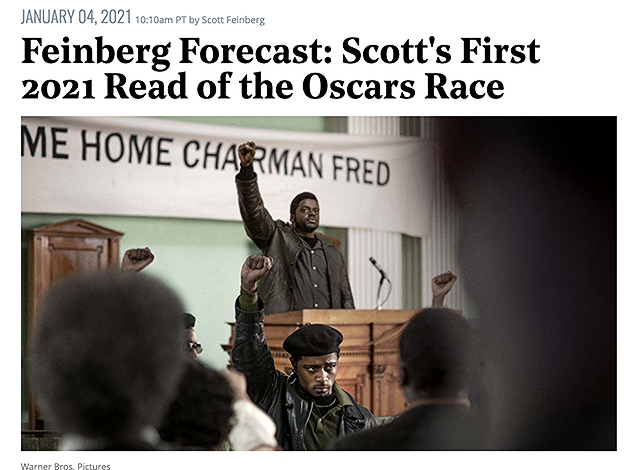
The question for Oscar-race handicappers is “why does Feinberg have it in for Spike Lee‘s Da 5 Bloods“? I don’t mean to imply that Feinberg has a hardnosed problem with Lee’s film but there must be some reason why he’s included it in the much-dreaded “Major Threats” category.
If Feinberg has categorized your awards-hopeful film as a “major threat,” you’re…well, I’d better be careful here. I was going to say “you’re as good as dead” but what I really mean is that “major threat” means “uh-oh.” Over the last several weeks Da 5 Bloods has been on just about every Best Picture top-ten contender list. Right now it’s occupying the #9 slot on the Gold Derby expert list.
Feinberg is just one guy, of course, and voters will vote how they want to vote, etc. Especially the crowd that voted last year for Parasite…people that live on their own planet.
Here are the films included in Feinberg’s top four categories. Hollywood Elsewhere has boldfaced those titles that really and truly have the Best Picture juice …films that deserve to be Best Picture nominated in the eyes of the Movie Godz. Before starting I’m going to say for seventh or eight time over the last three or four weeks that while Steve McQueen’s Mangrove and Roman Polanski‘s J’Accuse won’t be under consideration for reasons that have nothing to do with quality, they would DEFINITELY be Best Picture hotties in a fair and just universe.
Frontrunners
Nomadland (Searchlight)
The Trial of the Chicago 7 (Netflix)
Minari (A24 — Spirit Awards)
Promising Young Woman (Focus)
Sound of Metal (Amazon)
The Father (Sony Classics)
Ma Rainey’s Black Bottom (Netflix)
One Night in Miami (Amazon)
Soul (Pixar)
Mank (Netflix)
As long as militant British wokesters are going after Grease, we need to keep things going on this side of the Atlantic by cancelling Mel Brooks‘ The Producers (’67). It wears homophobia and anti-trans attitudes like an armband. “We’re not alone!!!” 52 years ago Gene Wilder‘s Leo Bloom went into catatonic shock over Christopher Hewett‘s Roger De Bris wearing a ball gown…what would Harry Styles say to that? Not to mention Elliot Page and Shiloh Nouvel Jolie-Pitt?
And what about Andreas Voutsinas‘ performance as “Carmen Ghia”, De Bris’ assistant who can barely control himself due to close physical proximity to Bialystock and Bloom in an elevator? What is that supposed to be, funny? It’s hateful to characterize gay men in this fashion.
Grease is one thing, but the sooner The Producers is erased from showbiz culture the better for all of us going forward. And that means hauling the 94-year-old Brooks before the judges and giving him what-for.